
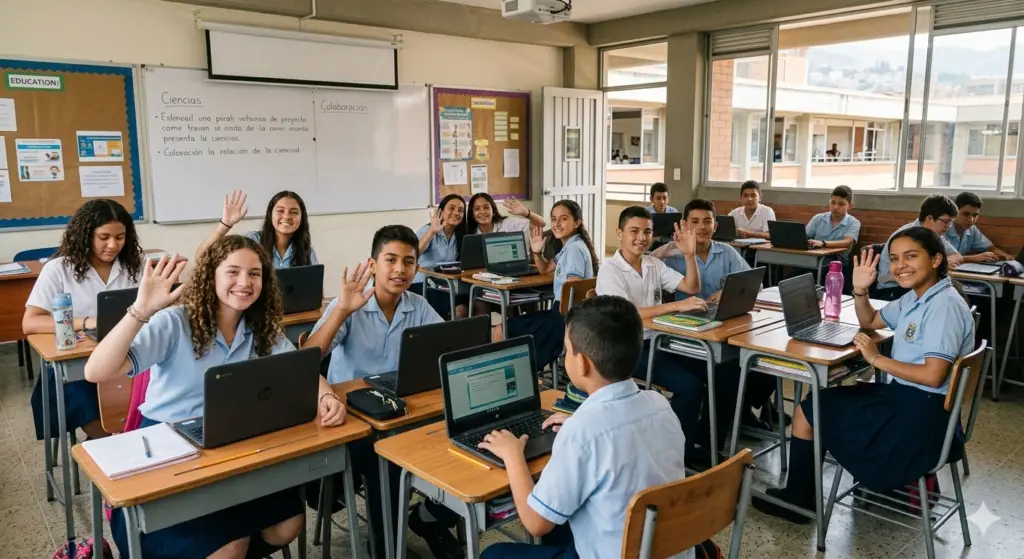
When students collaborate with peers from another country, something powerful gets added to their learning: they practice communication across real cultural differences, navigate perspectives shaped by entirely different contexts, and solve problems that connect local realities to global challenges. These are experiences that expand what’s already happening in great classrooms and they’re exactly why global classroom projects are such a valuable learning tool. It’s also why Class2Class.org is designed around a defined set of 21st century competencies.
But what are these skills, exactly? And why these eight, specifically? This article answers both questions and shows how each competency comes to life when students engage in international collaboration in education.
Why Competencies Matter More Than Content Alone
Major international organizations recognize that academic content becomes even more powerful when students also develop the competencies to apply it in real, diverse, and interconnected contexts.The OECD’s PISA Global Competence Framework defines global competence as the capacity to “examine local, global and intercultural issues, to understand and appreciate the perspectives and world views of others” (OECD, 2018). UNESCO’s frameworks for Global Citizenship Education (GCED) and Education for Sustainable Development (ESD) reinforce this, describing competencies that help students live and participate responsibly in a shared world (UNESCO, 2015; UNESCO, 2017).
The Class2Class competency model was built directly on these foundations. Each of the eight competencies it promotes is grounded in at least one major international framework and is observable through the real work students produce during projects.
The 8 Competencies of the Class2Class Model
1. Intercultural Communication
What it is: Communicating and building understanding with people from different cultural backgrounds, with respect and openness.
Why it matters in a global classroom: Every international project requires students to coordinate, share ideas, and resolve misunderstandings across cultures. This competency is the foundation that makes all of that possible. Research on Collaborative Online International Learning (COIL) confirms that structured intercultural exchanges are effective for developing this capacity in students (Hackett et al., 2023).
Students develop it by: Writing and participating in respectful cross-cultural exchanges, establishing shared agreements with partner classrooms, and reflecting on cultural differences throughout the project.
2. Global Awareness
What it is: Understanding global issues and their connection to local realities, and acting responsibly to contribute to a more just and sustainable world.
Why it matters: Teaching global citizenship means helping students see that what happens in their community is connected to what happens elsewhere. Class2Class projects link local experiences to global challenges, often aligned with the UN Sustainable Development Goals.
Students develop it by: Identifying and analyzing a global problem from their own context, comparing realities with their partner classroom, and proposing actions that connect local and global perspectives.
3. Collaboration and Teamwork
What it is: Working effectively in diverse teams toward a shared goal, coordinating roles, contributions, and decisions.
Why it matters: The value of intercultural learning only becomes concrete when international teams actually build something together. This competency ensures that students don’t just meet peers from other countries, they learn to work with them.
Students develop it by: Making shared decisions, giving and receiving peer feedback, and working through disagreements constructively.
4. Digital Literacy
What it is: Using digital tools critically, safely, and responsibly to communicate, collaborate, and learn in global environments.
Why it matters: International collaboration happens digitally. Students who lack digital literacy can’t participate equitably, and those who use digital tools without understanding ethics and safety can cause harm. This competency ensures participation is both effective and responsible.
Students develop it by: Using collaborative platforms to coordinate and co-create content, producing shared digital products, and practicing responsible online behavior, including respect for privacy and authorship.
5. Critical Thinking and Problem-Solving
What it is: Analyzing complex problems from multiple perspectives, evaluating information, and proposing well-reasoned, practical solutions.
Why it matters: International projects require students to make sense of different contexts, argue with evidence, and build responses that are relevant both locally and globally. This is where intercultural learning moves from observation to action.
Students develop it by: Formulating powerful driving questions, analyzing causes and consequences, evaluating sources critically, and documenting their reasoning and iterations throughout the project.
6. Emotional Intelligence
What it is: Recognizing and managing one’s own emotions, demonstrating empathy, and building respectful relationships with others.
Why it matters: Working across cultures and time zones is not always smooth. Tensions may arise. Misunderstandings happen. That’s why emotional intelligence helps students navigate these moments with maturity and keep collaboration moving forward.
Students develop it by: Practicing empathy in their communications, managing conflict constructively, supporting teammates, and reflecting on their emotional experiences in group work.
7. Adaptability and Leadership
What it is: Adjusting flexibly to changing conditions while taking collaborative initiative to guide the team toward its goals.
Why it matters: Real projects don’t go exactly as planned. Timelines shift, agreements change, and unexpected challenges come up. Students who can adapt and step up with leadership keep projects alive, and learn more in the process.
Students develop it by: Adjusting plans when things change, taking initiative to unblock challenges, organizing tasks, and encouraging equitable participation across the team.
8. Creativity and Innovation
What it is: Generating, developing, and improving ideas to create original solutions or products, working openly with others and learning from feedback.
Why it matters: This competency was added to the Class2Class model, not only because it appears consistently across international frameworks but, because project-based learning is where creativity is most visible. Innovation isn’t just about the final product; it’s about iteration, feedback, and co-creation across cultures.
Students develop it by: Exploring multiple ideas, developing and refining proposals, producing drafts and prototypes and documenting how their work evolved from the first version to the final product.
A Transversal Focus: Student Agency
Running through all eight competencies is a transversal quality that in Class2Class we call student agency: the ability to act with intention. It consists of setting goals, making decisions, taking responsibility and reflecting in order to improve. It is not a ninth competency, but a lens through which all eight are expressed.
The OECD Learning Compass 2030 places student agency at the core of future-ready education, describing it as students’ capacity “to set goals, reflect and act responsibly to effect change” (OECD, 2019). In Class2Class projects, agency is visible when students take initiative, follow through on commitments and reflect honestly on their progress.
Why This Framework Matters for Your Teaching
These eight competencies aren’t a checklist—they’re an integrated set of capabilities that grow together through well-structured, meaningful projects. When a student collaborates with a peer in another country to analyze a shared global challenge and co-create a solution, they are practicing intercultural communication, critical thinking, collaboration, creativity, and digital literacy simultaneously.
This is exactly what international collaboration in education makes possible: not isolated skill-building, but authentic, connected learning that prepares students for a complex world.
Here’s what makes the Class2Class approach work:
- Each competency is grounded in UNESCO and OECD international frameworks.
- All eight are observable through real project work, not abstract test.
- Students build them in context, alongside peers from other cultures.
- The model aligns with the UN Sustainable Development Goals
- Projects support teaching global citizenship across any subject or grade level.
How to Get Started
Bringing these competencies into your classroom doesn’t require redesigning your entire curriculum. Class2Class projects are structured to fit alongside your existing teaching, while giving students the international experience that develops these skills naturally.
- Create a free account at Class2Class.org
- Explore project ideas aligned to your subject and grade level
- Connect with a partner teacher from another country
- Launch your first project and watch the competencies develop in real time
Your students will do more than complete an assignment: they’ll practice the skills that matter most for their future.
References
Hackett, S., Janssen, J., Beach, P. et al. (2023). The effectiveness of Collaborative Online International Learning (COIL) on intercultural competence development in higher education. International Journal of Educational Technology in Higher Education, 20, 5. https://doi.org/10.1186/s41239-022-00373-3
OECD. (2018). Preparing our youth for an inclusive and sustainable world: The OECD PISA global competence framework. OECD Publishing. https://www.oecd.org/content/dam/oecd/en/topics/policy-sub-issues/global-competence/Handbook-PISA-2018-Global-Competence.pdf
OECD. (2019). OECD Learning Compass 2030: A series of concept notes. OECD. https://www.oecd.org/content/dam/oecd/en/about/projects/edu/education-2040/1-1-learning-compass/OECD_Learning_Compass_2030_Concept_Note_Series.pdf
UNESCO. (2015). Global citizenship education: Topics and learning objectives. UNESCO. https://unesdoc.unesco.org/ark:/48223/pf0000232993/PDF/232993eng.pdf.multi
UNESCO. (2017). Education for sustainable development goals: Learning objectives. UNESCO. https://stairwaytosdg.eu/images/UNESCO_Education_for_Sustainable_Development_Goals_ENG.pdf