

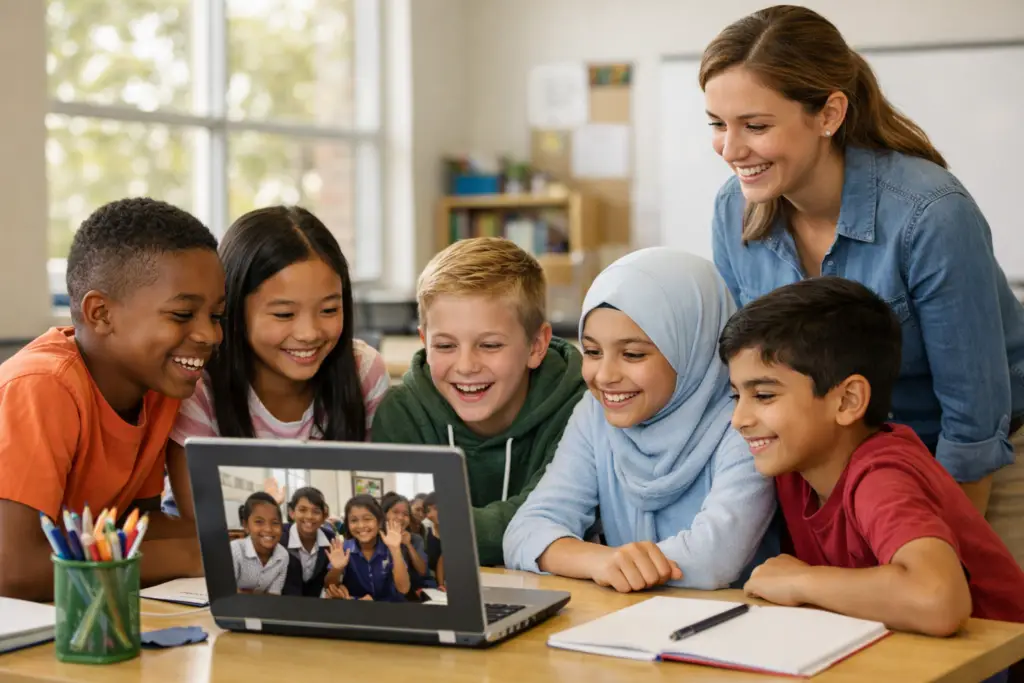
In a world where a student in Buenos Aires can collaborate with a peer in Nairobi on a shared environmental challenge, the walls of the traditional classroom are no longer boundaries — they are launchpads. Global citizenship education (GCED) prepares learners to understand interconnected global issues, respect cultural diversity, and take meaningful action in their communities and beyond. But what does it actually look like in practice, and how can you bring it into your classroom without overhauling your entire curriculum?
This article breaks down the foundations of global citizenship education, explores the competencies it develops, and offers practical strategies you can start using right away.
What Is Global Citizenship Education?
Global citizenship education is an educational approach that empowers learners of all ages to assume active roles — both locally and globally — in building more peaceful, tolerant, inclusive, and secure societies. According to UNESCO, GCED aims to nurture respect for all, foster a sense of belonging to a common humanity, and help students become responsible and active global citizens.
The concept is anchored in SDG Target 4.7, which calls on all countries to ensure that learners acquire the knowledge and skills needed to promote sustainable development — including through education for sustainable development, human rights, gender equality, promotion of peace and non-violence, and global citizenship.
GCED is not a standalone subject. It is a cross-curricular approach grounded in three domains of learning defined by UNESCO:
- Cognitive: Knowledge and critical thinking skills to understand the world’s complexities, including global issues and the interdependence of countries and populations.
- Socio-emotional: Values, attitudes, and social skills — empathy, solidarity, and respect for diversity — that enable learners to live together peacefully.
- Behavioral: The conduct, practical application, and engagement needed to act effectively and responsibly at local, national, and global levels.
These three domains work together. A student who understands climate change (cognitive) but feels no connection to affected communities (socio-emotional) and takes no action (behavioral) has only engaged with one dimension of global citizenship education.
Why Global Citizenship Education Matters Now
The case for GCED has never been stronger. Students today are growing up in a world shaped by climate emergencies, rapid migration, digital connectivity, and complex geopolitical shifts. Education systems that focus exclusively on national curricula and standardized testing risk producing graduates who are academically proficient but globally disengaged.
Research consistently supports GCED’s impact. The OECD’s PISA Global Competence Framework found that students with higher levels of global competence are better equipped to examine local, global, and intercultural issues; understand and appreciate diverse perspectives; engage in open and appropriate interactions across cultures; and take action for collective well-being and sustainable development.
A study published in the International Journal of Psychology found that when a student’s immediate environment — friends, family, school — is embedded with global awareness, it positively predicts how much the student identifies as a global citizen, which in turn predicts prosocial values and behaviors.
Beyond civic outcomes, GCED develops the exact competencies employers seek: intercultural communication, critical thinking, collaboration across diverse teams, and adaptability. These are not “nice-to-have” soft skills — they are the 21st-century skills that define employability and leadership in an interconnected economy.
Key Takeaway
Global citizenship education is not a standalone subject — it is a cross-curricular approach that develops cognitive, socio-emotional, and behavioral competencies. When students connect with peers from other countries, abstract concepts like diversity and interdependence become lived experience.
The Core Competencies of a Global Citizen
Global citizenship education builds a constellation of interrelated competencies. Drawing from the OECD PISA Global Competence Framework and UNESCO’s GCED guidance, these can be organized into key areas:
- Intercultural communication: The ability to interact effectively with people from different cultural backgrounds, with respect and openness.
- Global awareness: Understanding global issues and their connection to local realities, and acting responsibly to contribute to a just and sustainable world.
- Critical thinking and problem-solving: Analyzing complex problems from multiple perspectives, evaluating information from diverse sources, and proposing well-reasoned solutions.
- Collaboration and teamwork: Working effectively in diverse, multicultural teams toward shared goals.
- Empathy and emotional intelligence: Recognizing and managing one’s own emotions while building respectful relationships across cultural boundaries.
- Digital literacy: Using digital tools critically, safely, and responsibly to communicate, collaborate, and learn in global environments.
- Adaptability and leadership: Adjusting flexibly to changing conditions while taking collaborative initiative.
- Creativity and innovation: Generating original ideas and solutions, working openly with others and learning from feedback.
Student agency runs through all of these — the capacity to set goals, make decisions, take responsibility, and reflect in order to improve. According to the OECD Learning Compass 2030, student agency sits at the core of future-ready education.
Common Challenges Teachers Face
Despite the clear value of GCED, research indicates that many teachers face significant barriers to implementation:
- Lack of training: A systematic review found that only 4.5% of GCED programs included some kind of intervention for educators. Teachers’ own global awareness directly impacts student engagement, yet professional development in this area remains scarce.
- Curriculum constraints: In many contexts, pressure to cover national standards and prepare for high-stakes exams leaves little room for cross-curricular global themes.
- Sensitivity around controversial topics: Global issues often intersect with politics, inequality, and conflict. Some teachers worry about the perception of imposing political views or upsetting students whose lives are directly affected by these issues.
- Limited global connections: Without access to partner classrooms in other countries, GCED can feel abstract and theoretical rather than lived and experiential.
These challenges are real, but none of them are insurmountable — especially when teachers have the right tools, frameworks, and community support.
Practical Strategies to Implement Global Citizenship Education
You do not need to redesign your entire curriculum to bring GCED into your classroom. Here are actionable strategies, organized from simple entry points to deeper integrations:
Start with Perspective-Taking Activities
Introduce global perspectives through your existing lessons. A literature class can explore stories from different cultures. A science unit on water quality can compare local findings with data from another country. A history lesson can examine the same event from multiple national perspectives.
The National Education Association recommends empowering students as both teachers and learners — letting them share their own cultural knowledge, languages, and stories with peers. This positions students as active contributors rather than passive recipients of information.
Connect Your Classroom to the World
The most powerful GCED experiences happen when students interact directly with peers from other countries. Intercultural collaboration turns abstract concepts — diversity, interdependence, different perspectives — into lived experience.
Structured global collaboration programs give teachers a clear framework: matching with a partner classroom, designing a shared project around a topic aligned with the UN Sustainable Development Goals, and guiding students through phases of research, exchange, and reflection.
Even a short intercultural exchange — two hours of video introductions, cultural sharing, and collaborative discussion — can shift how students see the world and their place in it.
Align Projects with the SDGs
The 17 Sustainable Development Goals provide a ready-made framework for GCED. Walk through the SDGs with your students and identify goals that connect to your curriculum. Then design projects that ask students to investigate, compare perspectives across borders, and propose solutions.
For example:
- SDG 13 (Climate Action): Students in two countries research local climate impacts and compare mitigation strategies.
- SDG 4 (Quality Education): Students interview peers abroad about their educational experiences and present findings to the school community.
- SDG 12 (Responsible Consumption): Partner classes track waste generation, share data, and co-create a reduction plan.
Build Reflection into Every Activity
GCED is not just about doing — it is about thinking deeply about what was done, what was learned, and how perspectives shifted. Regular reflection activities — journals, group discussions, self-assessments — help students process intercultural experiences and connect them to broader global themes.
Reflection also builds metacognitive skills: students learn to notice their own assumptions, recognize bias, and articulate how their thinking has changed.
Invest in Your Own Global Competence
Teachers cannot facilitate what they have not developed themselves. Seek out professional development opportunities focused on global education — workshops, online courses, or structured learning communities. Connecting with educators from other countries, even informally, builds the intercultural competence that makes GCED authentic rather than performative.
How Class2Class Supports Global Citizenship Education
Class2Class.org was designed around the belief that global citizenship education works best when it is practiced, not just taught. The platform connects teachers and students across more than 144 countries through structured collaborative projects grounded in COIL (Collaborative Online International Learning), project-based learning, and design thinking.
Rather than requiring teachers to build international partnerships from scratch, Class2Class provides a global network where educators can find partner classrooms, choose a project approach that fits their available time and experience, and guide students through meaningful intercultural collaboration — all at no cost.
Three project approaches scale from quick entry points to semester-long integrations:
- Connect (1–2 hours): Intercultural exchange and cultural sharing — ideal for teachers trying global collaboration for the first time.
- Collaborate (4–8 hours): Project-based learning around a shared topic linked to the SDGs, with sustained research, partner exchanges, and collaborative outputs.
- Create (10+ hours): Design thinking projects where students identify a real problem, empathize with stakeholders, ideate, prototype, and present a solution together.
Each project develops the core competencies of global citizenship education — the 21st-century skills that matter most, from intercultural communication and global awareness to critical thinking, collaboration, and creativity. The platform tracks competency development across projects, building a visible Changemaker Journey for every student.
Teachers are supported through a Learning Space that guides them through project definition, execution, reflection, and dissemination — along with an AI-powered pedagogical advisor that helps with planning and sequencing without ever replacing the teacher’s professional judgment.
Moving Forward: From Awareness to Action
Global citizenship education is not a curriculum add-on or an idealistic aspiration. It is a practical, research-backed approach to preparing students for the world they will inherit — and the one they will shape.
The path forward starts with small, intentional steps: a perspective-taking activity in next week’s lesson, a connection with a classroom abroad, a project aligned with the SDGs. Each step builds the foundation for deeper engagement and more meaningful learning.
Related Resources
- COIL Guide: Collaborative Learning Tips
- COIL for High School: Global Education Strategies
- Class2Class Educational Framework