

Your students follow creators from Tokyo, listen to music from Lagos, and watch tutorials made in São Paulo — all before breakfast. They already live in a connected world. But the moment they walk into your classroom, the walls close in. The lesson is local. The textbook is local. The conversation stays inside four walls.
What changes when you open that door? When students in Bogotá and students in Nairobi investigate the same question, compare what they find, and build something together? That shift has a name: international collaborative learning. And it does not require a budget, a special program, or a technology overhaul. It requires a different way of organizing what students do.
What Is International Collaborative Learning — Beyond “Virtual Exchange”
Let us start with what it is not. International collaborative learning is not a one-time video call where students wave at a screen and say hello. It is not a pen-pal exchange that fades after two weeks. And it is not an add-on activity squeezed into the last Friday of the term.
In simple terms, it means two or more classrooms in different countries working together on a shared project over several weeks. They start from a common question. They investigate it within their own local context. They share what they discover, compare realities, and co-create a product — a presentation, a campaign, a prototype, a report — that neither group could have made alone.
The concept builds on what universities call collaborative online international learning (COIL), a framework developed by the SUNY COIL Center that has been connecting higher education classrooms for over a decade. But you do not need to be at a university to use this approach. The same logic — shared purpose, sustained classroom collaboration, and a tangible result — works powerfully in K–12 settings, and that is where platforms like Class2Class make it accessible to any teacher, for free.
The key difference from a simple virtual exchange is depth. This is not about exposure to another culture — it is about doing meaningful work together. Cross-cultural student collaboration becomes the method, not the destination. Students depend on each other’s contributions to move the project forward, which changes the dynamic entirely.
How International Collaborative Learning Works in Practice
If you have never seen this in action, the process is more structured than you might expect. A well-designed project follows clear phases — and that structure is what makes collaborative learning across countries manageable, even for teachers doing it for the first time.
Phase 1 — A shared question. Both classrooms begin with the same driving question tied to a real-world issue. For example: “How does water scarcity affect our community?” or “What does a sustainable school look like where we live?” The question must be broad enough to allow different local answers, but specific enough to guide investigation.
Phase 2 — Local investigation. Each group researches the question within their own context. Students interview community members, collect data, take photographs, analyze local conditions. This is where curriculum content comes alive — science, geography, language arts, or social studies becomes the tool to understand something real.
Phase 3 — Exchange and comparison. The classrooms share their findings. This is where the magic happens. Students in Jakarta discover that their peers in Lima face a completely different water challenge — and suddenly the topic is no longer abstract. They compare, contrast, ask questions, and begin to see their own reality through someone else’s eyes.
Phase 4 — Co-creation. Together, both groups produce something: a joint presentation, a comparative infographic, a video documentary, a proposal for their school communities. The product reflects both perspectives and requires genuine coordination — connecting classrooms not just to talk, but to build.
Phase 5 — Sharing with a real audience. The final product is presented — not just to the teacher, but to the partner classroom, the school community, or a broader audience. This gives the work purpose beyond a grade.
This phased approach is exactly how global classroom projects are structured on the C2C platform — every project comes with a driving question, work phases, and a final product designed for two classrooms to complete together.
A Real Example: The Global Water Conservation Challenge
For World Water Day, teacher Jhansi Ravikumar from India wanted to do more than give her students a lesson on water conservation. Using Class2Class, she connected her classroom with teachers Vathsala Nayer Vailathan in Malaysia and Zin Zin Thin in Myanmar to launch the Global Water Conservation Challenge — a project that turned environmental science into a shared mission across three countries.
Students aged 10 to 25 investigated how water pollution and scarcity affected their own communities. Each classroom researched local conditions — the chemicals in nearby rivers, the plastic waste in their neighborhoods, the daily habits that waste water at home and school. When they came together in a live session, something shifted. Despite living in three very different countries, the students discovered they faced strikingly similar challenges. As one student from Malaysia put it: “I really love this and I got lots of knowledge… it is so great learning about something that is so important to us.”
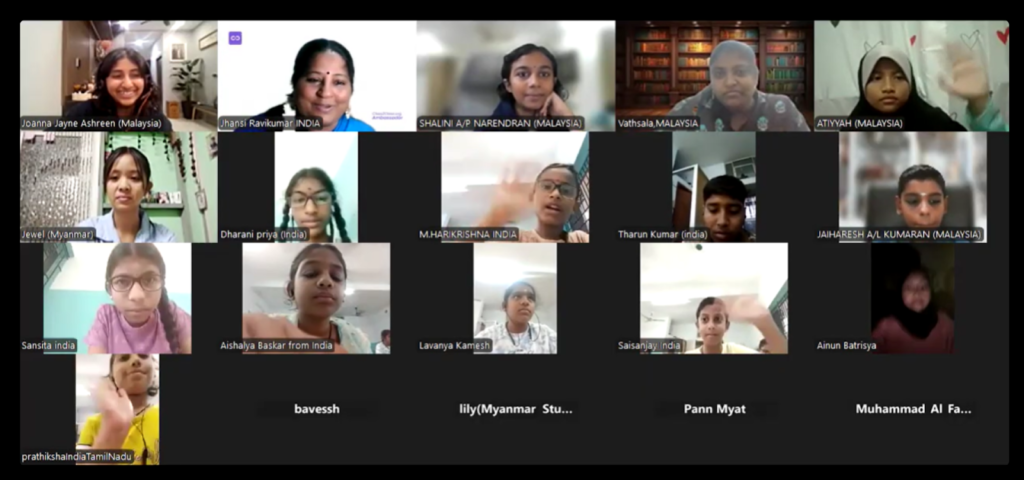
Students during a videocall for The Global Waater Conservation Challenge project.
The session included an interactive quiz where students tested their knowledge in real time, presentations on pollution causes and conservation methods, and reflections shared across classrooms. By the end, smiles and heart gestures filled the screens. The teachers asked for more. Teacher Vathsala said: “Our students really love these quizzes. We want more competition!” The students did not just study water — they used it as a lens to understand each other’s realities and their own role as global citizens.
That is international collaboration in education at its most practical: curriculum-aligned, structured, and producing something that matters to students because they built it with — and for — someone real.
Why International Collaborative Learning Transforms the Classroom
The transformation is not technological — it is pedagogical. What changes is what students do with their learning. Research consistently supports three core shifts that happen when international collaborative learning replaces the traditional, isolated classroom model.
Engagement deepens because the work has real purpose. When students know that a partner classroom in another country is waiting for their research, the stakes change. A study by Helm and Guth (2010) on telecollaboration in education found that students in internationally connected projects showed significantly higher levels of engagement and ownership compared to those in traditional settings. The work stops being “for a grade” and starts being “for someone who needs it.”
Curriculum content gains meaning through comparison. When students in India, Malaysia, and Myanmar all investigate water pollution in their communities — as they did in the Global Water Conservation Challenge — the data is no longer abstract. A student in Chennai learns that a peer in Yangon faces the same plastic contamination problem, and suddenly the science textbook chapter becomes personal. According to a meta-analysis by the SUNY COIL Center (Rubin, 2017), students in collaborative online international learning environments develop stronger critical thinking skills because they must constantly interpret, compare, and negotiate meaning across cultural contexts. Your subject becomes a lens for understanding the world — not just a chapter to cover.
Global and socioemotional competencies develop naturally. UNESCO’s 2018 report on Global Citizenship Education identifies empathy, perspective-taking, and collaborative problem-solving as essential competencies for the 21st century. When students work through a Design Thinking process — empathizing with peers in another country, defining a shared problem, ideating solutions adapted to each context — they practice these global skills as a natural part of the project, not as an isolated lesson. In a global classroom where students must communicate across languages, time zones, and cultural norms to produce a joint result, Design Thinking provides the structure and these competencies become the daily practice.
Your Subject, Their Reality, One Shared Project
Here is what matters most: you do not need to teach a special subject or add extra hours to your schedule. International collaborative learning can start with almost any topic already in your curriculum. A biology unit on ecosystems becomes a comparative study with a classroom in a different climate zone. A language arts module on storytelling becomes a bilingual anthology co-written across continents. A civics lesson on community participation becomes a joint proposal for local action, informed by how another community handles the same challenge.
The shift is not about adding technology. It is about changing what students do with knowledge. Instead of learning about global issues, they learn through global collaboration — applying Design Thinking to real problems alongside peers who see the world differently. That is the core of international collaborative learning — and it is available to any teacher willing to try.
And you do not need a fully equipped computer lab to get started. Even in contexts where students have limited or no internet access, the teacher can act as the bridge — using a single phone or one computer with a connection to share findings, exchange messages, or join a live session on behalf of the class. The collaboration may look different, and the pace may be slower, but the value of international collaborative learning remains real. Knowing that a classroom on the other side of the world is working on the same question changes how students see their own work, regardless of the technology available.
There is another common assumption worth addressing: that international collaboration requires English. It does not. A school in Colombia can collaborate with a classroom in Mexico or Spain. A school in France can partner with one in Quebec, Senegal, or Côte d’Ivoire. English certainly opens more doors for connecting classrooms across regions, but your native language already gives you access to a rich network of potential partners. On C2C, teachers find collaborators who share their language every day — and the learning is just as powerful.
Imagine Your First International Project with C2C
Think about a topic you are teaching in the next few weeks. Now imagine a classroom in another country asking the same question your students will explore. What would they discover that your students cannot see from where they are? What would your students reveal that no textbook could show them?
On the C2C platform, you can browse ready-made global classroom projects designed with this structure already built in — driving question, work phases, and a final product for two classrooms to create together. You do not have to design it from scratch. Choose a project, get matched with a partner teacher in another country, and start. It is free, it is structured, and teachers in over 137 countries are already doing it.
Your next unit does not have to stay inside four walls. Explore a project on Class2Class and see what international collaborative learning looks like when it comes to life.
References
Helm, F., & Guth, S. (2010). The multifaceted nature of telecollaboration. In S. Guth & F. Helm (Eds.), Telecollaboration 2.0: Language, Literacies, and Intercultural Learning in the 21st Century. Peter Lang.
Rubin, J. (2017). Embedding collaborative online international learning (COIL) at higher education institutions. Internationalization of Higher Education, 2, 27–44.
UNESCO (2018). Global Citizenship Education: Taking It Local. UNESCO Publishing.
SUNY COIL Center (2020). Guide to COIL Virtual Exchange. State University of New York.
Want to explore more ways to connect your classroom globally? Visit our SDG Calendar for year-round project-based learning opportunities aligned with the UN Sustainable Development Goals.