
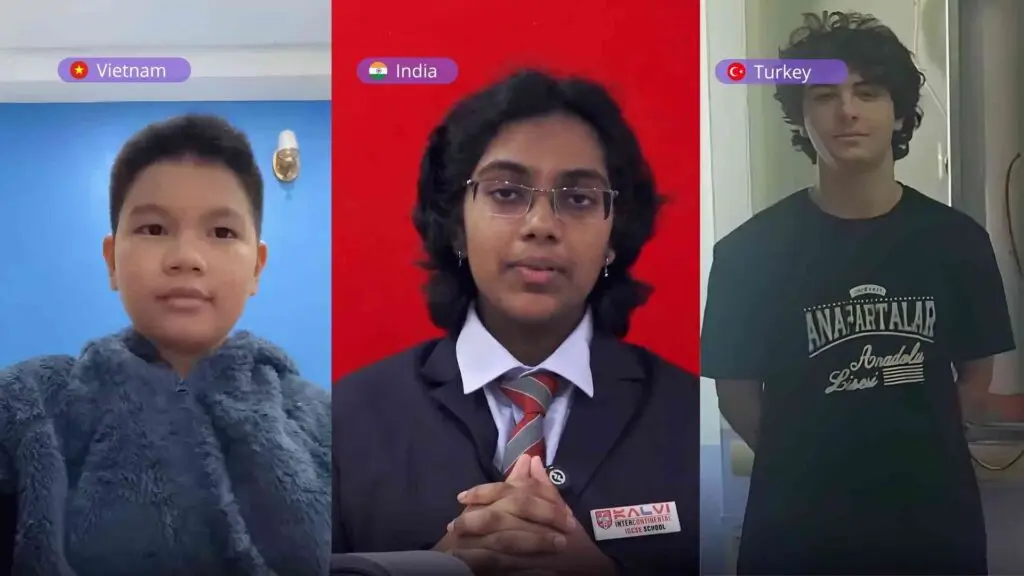
What happens when you bring students from 10 countries together for an international debate about water and sustainability? They don’t just learn to argue — they learn to listen, think, and speak with confidence. This is the story of how a collaborative project on Class2Class.org turned a question about rivers into one of the most meaningful learning experiences these students have had.
What Was the Project About?
The debate competition invited students aged 10 to 25 to explore a thought-provoking question: Should countries connect their rivers for irrigation, transport, and flood control?
Aligned with SDG #6: Clean Water and Sanitation , the project was designed as both a learning experience and a celebration of student voice. Students would develop critical thinking by analyzing both sides of the issue, strengthen their communication skills in English, build environmental awareness about human impact on nature, and collaborate with peers from around the world — learning to respect viewpoints very different from their own.
The project was coordinated by Teacher Jhansi Ravikumar from India, a Class2Class Ambassador, with Teacher Leo R. Veridiano from the Philippines (based in Indonesia) as the Guest of Honour. Leo has been organizing online debate and speech competitions since 2021 and brought years of experience to guide the workshop. Ambassador Md Nasim from Bangladesh opened the session with a warm and energizing welcome.
How the International Debate Unfolded
The collaboration followed a simple five-day plan that any teacher could adapt. On Day 1, teachers introduced the topic and explained the format. Each student would participate individually, choosing to speak either for or against connecting rivers. Over Days 2 and 3, students did their own research — finding facts, real examples, and different viewpoints to build a two-minute speech. On Day 4, they practiced presenting with confidence, clear pronunciation, and respectful delivery. By Day 5, each student recorded a two-minute video sharing their opinion. All videos were submitted through the Board Section of the project on the Class2Class platform.
But the real magic happened during the live international debate workshop on November 22, 2025.
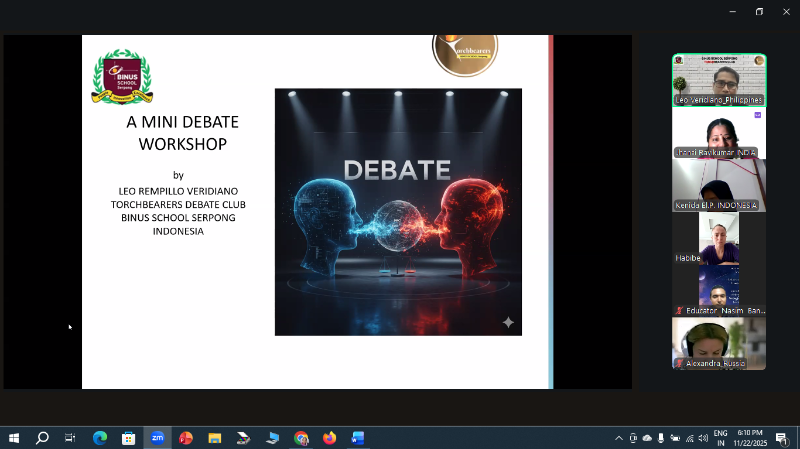
Teacher Leo guided students step by step through the basics of debate. He explained what a thesis statement is, how to structure arguments with claims, reasons, and evidence, and — most importantly — how to do a rebuttal: the skill of listening carefully to your opponent, identifying the weak points in their argument, and replacing them with stronger ideas.
“The meat of a debate is in the rebuttal,” Leo explained. “Many debaters forget to do it. They deliver their speech and think that’s enough. But the judges look for speakers who can listen, respond, and think on their feet.”
Then the students put this into practice — live, in front of their peers from multiple countries.
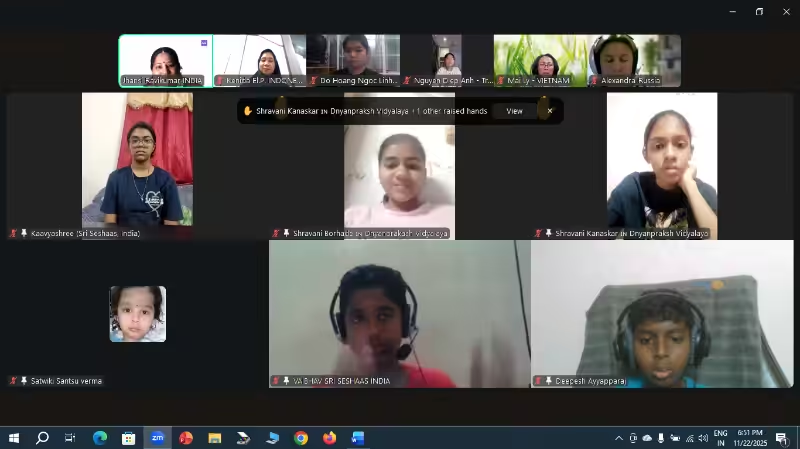
Satwiki from India delivered a memorable rebuttal. When asked to respond to the argument that connecting rivers increases the danger of flooding, she replied with confidence: “This argument is not true, because in our country we connect the rivers especially to decrease the danger of floods. After we experienced a great flood in Punjab, the government planned to connect rivers across India to reduce it. They also use hydroelectricity to utilize the water.”
Teacher Leo was visibly impressed. “I’m so proud of Satwiki. You gave such a wonderful point — and the pronunciation is so correct.”
Kavyashree from India gave a strong opposition speech, listing five clear reasons against connecting rivers — from ecosystem damage to climate unpredictability. Vaibhav, also from India, argued passionately that water is “a natural gift” and that sharing it between countries does not create problems but builds relationships. Shravani Kanaskar spoke about how extending rivers could bring water to dry areas, support farming, and strengthen the economy.
What stood out was not just the quality of their arguments, but the courage it took to speak up in a global setting — and the respect they showed for one another’s ideas throughout.
What This International Debate Left Behind
This project did more than teach students how to debate. It gave them something they could feel — a shift in how they saw themselves and one another.
For many, the workshop was a first. Shravani had never joined anything like it before. “This is the first time I joined this type of competition,” she said afterward. “I learned so much from this class.” And yet, when it was her turn to speak, she stood her ground and delivered her argument clearly in front of peers from across the globe. That kind of moment — when a student surprises herself — is hard to plan, but easy to recognize.
The preparation mattered just as much as the live session. Students had to research both sides of the issue, not just the one they agreed with. As Teacher Leo told them during the workshop: “Research not only the arguments that support your thesis, but also the arguments against it. Know what your opponents will say, so you’re ready.” That simple advice pushed them beyond repeating opinions and into real critical thinking — weighing evidence, anticipating counterarguments, and defending their position with facts.
And it worked. Sai Mahand, who was about to attend a separate debate competition the following week, said he would go back and rewrite part of his speech. “After attending this debate workshop, I’m going to modify it,” he explained, “because I didn’t add any rebuttal.” He had just learned the skill that afternoon — and was already planning to use it.
Deepesh put it even more directly: “I saw a lot of YouTube videos, but they didn’t give me as much knowledge as this workshop. The personal advice Sir gave about rebuttals was very helpful.” There is something powerful about learning from a real person, in real time, alongside students from other countries. It is different from watching a video alone.
Kavyashree, who had some prior debate experience, noticed the difference too. “I did not know much about debates before,” she reflected. “But now that I know so much more — thank you to Leo Sir — this workshop has made me ready to face future things.” She didn’t just learn technique. She gained a sense of readiness.
Vibhav described the same feeling from another angle: “This training session made me more comfortable with my speech and to deliver it in a fierce and perfect way.” He and three classmates were preparing to compete against students in Uganda — and after the workshop, they felt better equipped to do it.
“ Even though my students are only in primary school, I believe they can learn to debate when we guide them step by step. I start by giving them two short stories — one about a dry village that needs more water, and one about a river where fish get sick because dirty water flows in. Then I ask them to choose which story makes more sense to them and turn that into a reason. “
Mai Ly, Teacher, Vietnam
The teachers who watched the workshop were moved by what they saw. Teacher Alexandra Ziborova from Russia said: “I was really impressed with the students’ ideas and viewpoints. All of them tried to do their best and tried to say something reasonable. Debating is a very special skill that people should have.”
Teacher Habibe Yıldırım from Turkey, for whom this was also a first experience with debate, admitted: “After taking part in this workshop, I learned so many things. I have a lot of things to teach my students now. Your students are so impressive and so confident — that really impressed me.”
And Teacher Zinzinthin from Myanmar captured what many in the room were feeling: “I’m so amazed and surprised — they are very good at critical thinking. I love debate because this is a key to promote critical thinking in students.”
By the end of the project, every participating student had recorded a two-minute debate video shared on the Class2Class platform. A live debate workshop had taken place, where students practiced rebuttals in real time. On November 29, 2025, the International Debate Celebration brought everyone together again — this time to watch selected videos, share reflections, and receive international certificates for their participation.
But perhaps the most telling outcome was what happened next. Teacher Burçin Can Solak from Turkey — who had told the group, “This was the first time I was in a debate, and I really liked it. It’s clearer for me now. I know how to teach my students debate” — agreed on the spot to organize a new debate between her students and others the following year. Teacher Zinzinthin shared that her center in Myanmar would be hosting its own debate training in December. And Teacher Kenida from Indonesia, who had joined this time just to observe, said she would bring her students to the next project.
The Asian Parliamentary debate format, which was new to most participants, is now part of their teaching toolkit. And the workshop materials — including Leo’s presentation on rebuttals and the step-by-step project timeline — were shared on the platform for any teacher to use.
What started as a single project about rivers became something wider: a network of teachers who now know each other, trust each other, and are already planning their next collaboration.
A Project Worth Replicating
What made this international debate project work so well was its simplicity. The structure was clear: introduce the topic, research both sides, practice, record, and celebrate together. Any teacher can follow this format. The debate topic can be adapted to any subject or SDG — from climate action to gender equality, from responsible consumption to quality education.
You don’t need an international debate expert on your team to get started (though it certainly helps!). You need a good question, a safe space for students to speak, and a willingness to let them lead the conversation.
Teacher Jhansi Ravikumar, who organized the project, put it simply: “Thank you, Class2Class.org, for helping us connect students beyond borders. Together, we continue to help young learners grow.”
Ready to Start Your Own International Debate?
If this story inspired you, imagine what your students could do. Class2Class.org is a free platform where teachers from around the world connect their classrooms through collaborative projects aligned with the UN Sustainable Development Goals .
You can explore existing projects, join one that fits your curriculum, or create your own — just like Teacher Jhansi and her team did. Visit the SDG Calendar to find a project that matches your next lesson. Your students’ version of this story is waiting to happen!