

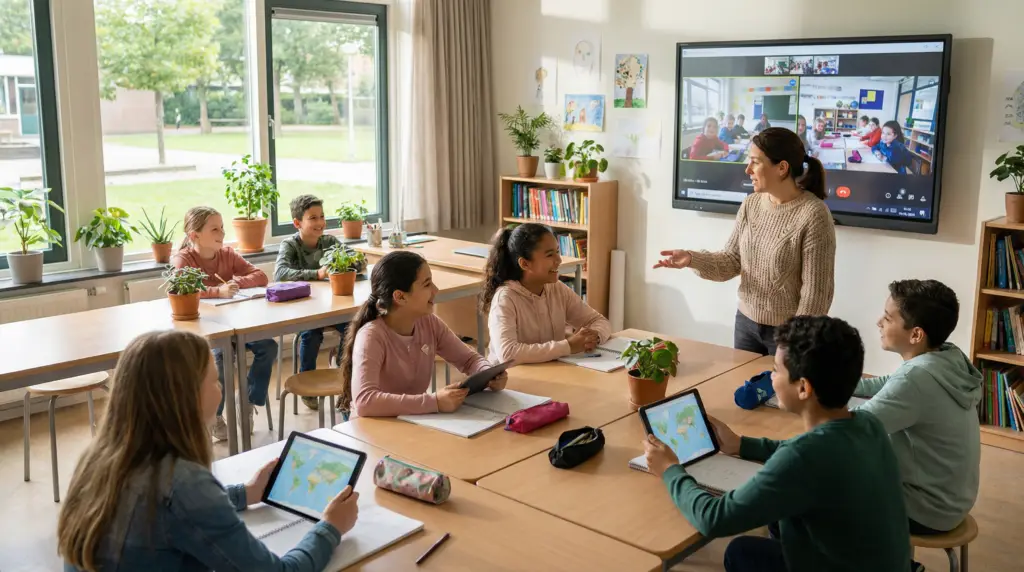
Global learning experiences help students do more than learn about the world from a distance. They create structured opportunities to work with different perspectives, connect local issues to global challenges, and build the habits of communication, reflection, and collaboration that matter in real life. The OECD describes global competence as the ability to apply knowledge, skills, attitudes, and values to global issues and intercultural situations (OECD).
For teachers, that matters because global learning is not an extra layer added on top of the curriculum. It is a practical way to make lessons more relevant, more collaborative, and more connected to the kinds of challenges students already see around them. UNESCO frames global citizenship education as an approach that helps learners understand interconnected issues, value diversity, and work across differences (UNESCO GCED). UNESCO also explains that education for sustainable development builds the knowledge, skills, values, and agency people need to act on real social and environmental challenges (UNESCO ESD).
In short: the benefits of global learning experiences include stronger cultural understanding, better collaboration skills, more meaningful curriculum connections, greater student agency, and richer teaching design.
What are global learning experiences?
Global learning experiences are learning activities that help students explore real issues, perspectives, and partnerships beyond their immediate context. In practice, that can include cross-cultural classroom projects, shared inquiry around global challenges, collaborative research, virtual exchange, and reflective discussions that connect local realities to global ones (UNESCO GCED).
The strongest global learning experiences are not built around passive exposure. They ask students to interact, compare, question, create, and reflect. The goal is not simply to meet another classroom. The goal is to help students build understanding through guided collaboration, with the teacher designing the conditions that make that learning meaningful.
Why global learning experiences matter now
Students are growing up in a world shaped by interdependence. Climate, migration, media, inequality, culture, and technology do not stay inside national borders. UNESCO’s work on global citizenship education emphasizes that learners need opportunities to understand those connections, respect diversity, and participate constructively in local and global communities (UNESCO GCED).
The OECD makes a similar point through its global competence framework, which links intercultural understanding, perspective-taking, and action on global issues to the knowledge, skills, attitudes, and values students need to develop (OECD). In other words, global learning experiences are not a nice extra. They are one of the ways schools can prepare students to think carefully, work with others, and act responsibly.
1. Global learning experiences deepen cultural understanding
One of the clearest benefits of global learning experiences is that they move cultural understanding beyond stereotypes or textbook summaries. When students share questions, stories, routines, and viewpoints with peers in another place, they begin to see culture as lived experience rather than abstract information.
This matters because intercultural communication is built through contact, listening, and reflection. The Class2Class educational framework highlights cross-cultural communication, global awareness, and collaboration as core parts of student development (Class2Class Educational Framework). The OECD also links global competence to the ability to engage with intercultural situations thoughtfully and respectfully (OECD).
For teachers, this benefit becomes stronger when projects are carefully framed. Students need time to ask good questions, compare perspectives, and reflect on what they notice. A strong global learning experience does not rush to consensus. It helps students understand difference with curiosity and respect.
2. Global learning experiences strengthen real-world skills
Global learning experiences create a natural setting for students to practice communication, teamwork, digital literacy, and problem-solving in context. Instead of learning these skills in isolation, students use them for a real purpose: working with others, making sense of shared topics, and presenting ideas clearly.
Class2Class describes its framework as skill-focused and student-centered, with learning designed to develop transferable competencies through practical collaboration (Class2Class Educational Framework). That fits closely with UNESCO’s ESD framing, which includes cognitive, socio-emotional, and behavioral dimensions of learning (UNESCO ESD).
In the classroom, this can look like students negotiating roles in a mixed-country team, comparing local evidence, using shared digital tools responsibly, or adjusting their communication for a different audience. These are not simulated future skills. They are present-tense learning experiences that ask students to think and act with intention.
3. Global learning experiences make curriculum more meaningful
A common challenge for teachers is helping students feel that what they learn connects to life beyond school. Global learning experiences can make that connection much clearer. When students explore water, food, migration, language, identity, or energy with peers in another setting, the curriculum becomes more concrete and more urgent.
UNESCO’s GCED and ESD work both emphasize linking knowledge to real issues, diverse perspectives, and active participation (UNESCO GCED, UNESCO ESD). That makes global learning especially useful for project work, interdisciplinary teaching, and SDG-connected inquiry.
For example, a science topic becomes richer when students compare environmental observations across regions. A literacy unit becomes more engaging when students exchange narratives with peers abroad. A social studies discussion becomes more thoughtful when students see how the same issue feels different in another community. The curriculum does not need to be replaced. It needs to be opened.
4. Global learning experiences increase student agency
Students are more likely to invest in their learning when they feel their ideas, questions, and contributions matter. Global learning experiences support that sense of agency because students are not only consuming content. They are participating in something that depends on their voice, attention, and follow-through.
This is one reason Class2Class places student-centered learning at the heart of its framework, describing students as active agents who co-create and contribute rather than simply receive information (Class2Class Educational Framework). UNESCO’s ESD framing also points to agency as a core outcome of sustainability education, alongside knowledge, skills, and values (UNESCO ESD).
For teachers, agency grows when the work is structured well. Students need clear roles, reflection points, and tasks that are genuinely collaborative. Even a short global learning experience can build agency if students are asked to contribute something real, respond to others thoughtfully, and reflect on what changed in their thinking.
5. Global learning experiences help teachers design richer learning
The benefits of global learning experiences are not limited to students. Teachers also gain a stronger design space for meaningful instruction. A well-structured international project can make it easier to teach perspective-taking, formative reflection, authentic communication, and real-world problem-solving within everyday classroom work.
Class2Class positions its framework around structured global collaboration rather than unplanned connection, with COIL serving as one of the pillars that supports purposeful cross-border learning (Class2Class Educational Framework). That matters because teachers do not need more noise. They need approaches that make complex learning easier to guide.
A global learning experience can also help teachers create better questions. Instead of asking students to repeat information, teachers can ask them to compare contexts, examine assumptions, test ideas, and build shared responses. The result is often deeper engagement and more thoughtful reflection without abandoning curriculum goals.
Quick ways to bring global learning into class
- Compare the same topic across two communities.
- Use a short exchange before planning a larger project.
- Give students one shared output and one reflection task.
- Connect the topic to a real global issue or SDG.
How Class2Class supports global learning experiences
Class2Class explains its educational model through three connected pillars: COIL, skill-focus, and student-centered learning (Class2Class Educational Framework). In practical terms, that means teachers can create projects that help students collaborate across borders while developing global awareness, teamwork, digital literacy, and critical thinking in authentic contexts (Class2Class Educational Framework).
The broader Class2Class platform message is also consistent: teachers can connect with classrooms around the world and use international collaboration to bring real-world issues into the curriculum (Class2Class homepage). That is important because the teacher remains the designer and facilitator of the learning experience. The platform supports the work, but the educational decisions still begin with the teacher.
How to start with one manageable project
- Choose one topic already in your curriculum.
- Turn it into a question students can compare across contexts.
- Plan one short exchange or collaborative task.
- Give students a clear role and a simple shared output.
- End with reflection on what they learned about the topic, the partnership, and themselves.
This matters because effective global learning experiences are built through structure, not scale. A short and well-guided collaboration can be far more valuable than a larger project with unclear goals.
Conclusion
The benefits of global learning experiences are both academic and human. They can deepen cultural understanding, build real-world skills, make the curriculum more meaningful, strengthen student agency, and give teachers richer ways to design learning. Those benefits are not automatic, but they become much more likely when global collaboration is guided by clear pedagogy and purposeful reflection.
For schools that want students to think beyond their own context while staying grounded in real classroom work, global learning experiences offer a strong path forward. They help students learn with the world, not only about it.