

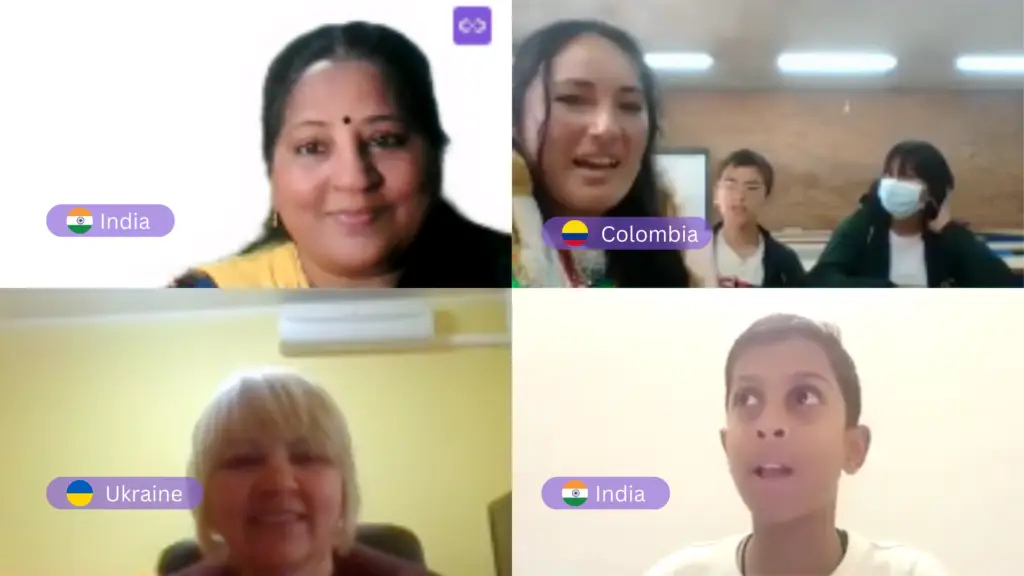
Teacher Jhansi Ravikumar from India, Teacher Oksana Zadnipriana from Ukraine, and Teachers Paola Aguilar-Cruz and Mily Díaz from Colombia wanted their students to do more than read about women in science — they wanted them to research, present, and share those stories with peers from other countries. Through Class2Class.org, they organized a single live session where all three classrooms came together to celebrate the women in STEM who inspire them most.
What Is the Women and Girls in STEM Project?
The Women and Girls in STEM project invites students aged 13 to 19 to research a significant female scientist from their own country, create a digital poster about her life and achievements, and present it live to classrooms around the world.
The preparation happens offline before the session. Students research their chosen figure, design a poster using tools like Canva or Google Slides, and prepare a short presentation. The poster includes a biography, key achievements, and an inspirational message. When everything is ready, partner classes meet in a single live online session to share their work with each other.
Aligned with UN Sustainable Development Goal 5 — Gender Equality, the project connects classroom research with a broader global conversation about representation in science and technology.
The Impact on Students
Across all three classrooms, the project gave students the opportunity to develop skills that go beyond the subject of science:
- Research and presentation skills — Students gathered information, organized it clearly, and delivered it to an international audience.
- English communication — Presenting live in English to peers from other countries gave students a real and meaningful context to practice the language.
- Intercultural awareness — Listening to which women peers from other countries chose to honor gave students a direct look at different scientific traditions and national histories.
- Confidence — Several students admitted they were nervous going in. By the end of the session, they had presented in front of classrooms from three continents.
The Story
Teacher Jhansi opened the session and welcomed all the teachers and students. Using her experience, she coordinated the collaboration and facilitated the exchange. The students prepared, and everyone joined together in an organized way.
Teacher Oksana’s class was the first to share. Her students presented Ukrainian women who had shaped science and technology — among them Katarina Yushenko, one of the creators of the world’s first high-level programming language, and Maryna Viazovska, who in 2022 became only the second woman in history to receive the Fields Medal, solving a mathematical problem that had remained open for more than 400 years. Teacher Oksana also shared her own professional work as co-author of STEM textbooks used in Ukrainian secondary schools — adding a living example to the stories her students had just told.
Student Leela closed the Ukrainian segment with words that stayed with everyone in the session:
“They show that science has no gender. They are strong, smart, and unstoppable. They inspire me to believe in myself.”
Leela (Ukraine)
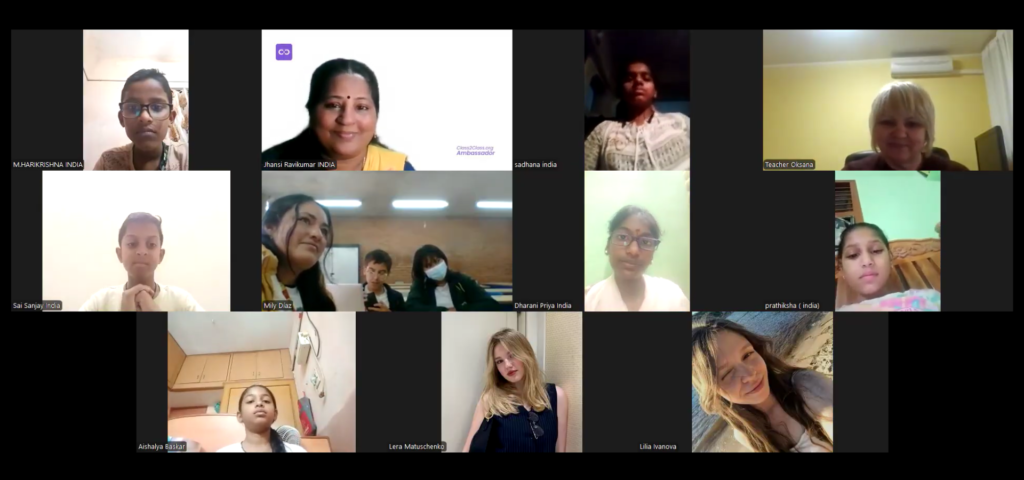
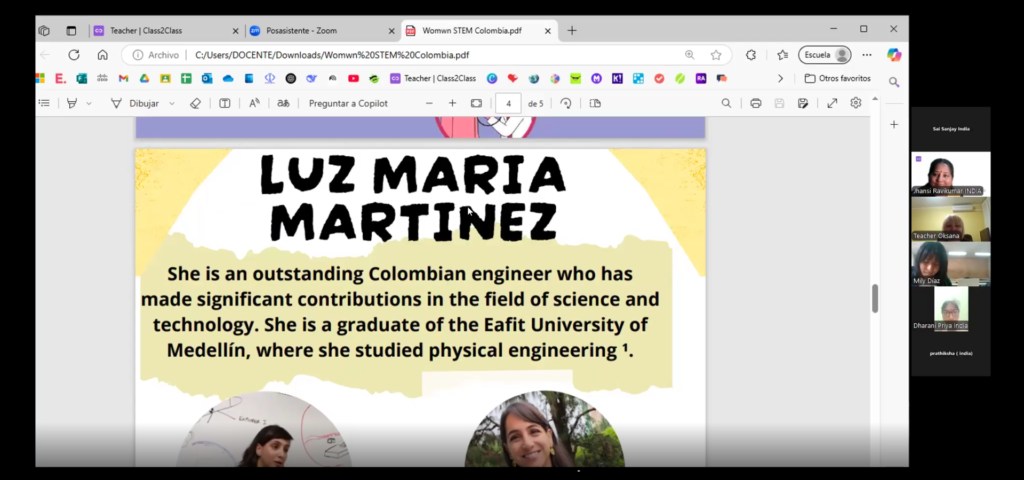
Teacher Mily’s students took the floor next. They introduced their international peers to Colombian women who had made their mark far beyond their country’s borders — Diana Trujillo, a NASA engineer who helped build the Perseverance rover; Nubia Muñoz, whose research established the link between HPV and cervical cancer; and Andrea Males Mesa, a young astronomer known for her work on exoplanets. Each student spoke directly to the camera, describing their chosen figure and explaining why her work matters.
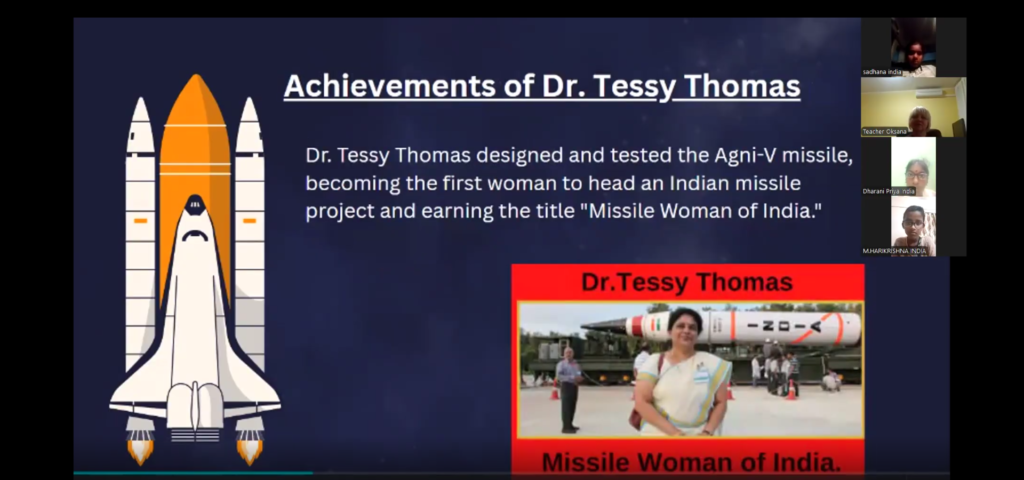
Teacher Jhansi’s students from Tamil Nadu closed the session with stories from India’s defense and space programs. They presented Dr. Tessy Thomas, the first woman to lead India’s missile program, known as the “Missile Woman of India,” and Dr. Yen Walmadi, the first woman scientist from Tamil Nadu to lead a major space project and the voice behind India’s satellite launch countdowns. One student ended her presentation with a line that drew a quiet admiration from both partner classes:
“She proved that hard work and passion can take us to the stars.”
Bavessh (India)
At the end of the session, Teacher Jhansi invited everyone to share their reflections. An Indian student spoke about the cancer research presented by the other teams: “They improved our lives.” Leela from Ukraine said she was moved by the presentations from India. And one Colombian student, speaking last, said what many were feeling: “It was a beautiful opportunity. I was nervous, but it was a great experience.”
Teacher Mily Díaz put it best:
“I really appreciate this project. Not only because the students are interacting, but because talking about women in STEM is wonderful. Today you shared the women who are showing important things in your countries. It’s beautiful to recognize them — and to recognize our participation in this field.”
Mily Díaz (Colombia)
What the three teachers built together was simple in structure but meaningful in practice. Their students came to the session with research, with nerves, and with something to say — and they left with the experience of having said it to the world. That combination of preparation and real connection is exactly what makes this kind of project worth doing.
Start your own collaborative project
If this story resonated with you, the structure is already there for you to use. The Women and Girls in STEM project gives your students a clear task — research, design, present — and gives you a ready-made framework for connecting with a partner class abroad. The preparation fits within your normal schedule, and the exchange happens in a single live session.
Class2Class.org is completely free. A global community of educators from 144+ countries is already there, ready to collaborate.