

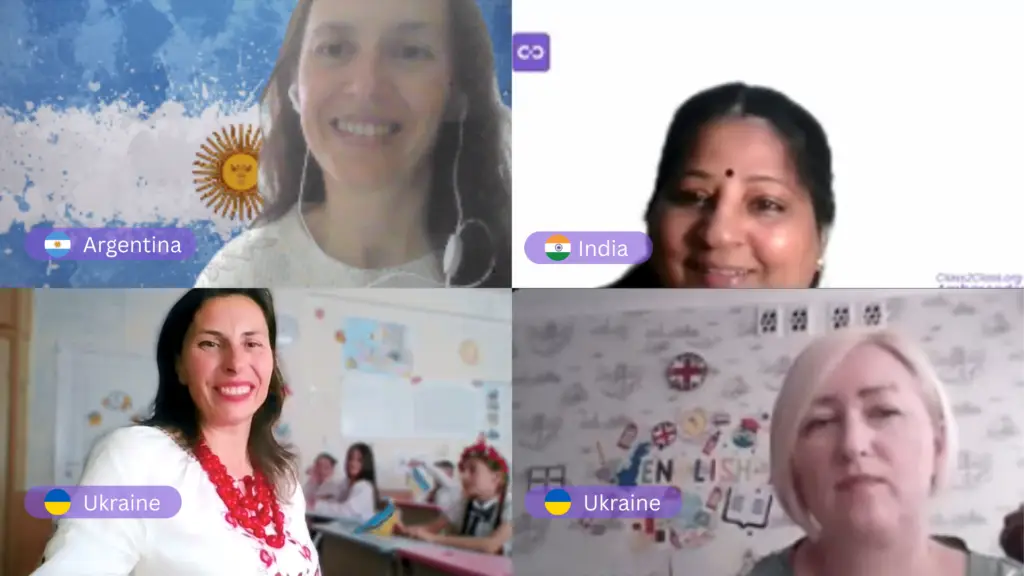
Teacher Gisel Crespo from Argentina wanted her students to see what school looks like beyond their own classroom. To do that, she brought together Teacher Jhansi from India and Teacher Olenka from Ukraine for a live exchange built around simple but meaningful questions: What does a school day look like for you? Do you wear a uniform? What celebrations do you have? These questions opened up real conversations between students — and while they shared, they also practiced their English and their confidence speaking to an international audience. Below you will find the full story of how it all came together.
What Is the My School Project?
The My School project is built around a simple idea: each class prepares a presentation about their country, their city, and their school — and then they meet online to share it with each other. What does your school building look like? When does the school year start? Do students wear uniforms? These are the kinds of questions that guide the exchange. Teacher Gisel hosted two separate sessions through Class2Class.org — one with Teacher Jhansi Ravikumar from India, and another with Teacher Olenka Sydorenko from Ukraine.
Through those sessions, students practiced their English, learned how to present and collaborate with peers from other cultures, and came away with a clearer picture of what school life looks like beyond their classroom.
The Impact on Students
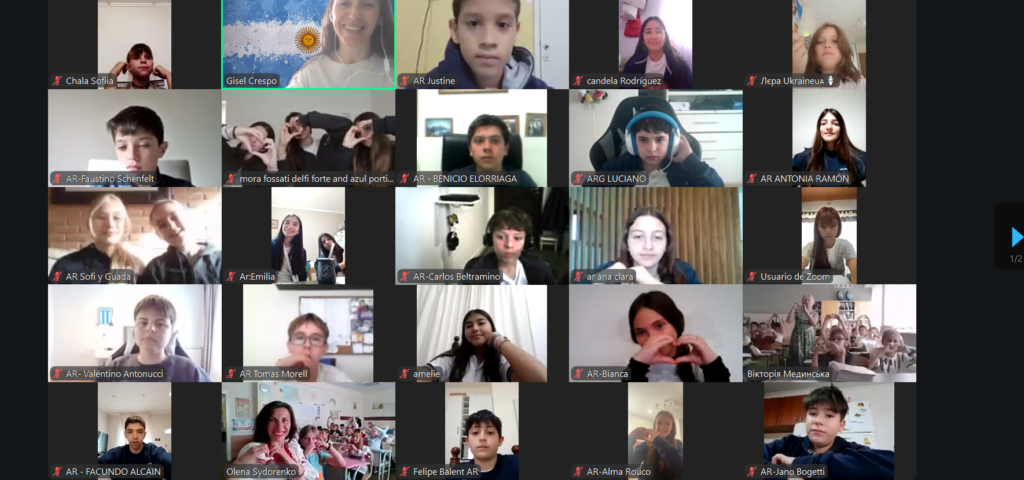
Across both sessions, students walked away with more than facts about other countries. They built real skills in a real context:
- Speaking in English in front of an international audience for the first time gave students a great level of confidence.
- Listening to peers from other cultures made intercultural understanding feel close and personal.
- Learning a few words in Spanish, Ukrainian, or English from the people who actually speak them every day made the exchange feel personal on both sides.
The Story
Argentina and India
Teacher Gisel’s students opened with a presentation about Argentina — a country of 23 provinces in South America, with Spanish as its official language. They shared their city of General Pico, located in the province of La Pampa, and walked their Indian peers through their school life: 750 students, classes from Monday to Friday starting at 7:45 a.m., a gym, an auditorium, art rooms, and celebrations like the Talent Show and Colors Day, where the whole school divides into two teams for a day of games and activities. They closed by teaching a few words in Spanish like “Hola” (Hello) and “Adiós” (Goodbye) and inviting their Indian peers to repeat along.
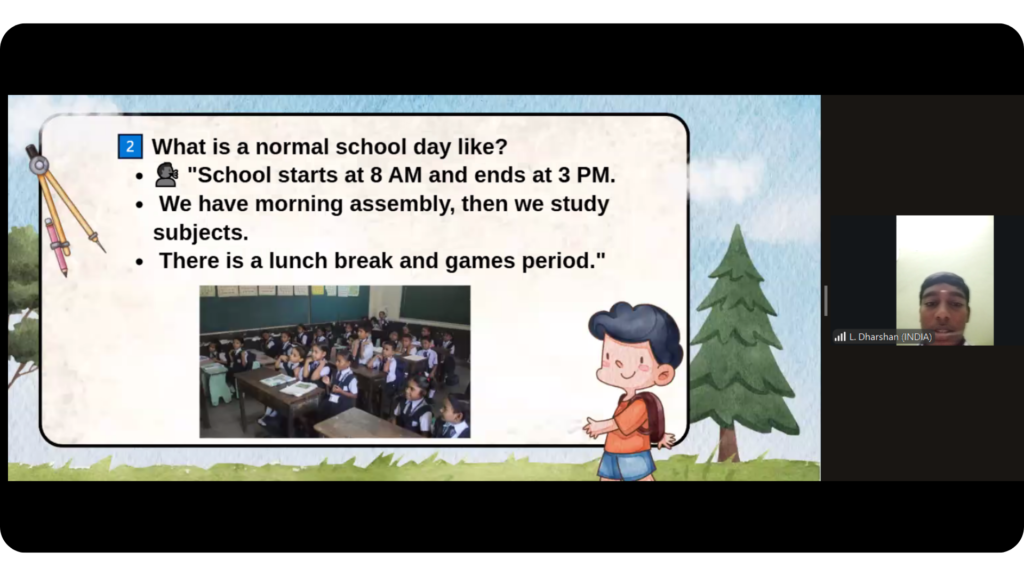
India’s students introduced themselves individually — sharing their grade, hobbies, and ambitions. Their school has three floors across four blocks, 95 classrooms, a shared library, a playground, and a garden surrounded by large trees. Classes run from 8:00 a.m. to 3:00 p.m., starting with a morning assembly. Students wear blue uniforms on most days, with casual dress on Fridays. Almost every student wanted to become a doctor, and when one said she wanted to be a teacher, both classrooms smiled. The Q&A that followed brought the session to life: an Argentine student asked about the bindi, and an Indian student explained the cultural and spiritual tradition behind it. Both classes ended with a group photo, waving and making heart gestures at the screen.
Argentina and Ukraine
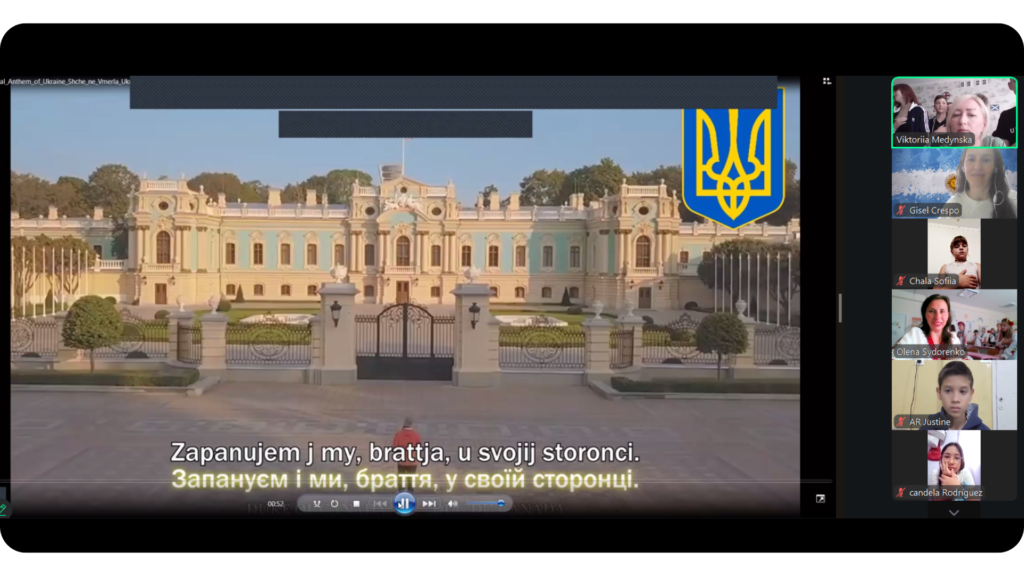
Students from School No. 9 in Brovary presented Ukraine with real detail — a country in Eastern Europe bordered by the Black Sea, with Kyiv as its capital. They explained the symbolism of the blue and yellow flag, introduced varenyky as their national dish and its place in Ukrainian culture, showed the vyshyvanka — Ukraine’s traditional hand-embroidered clothing — and performed the Carol of the Bells, known worldwide but originally a Ukrainian carol called Shchedryk. Their school, located just 10 kilometers from Kyiv, has three floors, 61 classrooms, and around 1,720 students, with facilities that include a gym, a swimming pool, a football field, and after-school clubs ranging from table tennis to gymnastics. Ten students had recorded their voices for a school video shown during the session, and Teacher Olenka pointed each one out as they appeared — a small gesture that made them visibly proud.
Argentine students practiced Ukrainian words live on the call — pryvet (hello) and dyakuyu (thank you) — repeating after their peers in a moment that was warm and genuinely fun. The session closed with a Kahoot game both classes played together.
“Dear friends from Argentina. It was an amazing meeting. We are so excited. So interesting to know more about your country, home town, and school. I like your school very much! Thanks for collaboration.“
Olena Sydorenko, Teacher, Ukraine
Both sessions were different in content and in tone, but they shared the same result: students on all sides got a genuine, firsthand look at school life beyond their own experience — and that is something that stays with them long after the call ends.
Start your own collaborative project
If this story resonated with you, you can run the same project with your own students — for free. The My School project gives you a clear structure to follow: each class prepares a presentation about their country, their city, and their school, and then both classes meet online to share it. The questions are simple, the format is tested, and the experience for your students is one they won’t forget.
Sign up on Class2Class.org, and start connecting your classroom with teachers around the world. Your students’ version of this story is waiting to happen!