
What is project-based learning in education? A classroom guide
Project-based learning in education uses a question and a project to organise learning. Students investigate, create an output, use feedback and share what they learned with an audience. Teachers guide the work, teach needed knowledge and check individual understanding throughout.
Last updated

A useful project gives students a reason to apply what they are learning. Start with a question connected to your subject, guide an investigation and ask students to create something an audience can respond to. You can begin with one small project rather than redesigning the whole curriculum.
What project-based learning means
In project-based learning, the project organises the learning rather than being only a final task after a unit. Students use subject knowledge to investigate a question, make decisions and create an output. They still need teacher explanation, examples and support along the way.
Think of planning a meal for a school fair: students need to learn about ingredients, cost and preparation to make something for an audience. The same idea can guide a research poster, a model, a video or a proposal.
- A useful question connected to a real issue or audience.
- An investigation in which students use sources, ask questions and make choices.
- An output such as a poster, model, video or proposal, improved through feedback.
- An audience who can respond to the work, alongside checks of each student's learning.
See a classroom exchange in action
The Women and Girls in STEM exchange connected classrooms in Colombia, India and Ukraine. Students researched women scientists from their own countries, created digital posters and shared them during a live session.
A question for this kind of task is: which women scientists should we learn about, and why? Students can investigate a scientist's contribution, explain it in a poster and answer a question from another class.
The partner classrooms provided an audience for the posters. This gave students a reason to explain their research clearly and listen to another class's presentation.
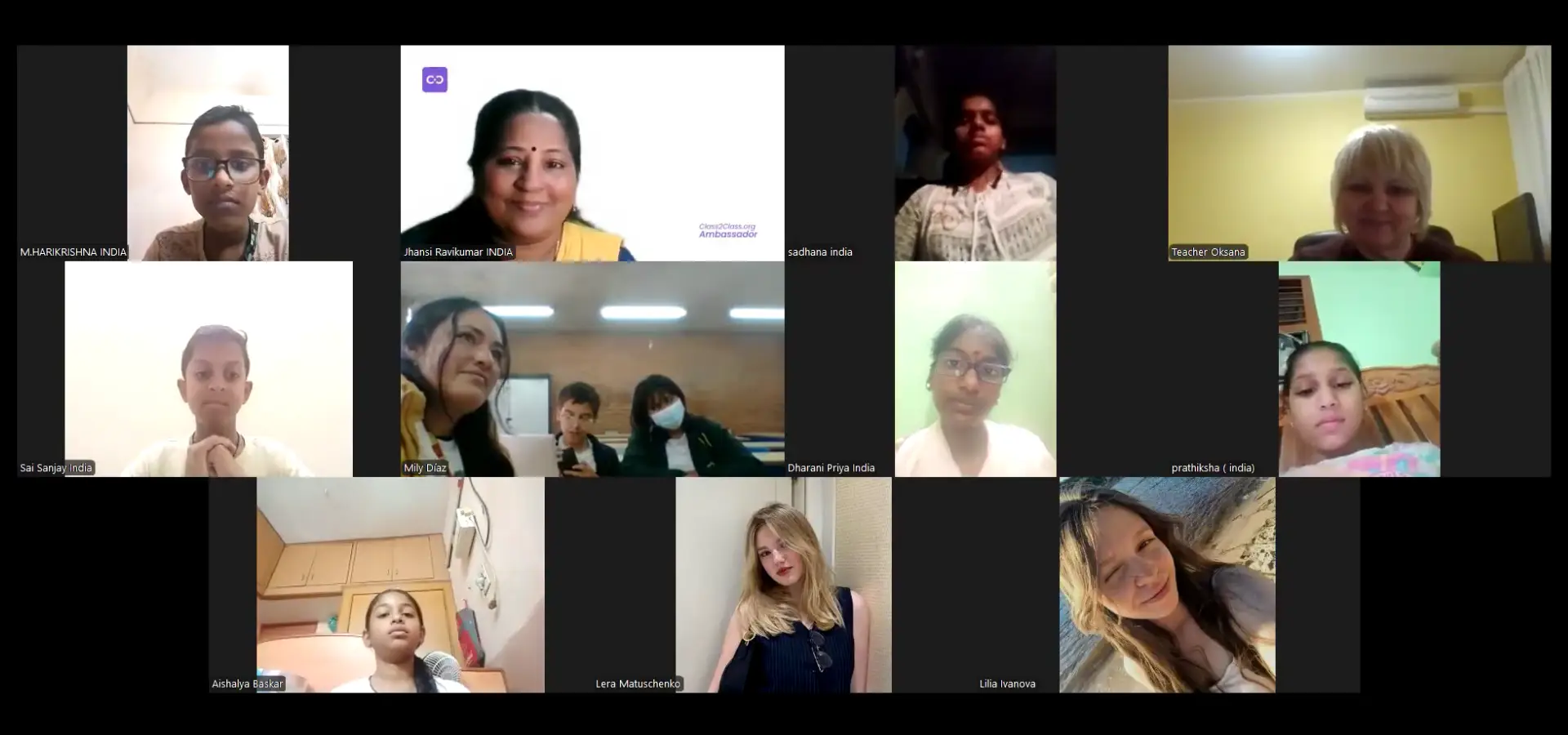
Read the full Women and Girls in STEM story for the teachers' account of the exchange.
The example brings together research, a created product and an audience. When you adapt it, connect those parts to your subject goals and include a check of what each student can explain.
Plan a small project
Choose one topic from your curriculum and turn it into a question students can investigate. For example: how could our school reduce wasted water? Keep the first question and output small enough for the time you have.
Select a few useful sources or data, teach any knowledge students need and let groups compare what they find. They could use public information, observations or an appropriately planned interview. Ask them to explain how the evidence helps answer the question.
Agree an output and an audience: a poster for another class, a short presentation or a proposal for the school. Add a feedback point before the final version. Ask each student to explain one decision or finding, so the group product is not your only evidence of learning.
What the research can tell you
Research offers useful guidance, but it does not mean every project will produce the same result. Read the findings alongside the subject, students, support and assessment used in each study.
Chen and Yang (2019) analysed 46 comparisons from 30 journal articles and found an average positive effect on academic achievement. Effects varied with features such as subject and teaching time. Their result does not establish that every project works better or that this classroom example will reproduce it.
Kokotsaki, Menzies and Wiggins (2016) highlight teacher support, well-run groups and aligned assessment. They also warn that the designs of most reviewed studies cannot establish a causal link with positive outcomes with certainty.
Condliffe and colleagues' 2017 MDRC review describes evidence of effectiveness as promising rather than proven. It explains challenges with study designs and measuring the learning that projects aim to develop.
PBLWorks' Gold Standard framework is a useful design resource. It includes a challenging question, sustained inquiry, authenticity, student voice, reflection, critique and a public product. Use it to check the question, feedback points and final output in your plan.
Plan with a partner classroom
A partner class can respond to students' questions and products. Use Class2Class Discover to explore ideas, then find a teacher in Connect and agree the learning question, timing and sharing plan. Class2Class is free for teachers and students.
The Project Creation Assistant can help draft a topic, goals and activities. Review and edit the suggestions for your subject and students. You can also start with an existing idea or create your own project.
References and further guidance
Chen, C. H., & Yang, Y. C. (2019). Revisiting the effects of project-based learning on students' academic achievement: A meta-analysis investigating moderators. Educational Research Review, 26, 71-81.
Kokotsaki, D., Menzies, V., & Wiggins, A. (2016). Project-based learning: A review of the literature. Improving Schools, 19(3), 267-277.
Condliffe, B., Quint, J., Visher, M. G., Bangser, M. R., Drohojowska, S., Saco, L., & Nelson, E. (2017). Project-Based Learning: A Literature Review. MDRC.
PBLWorks. Gold Standard PBL: Essential Project Design Elements. Buck Institute for Education.
National Academies of Sciences, Engineering, and Medicine (2018). How People Learn II: Learners, Contexts, and Cultures. The National Academies Press.
Want to explore more ways to bring global collaboration into your classroom? Visit our SDG Calendar for year-round project based learning opportunities connected to the UN Sustainable Development Goals.
Frequently asked questions
Is project-based learning just a project at the end of a topic?
No. In PBL, the question and project organise how students learn the topic. Plan investigation, creation, feedback and an audience, and teach the knowledge students need along the way.
Do I have to stop direct teaching or tests?
No. Teacher explanation, modelling and checks of individual understanding can support the project. Use them where students need knowledge or where you need to see what each person has learned.
How can I start with limited time?
Choose one curriculum question, a small output and an audience. Plan one feedback point before students share the final work. Adapt the time to your lessons rather than trying to run a large project first.
Does PBL guarantee better results?
No. Some studies find positive average results, but outcomes depend on the design and context. Use clear goals, guidance and individual assessment, then review what your students learned.
Explore classroom projects
Explore Class2Class project ideas and choose one to adapt for your class.