A teacher’s complete guide to the eight global competencies, the frameworks behind them, and how they grow project by project in real classrooms.
Why competencies, not just content?
Most teachers know the feeling. A student can recite the water cycle, name the capitals of ten countries, and define what a stakeholder is — and then freeze the moment they’re asked to defend an idea in front of peers from another culture, coordinate with a team that disagrees, or design a solution for a problem that doesn’t have a textbook answer. The gap is not in what they know. It’s in what they can do with what they know.
The 8 C2C competencies are a shared vocabulary for closing that gap. C2C designed this framework to name eight global skills that international classroom collaboration is uniquely positioned to grow — skills like intercultural communication, critical thinking, and adaptability. The framework is grounded in research from the OECD PISA Global Competence Framework and UNESCO’s work on Education for Sustainable Development and Global Citizenship Education.
This article walks through what the 8 C2C competencies are, what they look like in real Class2Class projects, and how teachers help each one develop, one project at a time.
What the 8 C2C competencies actually are
The framework has eight competencies that work together in every international project: intercultural communication, global awareness, collaboration and teamwork, digital literacy, critical thinking and problem-solving, emotional intelligence, adaptability and leadership, and creativity and innovation.
Here’s what each one means in practice:
Intercultural communication is the ability to listen, ask, and adjust across cultural differences. Global awareness is the capacity to see one’s classroom as part of a larger system of people, places, and challenges. Emotional intelligence is the literacy of one’s own and others’ emotions in a learning context.
Collaboration and teamwork is the ability to coordinate, divide labor, and resolve disagreement productively. Adaptability and leadership name the move from reacting to a changing situation to shaping it. Digital literacy, in C2C’s frame, is not simply “knowing how to use apps” — it is the literacy of communicating, creating, and verifying information in digital spaces.
Critical thinking and problem-solving is the ability to evaluate information, weigh evidence, and reason through ambiguity. Creativity and innovation are the moves that turn a defined problem into a designed response.
The transversal lens: student agency
Running across all eight is a transversal quality C2C calls student agency: the ability to act with intention by setting goals, making decisions, taking responsibility, and reflecting in order to improve. Agency is not a ninth competency but a lens through which all eight are expressed. Without agency, competencies become just checkboxes — students might collaborate, but not own the work they’re doing.
That’s the framework on paper. Now let’s see what it actually looks like when teachers put it into practice.
What the 8 C2C competencies look like in real classrooms
A list of competencies is just a list until you can see them moving. Three verified C2C projects make the framework concrete.
My School: An Intercultural Exchange
In the My School project , Teacher Gisel hosted sessions through Class2Class.org with classrooms in India and Ukraine. Each class prepared a short presentation about their country, city, and school, then met live to share it. On paper it’s a simple intercultural exchange. In practice, it asks students to notice what is normal at home and unfamiliar abroad — the seed of intercultural communication and global awareness — while they manage the nerves and curiosity of meeting peers across continents (emotional intelligence). It’s also the lowest-friction entry point for teachers new to international collaboration.
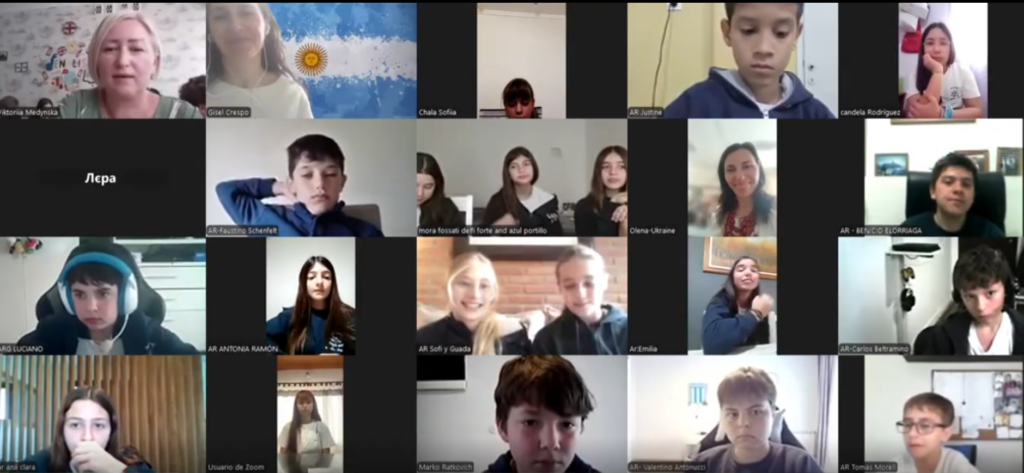
Teachers and students from Ukraine and Argentina connected through the My School project during one of their two live exchange sessions .
Should Rivers Be Connected?: An International Debate
The international debate Should Rivers Be Connected? brought students from ten countries into a structured conversation about whether nations should connect their rivers for irrigation, transport, and flood control. Coordinated by Teacher Jhansi Ravikumar (India) with Teacher Leo R. Veridiano (Philippines/Indonesia) as Guest of Honour, the project ran on a five-day plan: introducing the format, researching positions, practicing presentations, and debating live. Students didn’t only argue — they had to listen, hold a position under pressure, and adapt to peers whose evidence and assumptions differed from theirs. Collaboration, adaptability, and digital literacy (the research-and-present cycle) all moved together.
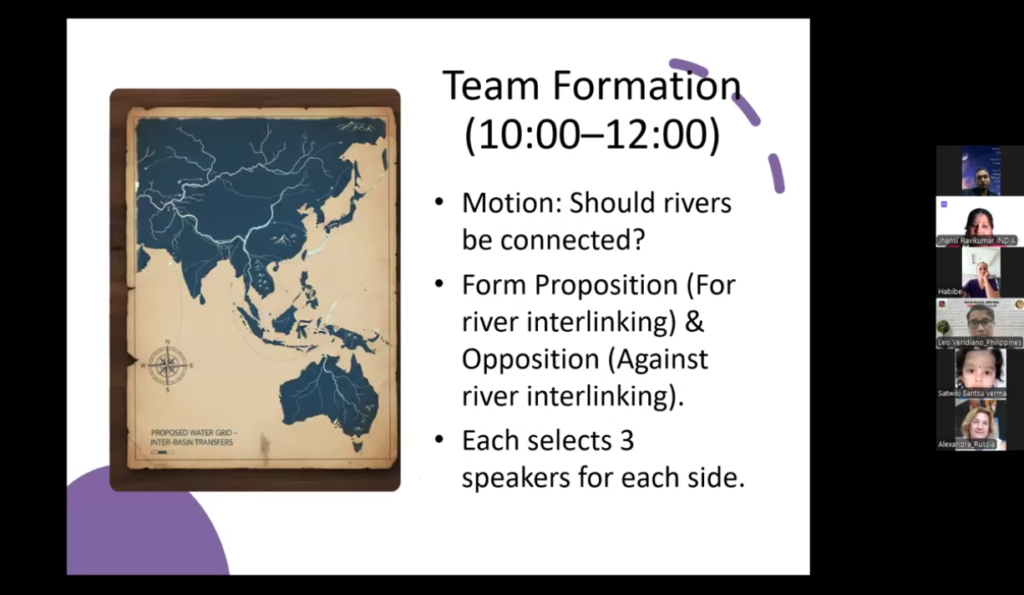
Students learning how to debate, guided by Guest of Honor Teacher Leo R. Veridiano (Philippines/Indonesia).
The Global Water Conservation Challenge
The Global Water Conservation Challenge connected classrooms in India, Malaysia, and Myanmar — led by Teachers Jhansi Ravikumar, Vathsala Nayer Vailathan, and Zin Zin Thin — around a real, SDG-aligned problem. Students researched local water issues, compared contexts across the three countries, and proposed responses. Critical thinking organized the inquiry, creativity powered the proposed solutions, and global awareness turned a local issue into a shared one.
Two further examples worth exploring: K-pop in the Classroom , a four-week PBL project that turned a topic students already loved into rigorous cultural analysis, and Women in STEM Across Borders , in which classrooms in Colombia, India, and Ukraine researched and presented women scientists from their own countries.
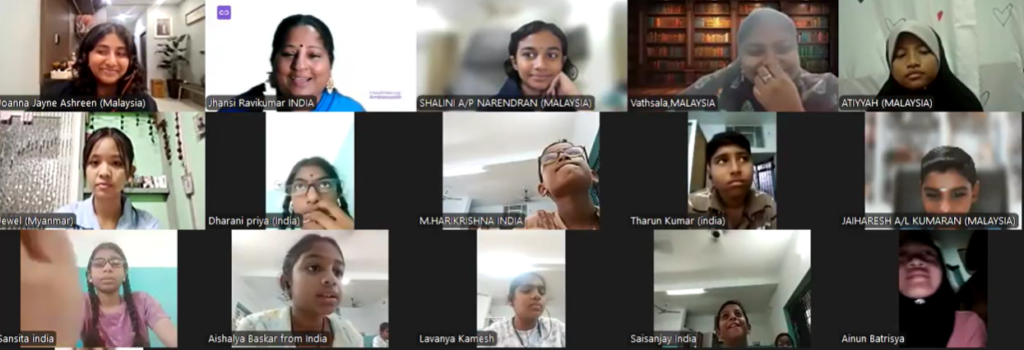
Students from Malaysia, India and Myanmar sharing internationally on a live videoconference.
The pattern is consistent: every real project pulls on several of the 8 C2C competencies at once. The competencies are not taught — they are exercised .
How the 8 C2C competencies develop through projects
The competencies don’t develop through worksheets or lectures — they develop through real projects with international partners. C2C offers three project approaches, each with a different scope and time commitment. Teachers choose the approach that fits their context and learning goals.
Three project approaches
- Connect projects (1–2 hours) focus on intercultural exchange and relationship-building. Students meet peers from another country, share about their contexts, and build the foundation for future collaboration. Example: the My School project, where classrooms present their schools and cities to international partners in a single live session.
- Collaborate projects (4–8 hours) take students into shared inquiry around a topic. Students research together, exchange perspectives, and create joint outputs. Example: Should Rivers Be Connected?, where students across ten countries debated water infrastructure using evidence from their own contexts.
- Create projects (10+ hours) guide students through a full problem-solving cycle. Students identify a challenge, research it across international contexts, and design concrete responses. Example: the Global Water Conservation Challenge, where students proposed solutions to water scarcity informed by three different countries.
Each approach develops multiple competencies simultaneously. The difference is in scope and duration, not in pedagogical value — a well-designed Connect project can be just as transformative as a Create project. Teachers often mix approaches across a school year based on curriculum fit and available time.
The methodological backbone: COIL + PBL + Design Thinking
Inside every project, three methodologies do the pedagogical work. Collaborative Online International Learning (COIL) is the structural frame — the international, virtual, co-taught format itself (Rubin, 2008). Project-Based Learning provides the inquiry cycle through which students explore real questions and apply knowledge across subjects. Design Thinking gives the iterative moves of understanding, ideating, prototyping, and reflecting. Together they ensure that competency development is participatory and connected to real-world contexts, not abstract.
The Changemaker Journey and formative evaluation
Across a school year, a teacher can run several projects of mixed approaches — typically one Connect, one Collaborate, and one Create — and trace student progress through what C2C calls the Changemaker Journey. Importantly, evaluation in C2C is formative : it makes learning visible, supports group-level reflection, and never assigns AI-generated grades to individual students. The aim is growth, not ranking — consistent with Black and Wiliam’s (1998) finding that formative assessment produces the largest gains in student learning when it is genuinely used to inform next steps.
The take-home is concrete: a teacher who runs three projects per year — one of each approach — gives every student dozens of authentic moments to practice each of the 8 C2C competencies, with reflection built in.
What this means for your classroom
The 8 C2C competencies are not an extra curriculum to add to an already-full timetable. They are the how of the subjects you already teach — the lens through which content becomes practice. The framework’s promise is also its honesty: students do not learn to collaborate by being told to collaborate, or to think critically by being told to think critically. They learn by being placed in situations where those moves are needed, and by reflecting on what they did. International projects are one of the most reliable ways to create those situations.
The question isn’t whether to start. It’s which project to run first.
Take the first step
Create a free Class2Class account and run your first international project this term. Start with a Connect project if you want something quick (1–2 hours, single session). You’ll see what happens when your students meet peers who see the world differently — and you’ll understand why these eight competencies matter more than any list can explain.
References
- Black, P., & Wiliam, D. (1998). Inside the Black Box: Raising Standards Through Classroom Assessment . Phi Delta Kappan, 80(2), 139–148.
- OECD (2018). Preparing Our Youth for an Inclusive and Sustainable World: The OECD PISA Global Competence Framework . OECD Publishing.
- Rubin, J. (2008). Collaborative Online International Learning: An Emerging Format for Internationalizing Curricula . SUNY COIL Center.
- UNESCO (2017). Education for Sustainable Development Goals: Learning Objectives . UNESCO Publishing.
- Wiek, A., Withycombe, L., & Redman, C. L. (2011). Key Competencies in Sustainability: A Reference Framework for Academic Program Development . Sustainability Science, 6(2), 203–218.