



Explore proven student engagement strategies that work. See how giving students a real purpose and audience changes effort, motivation, and learning.
You spent the weekend preparing. The slides are clear, the examples are relevant, the timing is tight. Monday morning arrives, you deliver the lesson — and halfway through, you notice it. A student staring at the window. Another one doodling. A third scrolling under the desk. They are not being disruptive. They are just… somewhere else.
If you have tried different student engagement strategies — gamification, group work, digital tools — and still see that quiet withdrawal, this article is for you. The problem is not your toolkit. The problem is that most strategies focus on how students learn without first answering a more fundamental question: why should they care?
That missing “why” is what we call learning without purpose — and it is the root cause of the disengagement that no method alone can fix. The good news is that one shift changes everything, and it is simpler than you think.
The Real Problem: Disengagement Is Not Resistance — It Is a Signal
Most teachers are trained to spot behavioral problems. A student who talks out of turn, who refuses to work, who disrupts the class — those are visible and actionable. But the student who sits quietly, completes the minimum, and never asks a question is far more common — and far more difficult to reach.
This kind of disengagement is not defiance. It is a signal. It means the student has decided, probably unconsciously, that what is happening in the classroom has no connection to anything that matters to them. The content feels abstract. The assessment feels arbitrary. And the effort feels pointless.
This is not a character flaw. It is a rational response to an experience that lacks a visible “what for.” When the brain cannot answer the question “why does this matter outside this room?”, it files the information as disposable. Research on the forgetting curve confirms this: without reinforcement and real-world anchoring, students can forget up to 70% of new material within 24 hours. The issue is not effort — it is design.
If this resonates, the article Why Students Forget What They Learn goes deeper into the neuroscience behind this pattern and what it means for how we plan our lessons.

Active methodologies like collaborative learning help students retain knowledge by connecting, applying, and discussing what they learn.
The key insight here is that among all the student engagement strategies available, the most effective one does not start with a new activity or a new tool. It starts with giving students a reason — a purpose that connects what they are learning to something real. Once you understand this, every other element of your strategies becomes more effective, because purpose is the foundation they all depend on.
The Best Student Engagement Strategies Start with a Real Audience
Now consider a different scenario. Same students, same school, same age group. But this time, the work they produce will be seen by someone outside the classroom — not just graded by their teacher, but read, watched, or discussed by peers in another country. This is the core idea behind connecting classrooms: giving students a real audience that makes their effort matter.
That shift — from “this is for a grade” to “someone is waiting for this” — changes effort at a level that no rubric or reward system can match.
This is exactly what happened in a project called K-pop Talk on Class2Class. A teacher in Bangladesh, Tr. Nassim Mia, noticed his students were passionate about Korean pop music. Instead of filing that as a distraction, he turned it into a four-week international collaboration project. Students from multiple countries formed teams, chose a K-pop song, and researched its cultural meaning — why BTS connects with global audiences, what Blackpink represents in terms of identity and expression, how K-pop became a worldwide cultural movement.
Then classrooms were paired across borders. Students met online, shared their research, performed songs and dances, and discussed what K-pop meant in their own cultural context. The conversations went deeper than anyone expected. Students were comparing entertainment industries, exploring how music shapes identity, and finding common ground through shared passion. This is what happens in a global classroom when the topic is right: students from classrooms around the world connect over something they genuinely care about.
None of this was driven by test pressure. It was driven by purpose. Students cared because their work had a real destination — a classroom on the other side of the world that was genuinely interested in what they had to say.
According to a meta-analysis by Chen and Yang (2019), students in project based learning environments that include international collaboration consistently achieve stronger academic results — with effects especially significant in conceptual understanding and the ability to apply knowledge to new situations. This is also the foundation of COIL projects (Collaborative Online International Learning), the methodology behind platforms like Class2Class that structure global classroom collaboration into a repeatable, teacher-friendly process.
The lesson is clear: the most powerful of all student engagement strategies is not a technique — it is a context shift. Give students an audience, and purpose follows naturally.
How to Start: You Do Not Need to Redesign Everything
If you are reading this and thinking “this sounds incredible, but also like a massive project I do not have time for” — that reaction is completely normal, and it is worth addressing directly.
You do not need to overhaul your curriculum. You do not need to be an expert in active learning methodology. You do not even need to start with a long project.
Class2Class organizes every collaboration into three levels, and the first one — called “Connect” — takes as little as one to two hours. It is an intercultural icebreaker where your students introduce themselves to a partner classroom in another country and share something about their daily reality. That is it. No complex logistics, no weeks of planning. Just a real exchange with a real audience. Even this small step is a form of global citizenship education — students begin to see themselves as part of a world beyond their school walls.
The First International Project Guide walks you through the process in four clear phases: Define, Execute, Reflect, and Share. A built-in Project Assistant on the platform suggests learning objectives, activities, and evaluation criteria based on the topic and age range you choose — so you are not starting from a blank page.
If you want even more structure, the Global Project Templates library offers complete, ready-to-use frameworks. Each template includes timelines, skills, assessment ideas, and free resources. You choose a topic that fits your classroom, adapt the template to your context, and publish the project to find a partner teacher. The platform handles the matching. These templates are designed around project based learning principles and structured as COIL projects, so the pedagogical foundation is already built in.
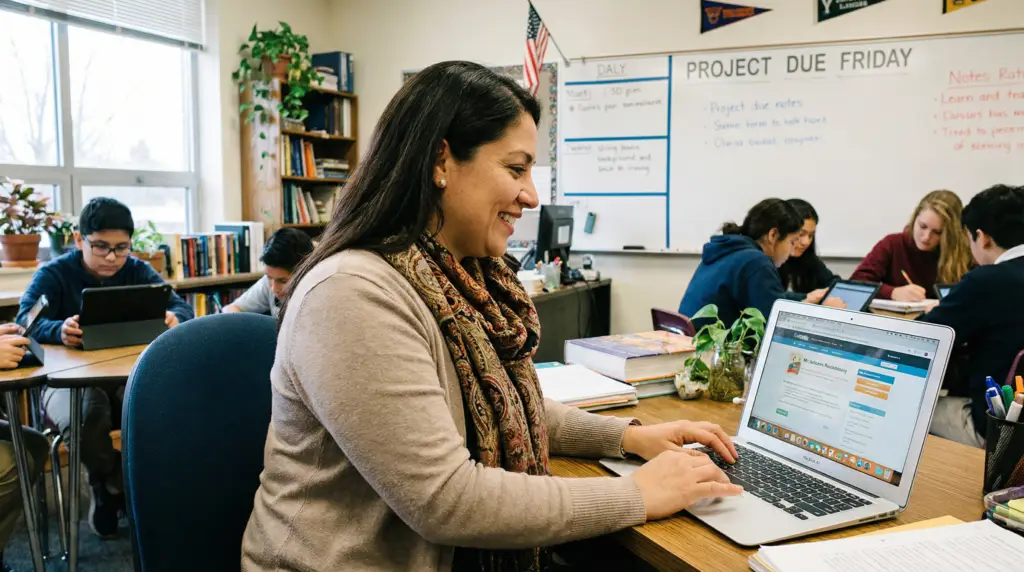
The point is this: effective student engagement strategies do not require a revolution. They require a connection — one class, one topic, one partner — and the rest grows from there.
Purpose Is the Strategy: Everything Else Is a Tool
Go back to the student staring out the window. The one you thought was checked out. Chances are, that student was not rejecting your class. They were waiting — for a reason to care, for a connection between the content and something real, for the feeling that their effort would matter to someone beyond the gradebook.
You have probably tried many student engagement strategies over the years. Some worked better than others. But the ones that created lasting change likely had one thing in common: they gave students a purpose that went beyond the grade. Connecting classrooms internationally is one of the most direct ways to create that purpose — and it is one of the most accessible active learning approaches available today.
The platform is completely free. The structure is already built. The hardest part is deciding to begin.
Ready to Give Your Students a Reason?
Explore the project library and find a collaboration that fits your classroom, or sign up and start building your own. If you want year-round inspiration, the SDG Calendar connects projects to the UN Sustainable Development Goals across every month of the year.
References
- Chen, C. H., & Yang, Y. C. (2019). Revisiting the effects of project-based learning on students’ academic achievement: A meta-analysis. Educational Research Review, 26, 71–81. Read the study
- Richards, B., & Frankland, P. (2017). The persistence and transience of memory. Neuron, 94(6), 1071–1084. As cited in Edutopia
- Class2Class.org (2026). Why Students Forget What They Learn
- Class2Class.org (2026). Global Collaboration in Action: K-pop in the Classroom
- Class2Class.org (2026). Your First International Project in 4 Steps
- Class2Class.org (2026). How to Use Global Project Templates
- Class2Class.org (2026). Designing Global Projects
- Class2Class.org (2026). SDG Calendar