





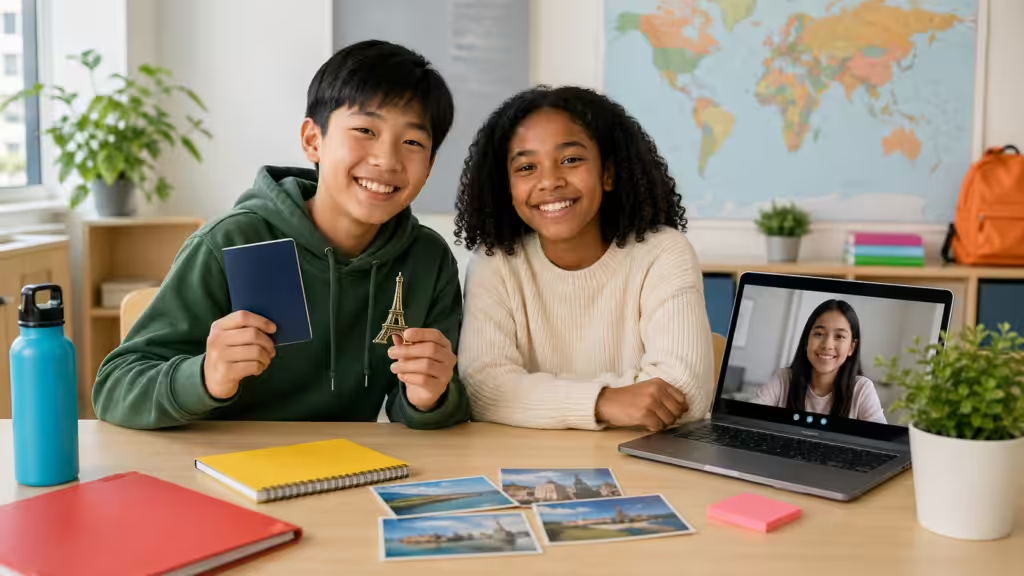
You want your students to see beyond their classroom walls. You know global competence matters in 2025, but international education exchange can feel overwhelming—expensive trips, complex logistics, passport issues, and time away from core curriculum. Meanwhile, your students need exposure to different cultures, languages, and perspectives more than ever.
International education exchange doesn’t have to mean costly overseas trips. Whether you’re exploring traditional travel programs or virtual alternatives, this guide breaks down exactly what these programs involve, how much they cost, and how you can get started with your own classroom this semester.
What Is International Education Exchange?
International education exchange refers to structured programs where students from different countries learn together, share perspectives, and collaborate on projects. These exchanges develop cross-cultural competence, language skills, and global awareness—skills UNESCO identifies as essential for 21st-century citizenship.
In K-12 settings, exchanges typically fall into two categories. Traditional exchanges involve physical travel: students visit partner schools abroad or host international visitors. Virtual exchanges, also called COIL (Collaborative Online International Learning), connect students from different countries together through video calls, shared projects, and online collaboration.
Both formats share core goals. Students practice perspective-taking, challenge stereotypes, develop communication skills across cultural differences, and build lasting relationships with peers from other countries. The difference lies in implementation, cost, and accessibility.
For elementary teachers, exchanges might mean kindergarteners drawing self-portraits to share with a class in Japan. Middle school science teachers might partner with a classroom in Kenya for a water quality comparison project. High school Spanish teachers could connect students with age-matched peers in Mexico for authentic conversation practice.
In-Person vs Virtual International Exchange Programs
Understanding the trade-offs between in-person and virtual formats helps you choose what works for your students, schedule, and budget.
Traditional In-Person Exchange Programs
In-person programs remain the gold standard for depth of cultural immersion. Students live with host families, attend classes in another country, and experience daily life in a different culture. Programs typically last one week to a full academic year.
Benefits are significant. Students develop independence, practice language skills in authentic contexts, form deep friendships, and gain confidence navigating unfamiliar situations. Many teachers report that students return transformed—more mature, culturally sensitive, and motivated to learn.
Challenges are equally real. Costs range from $2,000 to $10,000 per student depending on destination and duration. Not all families can afford this. Safety concerns require extensive vetting, insurance, and supervision. Visa requirements create barriers for some students. Time away from school raises academic continuity questions.
In-person exchanges work best when you have significant planning time (12-18 months), administrative support, parent volunteers for chaperoning, and a willing partner school abroad with similar resources.
Virtual Exchange Programs
Virtual exchange eliminates most barriers to international education exchange while delivering meaningful cross-cultural learning. Students connect via video conferencing, collaborate on shared documents, and complete joint projects—all from their regular classrooms.
The accessibility advantage is enormous. Virtual exchanges cost nothing beyond existing internet access. Every student participates regardless of family income. No passports, no time away from home, no complex liability waivers. Teachers maintain full control of curriculum integration and can start a virtual student exchange program within weeks instead of years.
Learning outcomes surprise skeptics. Research from Stevens Initiative shows virtual exchange students demonstrate gains in intercultural competence, perspective-taking, and global awareness comparable to short-term travel programs. Students practice authentic communication, challenge assumptions, and build relationships that often continue beyond the structured program.
Limitations exist. Screen-mediated interaction lacks the sensory immersion of physical presence. Time zone differences require scheduling creativity. Some cultural nuances get lost in video calls. Technology glitches happen.
Virtual exchanges excel when you want to reach all students, integrate global learning into existing curriculum, partner with classrooms in multiple countries simultaneously, or test international collaboration before committing to travel programs.
Cost Considerations for Different Exchange Models
Budget realities shape which international education exchange models you can implement. Here’s what each approach actually costs.
Traditional Exchange Program Costs
Airfare represents the largest expense, ranging from $800 to $2,500 depending on destination. Add program fees ($1,000-$3,000) covering host family placement, local transportation, insurance, and supervision. Students need spending money for meals, souvenirs, and activities ($300-$800).
Hidden costs add up: passport applications ($130-$165 for first-time applicants), visa fees if required ($50-$160), vaccinations, and luggage. Many schools require trip insurance ($100-$300).
Fundraising helps but requires significant teacher time. Successful strategies include grant applications to organizations like the Fund for Teachers or AFS-USA, community sponsorships, crowdfunding campaigns, and student-led fundraising events. Most teachers spend 50-100 hours on fundraising for a single trip.
Virtual Exchange Program Costs
Virtual programs operate at near-zero cost when schools already have internet access and basic devices. You need video conferencing capability (Zoom, Google Meet, Microsoft Teams—often already in education subscriptions), collaborative document tools (Google Workspace, Microsoft 365), and a way to communicate asynchronously (email, Padlet, Flipgrid).
Time represents your main investment. Expect 10-15 hours for initial partner finding, curriculum planning, and scheduling. Ongoing facilitation requires 1-2 hours per week during the active exchange period. This time investment pays dividends in reusable curriculum and established partnerships for future years.
Some teachers pursue grants for virtual exchange despite low direct costs. Funding can support release time for planning, professional development, or stipends. Organizations like the Stevens Initiative and iEARN offer resources specifically for virtual exchange opportunities schools can access.
Hybrid Models
Many teachers combine approaches. Start with a semester-long virtual exchange to build relationships and cultural knowledge. Follow with a short in-person visit where students meet their established exchange partners. This reduces culture shock, creates meaningful context for travel, and builds parent buy-in for future programs.
Costs for hybrid models fall between pure virtual and traditional exchanges. The virtual component costs nothing. A shortened 3-5 day visit might cost $1,500-$3,000 per student—more accessible than longer programs while still providing immersive experience.
Finding the Right Partner Classroom or Organization
Your exchange experience depends heavily on finding compatible partners. Look for alignment in several areas.
Grade levels should match within one year. Fourth graders work wonderfully with fourth or fifth graders from another country, but pairing them with seventh graders creates developmental mismatches. Language proficiency matters—consider whether students share a common language or if translation tools will support communication.
Curriculum connections strengthen exchanges. A U.S. teacher doing a water cycle unit pairs naturally with an Indian teacher teaching monsoons. A Japanese teacher exploring origami mathematics connects beautifully with a Canadian geometry teacher. Look for international educational exchange opportunities where learning goals overlap.
Time zones require practical consideration. Teachers in California (UTC-8) and South Korea (UTC+9) face a 17-hour difference. This doesn’t prevent partnership but requires creative scheduling—perhaps recorded video exchanges, asynchronous collaboration, or occasional early morning/late evening live sessions.
Commitment level and communication style matter more than most teachers expect. Find partners who respond to messages within a reasonable timeframe (24-48 hours), share your enthusiasm level, and demonstrate follow-through. Many promising exchanges falter because one teacher is significantly more engaged than the other.
For traditional in-person exchanges, established organizations provide structure and vetting. AFS Intercultural Programs, CIEE, and Rotary Youth Exchange offer proven frameworks, though at higher costs. School-to-school partnerships you develop independently offer more flexibility but require more legwork for safety protocols and logistics.
For virtual exchanges, platforms designed for teacher connections simplify partner finding significantly. These typically include teacher profiles, search filters by grade level and subject, and safety features appropriate for K-12 contexts.
Curriculum Integration and Learning Goals
Successful international education exchange programs connect to your existing curriculum rather than existing as add-ons. This approach justifies the time investment to administrators and ensures learning transfers to assessed standards.
In elementary classrooms, exchanges naturally support social studies standards about communities and cultures. A second-grade class in Texas partnering with a class in Ghana might compare daily routines, housing types, and family structures—hitting state standards while building global awareness. Math teachers create data collection projects where partner classes survey students about favorite foods, transportation methods, or pets, then graph results.
Middle school teachers align exchanges with content area standards. Science classes partner for environmental studies—students in Florida and students in Indonesia both collect water samples from local sources, test them, compare results, and discuss regional environmental challenges. Social studies classes explore historical events from multiple national perspectives, enriching understanding of how narrative shapes perception.
High school exchanges tackle complex global issues. Economics classes compare cost of living across countries. Literature classes read the same novel and discuss how cultural context shapes interpretation. Language classes provide authentic communication practice that textbooks cannot replicate.
Learning goals should extend beyond content mastery to include competencies that international education exchange uniquely develops. Students learn to communicate across cultural differences, question assumptions, demonstrate empathy for different lived experiences, and collaborate despite language barriers.
Assessment becomes creative. Rather than traditional tests, consider portfolios of exchange artifacts, student reflections on perspective shifts, collaborative products created with exchange partners, or presentations to younger grades about what students learned.
Addressing Common Administrative and Logistical Concerns
Administrators often raise predictable questions about international education exchange. Preparing answers in advance smooths approval processes.
Safety ranks as the primary concern for in-person exchanges. Document your vetting process for partner schools and host families. Obtain comprehensive insurance. Create emergency protocols including 24-hour contact systems. Many administrators approve virtual exchanges more readily specifically because students remain in supervised school buildings.
Curriculum time represents another common objection. Frame exchanges as curriculum enhancement rather than replacement. Show how exchange activities address specific standards. Demonstrate that 30 minutes weekly for video calls enriches learning rather than distracting from it.
Equity concerns require thoughtful responses. If you’re proposing a traditional exchange some families cannot afford, explain your fundraising plan and scholarship options. Virtual exchanges eliminate this barrier entirely—every student participates regardless of family resources.
Technology access for virtual exchanges concerns some administrators. Audit your current technology reality. Most schools in 2025 have sufficient devices and internet connectivity post-pandemic investments. If your school remains under-resourced, start with asynchronous exchanges requiring minimal bandwidth—pen pal letters, recorded videos, or shared photos.
Parent permission processes vary by district but generally follow field trip protocols for virtual exchanges. For in-person exchanges, expect additional documentation: medical forms, liability waivers, passport copies, and detailed itineraries.
How Class2Class Supports International Education Exchange
Class2Class provides free infrastructure specifically designed for K-12 virtual international education exchange. Teachers create profiles, search for partners by grade level, subject, and country, and manage exchanges through project workspaces. The platform handles partner vetting, provides lesson templates for common exchange activities, and supports both synchronous video calls and asynchronous collaboration—all within a safe, education-focused environment built for teachers like you.
Getting Started With Your First International Exchange
Starting an international education exchange requires less preparation than you might think. Follow these concrete steps.
- Decide on virtual or in-person format based on your resources, timeline, and student needs. Most teachers find success starting with a virtual exchange to learn the process before pursuing more complex in-person programs.
- Identify curriculum connections where international perspectives enhance learning. Choose an upcoming unit where student collaboration across cultures makes authentic sense—environmental science, cultural geography, literature analysis, or math problem-solving all work well.
- Find a partner teacher who shares your grade level, subject interest, and commitment level. Use platforms designed for teacher matching, or tap into existing networks through professional organizations. Look for teachers who respond promptly and demonstrate genuine engagement.
- Plan together with your partner teacher to establish shared goals, timeline, and logistics. Schedule a video call to discuss learning objectives, project structure, assessment approaches, and how you’ll handle challenges like time zones or technology problems. Document your plan in a shared document.
- Start small with a focused project lasting 4-6 weeks rather than a semester-long commitment. First exchanges teach you about pacing, student engagement patterns, and logistical details. A shorter timeline reduces risk while providing proof of concept for future exchanges. You can always extend or repeat successful partnerships.
Your first exchange won’t be perfect. Students might feel shy on initial video calls. Technology will glitch at inconvenient moments. You’ll discover scheduling complexities you didn’t anticipate. This is normal and expected—every experienced exchange teacher started exactly where you are now.
Conclusion
International education exchange transforms how students understand their place in the world. Whether through traditional travel programs or accessible virtual collaboration, these experiences develop competencies your students need for increasingly interconnected lives and careers. The choice between in-person and virtual formats depends on your specific context—budget, administrative support, student population, and curriculum needs—but both deliver meaningful cross-cultural learning when implemented thoughtfully. Start with one small project this semester. Your students’ expanded worldviews and newfound global connections will demonstrate why teachers worldwide consider international education exchange essential rather than optional.
Ready to bring this into your classroom? Class2Class connects K-12 teachers in 144 countries — free to use, free to match with a partner classroom, free to launch your first international project.