
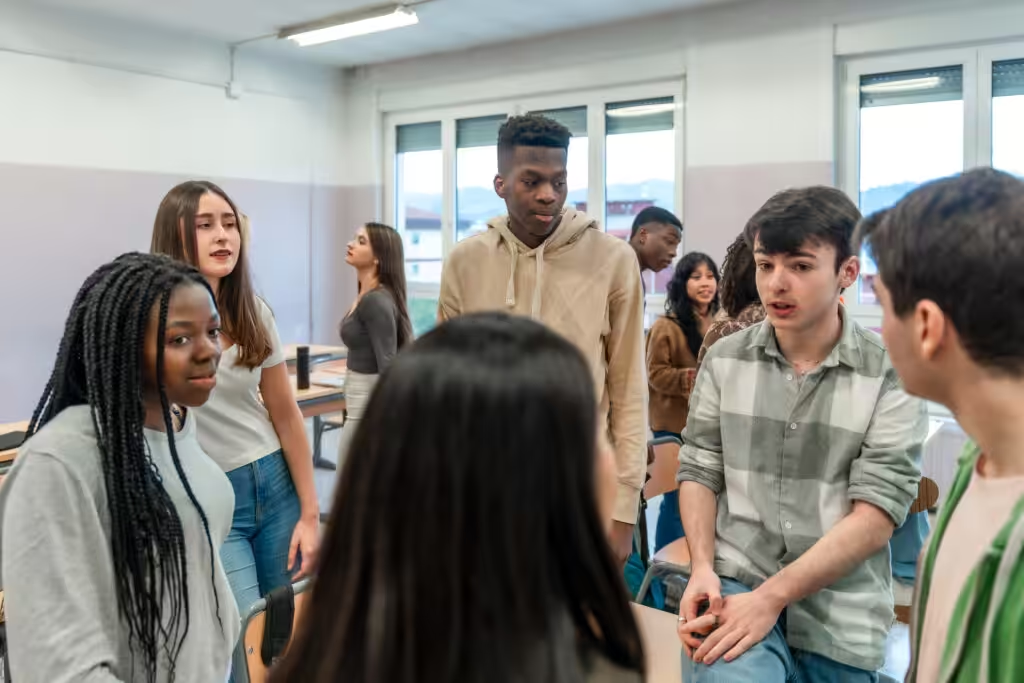
You have seen it before. You put students in groups, give them a task, and twenty minutes later one student is typing everything while the others watch. Or the group quietly divides the work into separate pieces, each person writes their part, and someone assembles it at the end. Both look like group work. Neither is real collaboration in the classroom.
This is not about effort or motivation. Most students are trying. The problem is that “work in groups” is not the same as “think together.” Without that distinction, teachers often plan for collaboration but deliver parallel work in close proximity. The two things feel similar from across the room. They are not.
This article explains what genuine collaboration actually looks like, what gets in the way, and how Class2Class projects are designed to build it — inside your classroom, before the international connection even starts.
What Real Collaboration in the Classroom Actually Looks Like
Genuine collaboration is not about sitting together. It is about needing each other to finish the work.
The key idea is what researchers call positive interdependence — the condition where each student’s success depends on the group’s success. When one student can complete the whole task alone, there is no interdependence. When the task can only be finished if every student contributes something only they can offer, interdependence becomes real. This is the dividing line between group work and genuine collaboration .
A 2023 Review of Collaborative and Cooperative learning Research confirmed that positive interdependence is the single most consistent predictor of whether group work produces deeper thinking. It is not about the size of the group, the topic, or the grade level. It is about whether students genuinely need each other.
It looks like this in practice:
- A student changes their answer because of something a classmate said
- The group makes a decision together that no one would have reached alone
- Students build on each other’s ideas in real time, not just after each person finishes speaking
- The final product contains contributions no single student could have written by themselves
This mirrors what the C2C framework names as Collaboration & Teamwork — one of the eight competencies students develop through Class2Class projects, defined as distributing roles, resolving conflict, and deciding together as a group, not dividing and compiling.
The OECD Learning Compass 2030 frames collaboration as a core competency — not just a social skill, but a way of thinking together that consistently produces richer outcomes than individual effort. When your class eventually partners with a classroom in another country, this skill will determine how much learning actually happens between the two groups.
3 Patterns That Look Like Collaboration (But Aren’t)
Before you can build real collaboration in the classroom, it helps to name what gets in the way. These three patterns appear in almost every classroom at some point, and they are easy to mistake for the real thing.
The student who carries the group. One student does most of the intellectual work — organizes the ideas, makes the decisions, writes the conclusion — while others contribute small pieces or none at all. The group produces something, but only one mind is doing the collaboration work. If that student were absent, the group would stop. This is not collaboration, it’s just solo work with witnesses.
Parallel work with a shared title. The group divides the task neatly. Everyone works on their own section at the same time, in the same room. At the end, the pieces are compiled. This feels collaborative because students are near each other and the deadline is shared. But each student’s thinking never changed because of anyone else’s input. The product is assembled, not co-created.
The group that agrees too quickly. Students reach consensus fast to avoid disagreement, produce the minimum required output, and stop. There is no negotiation of ideas — just the path of least resistance. This often happens when the task has one correct answer, when students don’t feel safe to push back, or when the grade goes to the final product rather than the thinking process.
Recognising these patterns is the first step. None of them happen because students are lazy or difficult. This means the fix is structural, not personal — and we’ll see how we can improve the task design.
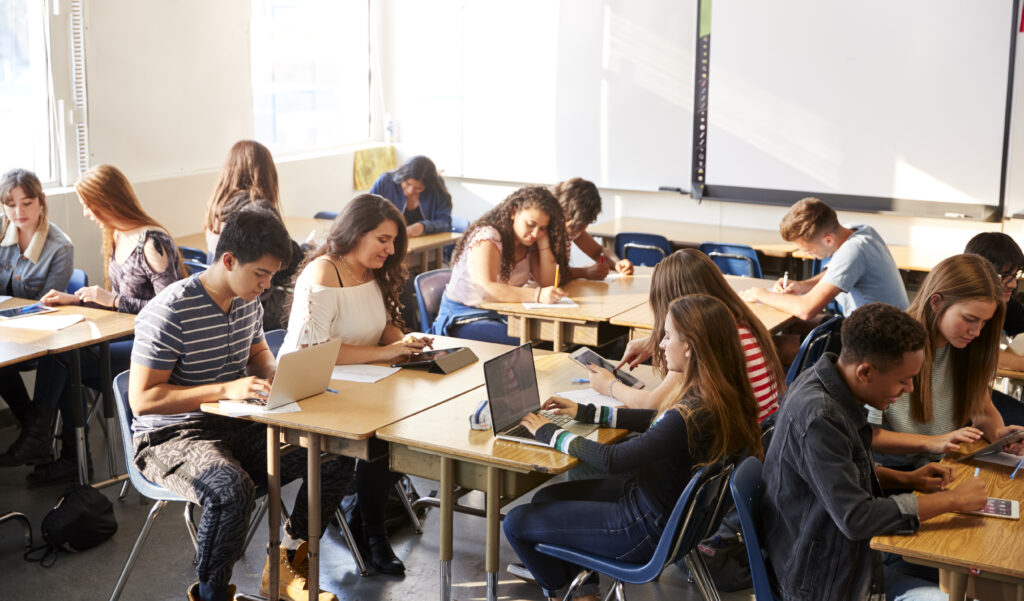
How to Create the Conditions for Real Collaboration
Real collaboration in the classroom does not appear automatically when groups are formed. It appears when the task structure makes it necessary. Three moves help.
Design tasks that require genuine interdependence. Instead of asking groups to “write a report on water quality,” assign each student a different lens: one researches environmental data, one researches community impact, one researches local policy, one researches solutions tried in another country. The group’s final product can only exist if all four perspectives are present. No student can do it alone, and no piece of the work is identical to another.
Give students collaboration roles, not just functional ones. Functional roles (researcher, editor, presenter) are useful. Collaboration roles go one level further: the student who asks “What does someone else in this group think?” when the room goes quiet; the student who records moments of disagreement and how the group resolved them; the student who checks whether quieter voices have been heard before a decision is made. When collaboration itself has a role, students practice it deliberately rather than hoping it will emerge.
Include moments where students must change their minds. Tasks that have one right answer tend to produce convergence, not collaboration. Tasks that involve judgment — “Which solution would work in our school’s context? What would you give up to make it happen? How does this look different in another country?” — require students to argue, listen, and update their thinking. The updating is the core of real collaboration in the classroom.
How C2C Projects Are Built Around Real Collaboration
The reason real collaboration in the classroom matters for Class2Class is practical: international collaboration does not work well if students have not yet learned to think together inside their own classroom first.
C2C projects are designed with this sequence in mind. The Collaboration & Teamwork competency develops in two connected layers. The first is internal — how students in your own classroom distribute roles, make decisions, and build shared products during the Execution phase. The second is external — how your class communicates and creates with a partner class in another country. The internal layer comes first, and it is not a warm-up. It is the foundation.
When your students run a Working in Class activity together — researching a question, designing a response, preparing something to share with a partner classroom — they are practicing exactly the thinking skills they will need with peers in Colombia, Morocco, or Indonesia. The four project phases (Definition, Execution, Reflection, Dissemination) ensure that collaborative work is not just one moment in the project; it is the structure the project moves through.
In the C2C article International Collaborative Learning: 3 Amazing Moves , teachers who ran more than one C2C project described the same progression: the skills students built internally in the first project — listening, updating their ideas, distributing responsibility — became visible in the international collaboration on the second. The internal and international layers reinforce each other.
What This Means for You This Week
Real collaboration in the classroom is a skill, not a personality trait. It is something students can get better at — but only when the task is designed to require it.
The difference between genuine collaboration and parallel group work is not about how hard students try. It is about interdependence. When students need each other to think, they collaborate. When they only need each other to compile, they work in parallel. The task design is what determines which one happens.
C2C projects are built to close this gap. When real collaboration in the classroom is already working, the international connection builds on a solid foundation. Start inside your classroom first — the international exchange will be stronger for it.