
Active Learning Methods: 8 Classroom-Tested Approaches for K-12 Teachers
- April 29, 2026
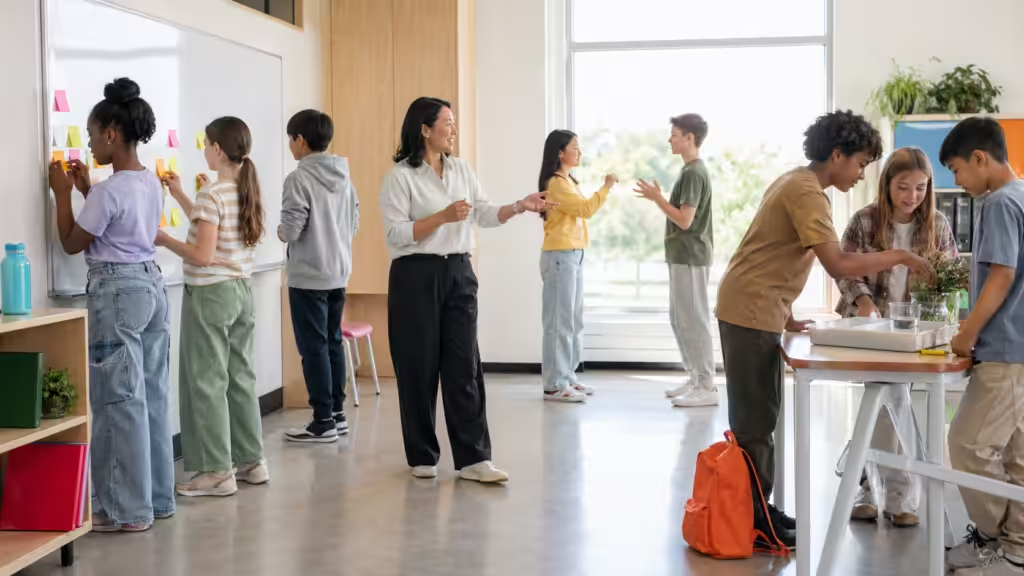
You know the scene: twenty minutes into your lecture, and half the class has mentally checked out. Eyes glazed. Pencils still. Maybe a few students furiously taking notes, but most just waiting for the bell.
Active learning methods flip this script entirely. Instead of students passively receiving information, they engage directly with concepts through discussion, problem-solving, collaboration, and creation. The shift isn’t just about keeping students awake—it’s about deepening understanding and retention in ways traditional instruction simply can’t match.
What Makes Active Learning Different
Active learning puts students in the driver’s seat of their education. Rather than absorbing information through lectures or reading, students process material through activities that require higher-order thinking.
The difference shows up in simple ways. In a traditional lesson, you might explain photosynthesis while students listen. In an active learning classroom, students might conduct experiments comparing plant growth in different light conditions, then present findings to peers.
This approach works because it mirrors how humans naturally learn. We remember 10% of what we read, 20% of what we hear, but 75% of what we practice and 90% of what we teach others. Active learning methods tap into these higher retention pathways.
Think-Pair-Share: The Gateway Active Learning Method
Think-Pair-Share is perhaps the most accessible entry point into active learning. You pose a question, give students time to think individually, pair them with a partner to discuss, then facilitate whole-class sharing.
A fourth-grade teacher in Chicago uses this when introducing fractions. She asks: “If you have a pizza cut into 8 slices and eat 3, what fraction is left?” Students think for 30 seconds, discuss with a partner for two minutes, then share reasoning with the class. The individual thinking time ensures every student engages before peer discussion begins.
Pros: Low barrier to entry, works across subjects and grade levels, increases participation from quieter students, takes minimal prep time.
Cons: Can feel repetitive if overused, requires clear time boundaries or discussions drift, some students dominate partnerships without careful pairing.
Implementation tip: Assign partners strategically rather than letting students choose. Mix ability levels thoughtfully, and rotate partnerships every two weeks to build classroom community.
Jigsaw Method: Building Interdependence
The Jigsaw method divides content into segments, with different students becoming “experts” on different pieces before teaching their section to classmates. This creates productive interdependence—everyone needs everyone else to complete the learning puzzle.
An eighth-grade history teacher teaching the American Revolution divides students into five groups. Each group studies one cause of the revolution: taxation, representation, Boston Massacre, Intolerable Acts, or colonial grievances. After becoming experts, students regroup so each new team has one expert from each topic. These mixed groups then create timelines showing how all causes interconnected.
Pros: Develops teaching skills alongside content mastery, creates accountability, works well for text-heavy content, reduces teacher talk time dramatically.
Cons: Requires careful planning and clear materials, struggling readers may not master their section well enough to teach it, takes significant class time for complex topics.
Implementation tip: Provide expert groups with guiding questions and key vocabulary before they study independently. Check in with each expert group before reassembly to ensure accurate understanding.
Problem-Based Learning: Real Challenges, Real Solutions
Problem-Based Learning (PBL) presents students with authentic problems before teaching the content needed to solve them. Students identify what they need to learn, research solutions, and apply knowledge to address the original challenge.
A fifth-grade class in Portland tackled urban heat islands. The teacher presented data showing their schoolyard was 15 degrees hotter than nearby parks. Students needed to research heat absorption, vegetation benefits, and urban planning to propose solutions. They learned about albedo, evapotranspiration, and city infrastructure—but only after the problem made this knowledge necessary.
This connects directly to project-based learning in real classrooms , where extended investigations drive deeper understanding.
Pros: Highly engaging, develops research and critical thinking skills, shows real-world application of academic content, students remember solutions they discovered themselves.
Cons: Time-intensive, requires comfort with less structured learning, difficult to predict exactly what students will explore, may not cover all standards efficiently.
Implementation tip: Start with a one-week PBL unit rather than multi-week projects. Choose problems with clear parameters but multiple valid solutions to balance openness with structure.
Gallery Walk: Making Thinking Visible
Gallery walks transform classrooms into interactive museums. Students create posters, displays, or presentations, then rotate through the room examining peers’ work and leaving feedback.
A seventh-grade science teacher assigns each group a different renewable energy source. Groups create posters explaining their energy type, its benefits and limitations, and where it works best. During the gallery walk, students place sticky notes with questions or connections on each poster. The creating groups later respond to these questions, deepening everyone’s understanding.
Pros: Gets students moving physically, provides multiple exposures to content, creates artifacts for future reference, allows different learning styles to shine.
Cons: Requires wall space or display areas, can become chaotic without clear protocols, some students rush through without deep engagement.
Implementation tip: Give students specific tasks at each station—a question to answer, a connection to draw, or a critique to offer. Use a timer to keep rotations moving but ensure adequate processing time.
Socratic Seminar: Structured Deep Discussion
Socratic seminars create structured space for student-led discussion of complex texts or questions. The teacher poses an opening question, then students build on each other’s ideas with minimal teacher intervention.
A high school English teacher uses Socratic seminars for literature analysis. Before discussing “The Great Gatsby,” students prepare by annotating key passages and writing three discussion questions. During the seminar, students sit in circles, responding to each other rather than raising hands for teacher permission. The teacher tracks participation and takes notes but doesn’t direct the conversation.
Pros: Develops speaking and listening skills, encourages evidence-based arguments, distributes authority from teacher to students, reveals student thinking clearly.
Cons: Requires extensive preparation and ground rules, can be dominated by confident speakers, feels risky for teachers used to controlling discussion flow.
Implementation tip: Start with inner/outer circle structures where half the class discusses while the other half observes and takes notes. This reduces pressure and provides entry points for less confident speakers.
Station Rotation: Self-Paced Skill Building
Station rotation divides the classroom into learning zones, each focused on different skills or content aspects. Students rotate through stations in small groups, working at their own pace within each stop.
A third-grade math teacher creates four stations for multiplication practice: one with manipulatives for building arrays, one with word problems, one with digital games, and one where she provides targeted small-group instruction. Students spend 15 minutes at each station, cycling through all four over two days.
Pros: Allows differentiation within the same lesson, breaks content into manageable chunks, provides variety that maintains engagement, creates opportunities for small-group teacher instruction.
Cons: Requires significant setup and materials preparation, classroom management becomes more complex, noise levels can escalate without clear expectations.
Implementation tip: Create self-checking answer keys or success criteria at each station so students can assess their work without waiting for teacher feedback. Establish transition signals everyone recognizes.
Peer Teaching: Learning by Explaining
Peer teaching asks students to explain concepts to classmates, leveraging the principle that teaching deepens understanding. This differs from Jigsaw because the entire class learns the same content, but students take turns being the instructor.
A sixth-grade science teacher assigns each student a different vocabulary term from the cells unit. Students create three-minute lessons including a definition, visual representation, and real-world example. Over a week, five students teach daily, with classmates taking notes and asking questions.
These approaches become even more powerful when students can engage through meaningful global collaborations , teaching peers from different cultural contexts.
Pros: Forces deep content mastery from student teachers, builds presentation skills and confidence, often more engaging when peers explain rather than adults.
Cons: Can spread misinformation if student teachers misunderstand content, creates anxiety for students uncomfortable with public speaking, inconsistent teaching quality.
Implementation tip: Review student lesson plans before they teach and provide feedback. Keep teaching segments short (3-5 minutes) to maintain focus and reduce pressure on student teachers.
International Collaboration: Active Learning Across Borders
Connecting classrooms across countries creates authentic active learning opportunities that traditional methods can’t replicate. Students collaborate with peers from different cultures on shared projects, making learning immediately relevant and globally minded.
A middle school class in Mumbai partners with a classroom in São Paulo to study water conservation. Students compare water usage patterns, climate challenges, and conservation strategies in both cities. They create joint presentations showing what each location can learn from the other, presenting findings via video conference.
This approach combines multiple active learning methods— project-based learning with international collaboration , peer teaching across cultures, and problem-solving with global perspectives.
Pros: Develops cultural competence alongside content knowledge, provides authentic audience for student work, builds communication skills across difference, makes learning purpose-driven.
Cons: Requires coordination across time zones, needs technology access and reliable internet, cultural or language differences may create communication challenges.
Implementation tip: Start with asynchronous exchanges using video messages or shared documents before attempting live video calls. This reduces scheduling pressure and gives students time to craft thoughtful responses.
Teachers interested in this approach can explore how active learning and international collaboration work together to create transformative educational experiences.
Combining Methods for Maximum Impact
The most effective active learning classrooms don’t rely on a single method but combine approaches strategically. A single lesson might include Think-Pair-Share for initial engagement, station rotation for skill practice, and peer teaching for synthesis.
A high school geography teacher structures a unit on climate change using multiple methods. She opens with Socratic seminar discussing climate data. Students then rotate through stations examining regional impacts. Groups use problem-based learning to develop mitigation strategies for different countries. The unit culminates in gallery walks where students present solutions and offer peer feedback.
This variety serves students with different learning preferences while building diverse skills. Some students shine in discussion-based seminars. Others excel at hands-on problem-solving. Mixing methods ensures everyone has entry points to demonstrate understanding.
The key is intentional selection. Each method should serve a specific learning goal rather than just adding variety for its own sake. Ask yourself: What do students need to understand or do? Which active learning method best develops that capacity?
Managing the Transition to Active Learning
Shifting from traditional instruction to active learning methods can feel overwhelming. Students accustomed to passive learning may initially resist taking more responsibility for their education.
Start small. If you currently lecture for entire periods, try inserting a single Think-Pair-Share into next week’s lessons. Once that feels comfortable, add a gallery walk. Build your active learning toolkit gradually rather than overhauling everything simultaneously.
Explicitly teach collaboration skills. Students don’t automatically know how to give constructive peer feedback or share talk time equitably. Model these skills, provide sentence frames for academic discussion, and reflect regularly on collaboration quality.
Expect productive struggle. When students encounter challenging problems or disagree during discussion, that’s not a sign you should intervene immediately. Learning happens in those moments of cognitive conflict. Your role shifts from information provider to facilitator who asks questions that extend thinking.
These methods also support broader student engagement strategies that create purpose in classroom learning.
Assessment in Active Learning Classrooms
Active learning methods require rethinking assessment beyond traditional tests and quizzes. When students learn through collaboration and creation, assessment should reflect those processes.
Use formative assessment continuously. During Think-Pair-Share, listen to partner conversations to identify misconceptions. In gallery walks, student questions and feedback reveal understanding gaps. Jigsaw activities make knowledge gaps visible quickly—if students can’t teach their section clearly, they need more support.
Consider performance-based assessments where students demonstrate learning through application rather than recall. After a problem-based learning unit on ecosystems, students might design a sustainable garden for the school rather than taking a multiple-choice test.
Incorporate self and peer assessment. Provide rubrics for group work and ask students to evaluate both their contributions and teammates’ efforts. This develops metacognitive skills and creates accountability beyond teacher grading.
How Class2Class Supports Active Learning Methods
Class2Class provides the infrastructure for teachers to implement active learning through global collaboration. The platform connects K-12 classrooms worldwide, making international peer teaching, collaborative problem-solving, and cross-cultural projects accessible for any teacher. Teachers can find partner classrooms matched by subject, grade level, and learning goals, then use built-in tools for student collaboration across borders—transforming active learning from a classroom activity into a global experience.
Getting Started with Active Learning Methods
- Choose one method to pilot this month. Select the active learning approach that feels most accessible given your subject, grade level, and comfort zone. Try Think-Pair-Share if you want low risk, or station rotation if you have hands-on materials ready.
- Prepare students with clear expectations. Before implementing any new method, explain the purpose, model the process, and establish behavioral norms. Create anchor charts showing discussion sentence frames or collaboration expectations.
- Start with a low-stakes lesson. Don’t debut active learning during your most critical content unit. Choose a lesson where student exploration and occasional confusion won’t derail learning objectives.
- Debrief the experience with students. After trying an active learning method, ask students what helped their learning and what felt challenging. Use their feedback to refine your approach before the next implementation.
- Connect with teachers using similar methods. Join the Class2Class community to find educators implementing active learning globally. Partner classrooms can share strategies, co-design projects, and support each other through the transition from traditional instruction.
Moving Forward
Active learning methods transform classrooms from places where knowledge is transmitted into spaces where understanding is constructed. These eight approaches—from the accessible Think-Pair-Share to the transformative power of international collaboration—give you practical starting points for that transformation.
The shift won’t happen overnight. You’ll have lessons that feel chaotic, discussions that don’t go as planned, and projects that take twice as long as expected. But you’ll also see moments of insight that lecture never produced, engagement from students who previously seemed unreachable, and learning that sticks because students constructed it themselves.
Start where you are. Choose one method. Try it next week. Then build from there, creating the active learning classroom your students deserve.
Ready to bring this into your classroom? Class2Class connects K-12 teachers in 144 countries — free to use, free to match with a partner classroom, free to launch your first international project.