

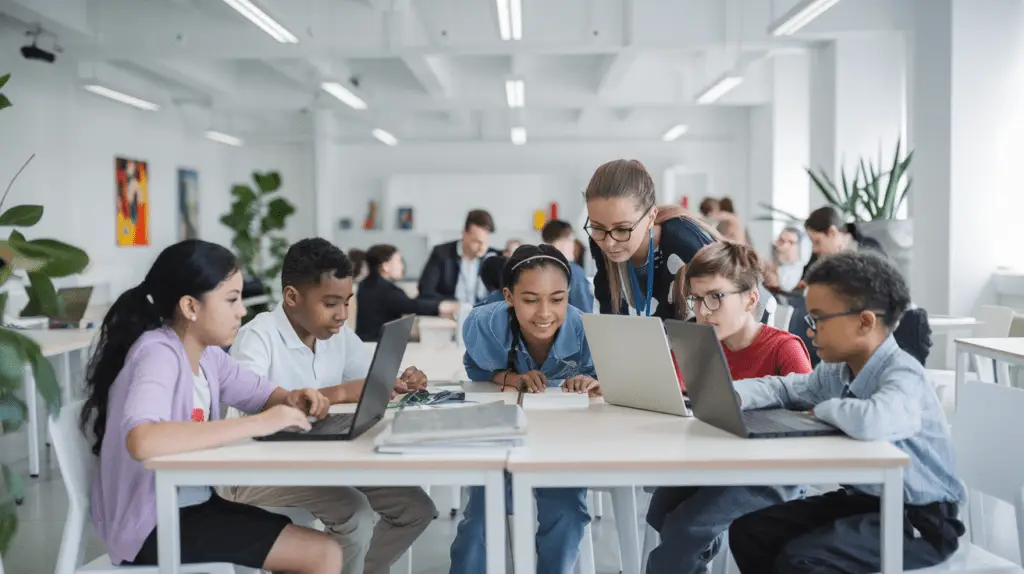
The Sustainable Development Goals are not abstract policy — they are a framework for the kind of learning students remember. When a middle school class in Ohio simulates unequal food distribution to explore SDG 2 (Zero Hunger), or a group of tenth graders in the Philippines designs an anti-plastic campaign tied to SDG 15 (Life on Land), the curriculum stops being something students receive and becomes something they do. The classroom application of SDGs gives teachers a globally recognized structure for making lessons feel urgent, relevant, and connected to the real world — and the evidence shows it works.
Adopted in 2015 as part of the United Nations’ 2030 Agenda, the 17 Sustainable Development Goals cover everything from poverty and hunger to climate action, quality education, and global partnerships. Education is not just one of those goals (SDG 4: Quality Education) — it is the vehicle for achieving all of them. SDG 4, Target 4.7 specifically calls for all learners to acquire the knowledge, skills, and values needed for sustainable development.
For teachers, that means the classroom application of SDGs is not an extra — it is part of what quality education is defined as under the UN framework. And the momentum is building fast: a 2023 survey found that three-quarters of countries plan to revise their curricula for sustainability in the next three years.
Key takeaway
The SDGs give teachers a ready-made framework that turns any subject into an opportunity for critical thinking, collaboration, and real-world problem-solving. The most powerful classroom application of SDGs happens when students stop studying global challenges in isolation and start working on them with peers across borders.
Why the Classroom Application of SDGs Matters
The case for classroom application of SDGs is not just philosophical — it is empirical. The OECD’s PISA 2018 assessment, which measured global competence across 600,000 students in 79 countries, found that almost half of all learners failed to demonstrate minimum global competence — the awareness, knowledge, and action-readiness needed to engage with sustainability challenges.
But the data also revealed a clear pattern: students who participated in more learning activities related to global issues showed consistently higher awareness, agency, and self-efficacy, even after controlling for socioeconomic background. This is strong evidence that the classroom application of SDGs produces real, measurable results.
That finding matters enormously for classroom practice. It means the teacher’s decision to embed SDG content into existing lessons has a measurable effect on how students think and act. UNESCO’s Education for Sustainable Development (ESD) for 2030 framework builds on this evidence, positioning the classroom application of SDGs as a critical mechanism for building the knowledge, skills, values, and attitudes young people need for a more just world. The 161 countries that adopted the Berlin Declaration on ESD in 2021 signaled that this is no longer optional — it is the direction education is moving globally.
Four Practical Strategies for Classroom Application of SDGs
You do not need to overhaul your curriculum to bring the SDGs into your classroom. The most effective approaches build on what you are already teaching. Here are four strategies that work across subjects and grade levels.
1. Extend What You Already Teach
The simplest entry point for any classroom application of SDGs is mapping the 17 Goals to topics already in your curriculum. Edutopia recommends doing this as a whole-staff exercise. A K–2 science unit on nutrition and hygiene extends naturally to SDG 3 (Good Health and Well-Being) when students explore why access to clean water and soap varies around the world.
A middle school math class can use real UN data — 272 million children out of school globally — to build data literacy while grounding statistics in human reality. This kind of classroom application of SDGs does not require new content. They reframe existing content through a lens that makes it matter more.
2. Use Project-Based Learning as the Engine
Project-Based Learning is one of the most powerful methods for classroom application of SDGs. Students choose a relevant goal, define learning objectives, tackle authentic tasks that mirror real-world challenges, collaborate in teams, and present their work to an audience beyond the classroom.
A 2025 study in the Journal of Lifestyle and SDGs Review found that PBL combined with STEM integration significantly improved critical thinking skills among junior high school students — the exact competencies SDG 4 (Quality Education) calls for. When a fourth-grade class codes robots to simulate animal habitat navigation for SDG 15 (Life on Land), they are not just learning to code — they are learning to think systemically about conservation.
3. Go Cross-Curricular
The most effective schools do not treat SDGs as a single subject — they embed them everywhere. English language arts classes use texts that connect to poverty, environment, and justice. A 2024 Frontiers in Education study found that integrating SDGs into English classes at a Philippine lab school produced measurable gains in critical thinking, problem-solving, and action competence — students went home and started segregating trash, advising parents on conservation, and advocating for SDG integration across all school subjects.
This cross-curricular classroom application of SDGs extends naturally to every discipline. Science classes connect directly to climate action (SDG 13), water systems (SDG 6), and biodiversity (SDG 15). Social studies classes investigate policy solutions through an SDG lens. Art and drama classes use simulation and creative expression to build empathy for global challenges. The SDGs become a shared language across the entire school.
4. Connect Classrooms Across Borders
SDG 17 — Partnerships for the Goals — is the connective tissue of the entire framework. When students in Brazil and Denmark work on SDG 7 (Clean Energy) together, they compare how energy is produced in their communities, discuss what “sustainability” means in different contexts, and build solutions informed by multiple realities.
This is PBL at its most powerful — and it is why networks like iEARN (30,000+ schools in 140+ countries) and Class2Class (1,700+ teachers from 113 countries) exist. Global collaboration turns the classroom application of SDGs from a solo exercise into a lived intercultural experience. For a deeper look at why this matters, see our teacher’s guide to the SDGs.
What Happens When Students Learn Through the SDGs
The evidence base for SDG-based learning is growing — and the findings are consistent. The OECD PISA 2018 data shows that across all countries, the number of sustainability-related learning activities a student participates in is positively associated with their attitudes, dispositions, and willingness to act — a relationship that holds even after accounting for socioeconomic background. A mixed-studies review of 56 studies on ESD-related learning found that every single study reported positive civic outcomes, with 19 documenting community-level civic action.
At the classroom level, the Frontiers in Education study from the Philippines documented a shift from passive to active learning: students who engaged with SDGs in their English classes developed critical thinking, initiative, and a sense of personal accountability for global issues. They stopped seeing sustainability as someone else’s problem. A longitudinal study on civic education spanning four years reinforced the finding that interdisciplinary, experiential learning — the hallmarks of SDG-based teaching — enhances students’ civic competence, including the knowledge, skills, and values for real-world participation.
The pattern is clear: a sustained classroom application of SDGs helps students develop competencies that matter far beyond the school walls — 21st-century skills like critical thinking, collaboration, and global awareness.
Common Challenges and How to Solve Them
Any classroom application of SDGs is not without friction. A 2025 comparative study in Frontiers in Education (Khademi & Budke) interviewing 30 geography teachers in Germany and Iran identified challenges that will sound familiar to teachers everywhere. Here are the three most common — and what works.
Curriculum rigidity and time pressure. Packed schedules and high-stakes testing leave little room for “extras.” The solution: do not add SDGs on top of your curriculum — embed them within it. Map goals to units you are already teaching and to school calendar events like Earth Day or World Water Day. A sustainability lesson is not an interruption to your science unit on ecosystems — it is the science unit on ecosystems.
Teacher knowledge gaps. Many educators lack confidence in their own SDG understanding. UNESCO reports that only one-third of teachers feel able to explain regional climate effects. The fix starts with accessible professional development — and with peer networks. Organizations like UNESCO’s ESD-Net 2030, iEARN, and Class2Class provide communities of practice that support the classroom application of SDGs by helping teachers learn from each other, not just from experts.
Making it feel real for students. Global goals can feel distant from daily student reality. The most effective teachers start with SDGs closest to students’ lived experiences — health and well-being for younger learners, inequality and justice for older ones — and use participatory methods: simulations, role play, community investigations. When students can do something with what they learn, motivation follows.
How Global Collaboration Makes SDG Learning Real
There is a difference between learning about global challenges and learning through them. The classroom application of SDGs reaches its full potential when students collaborate with peers in other countries — comparing realities, challenging assumptions, and building solutions together. This is where platforms like Class2Class fit in.
Class2Class is built around three project approaches — Connect, Collaborate, and Create — each grounded in established pedagogical frameworks. A Connect project (1–2 hours) is an intercultural exchange where two classes share their contexts around an SDG theme — an ideal starting point for teachers new to global work.
A Collaborate project (4–8 hours) uses Project-Based Learning to tackle a shared SDG challenge, with students researching, exchanging findings, and co-creating outputs. A Create project (10+ hours) follows a full Design Thinking process — empathize, define, ideate, prototype, test — where partner classes identify a real problem together and build a solution.
Behind these approaches are the methodologies that make them work: COIL (Collaborative Online International Learning), PBL, and Design Thinking. Teachers design the project and facilitate the collaboration. Students drive the inquiry. The result is SDG learning that is not theoretical but lived — grounded in real partnerships with real classrooms in other parts of the world. When a class in Kenya and a class in Canada investigate SDG 6 (Clean Water) together, they are not doing an assignment. They are doing the work the SDGs were designed to inspire.
Start Your First SDG Classroom Project
The classroom application of SDGs does not require a new curriculum, a special budget, or permission from a committee. It requires a teacher who decides that today’s lesson will connect to something larger than the textbook — and a structure that makes that connection real.
Whether you start by mapping one SDG to a unit you are already teaching, by running a simulation that makes inequality visible, or by connecting your students with a partner class on the other side of the world, the classroom application of SDGs begins with a single decision — and that first step is the one that matters most.
Class2Class gives you the partner teachers, the project structure, and the global community to turn SDG learning into a lived experience for your students. It is free, it is teacher-led, and it starts whenever you are ready.
Related Resources
- Sustainable Development Goals: A Teacher’s Guide — A comprehensive overview of the 17 SDGs and how they connect to classroom practice.
- Environmental Learning and Global Education — How environmental themes become cross-cultural learning opportunities through global collaboration.
- Classrooms Around the World — What classrooms actually look like across countries, and why that diversity is a teaching resource.
- Connecting Classrooms for Global Learning — A guide to building international classroom partnerships for meaningful student outcomes.
- 21st Century Skills in Global Classroom Projects — The competencies students develop through structured international collaboration.