
Picture this classroom moment. Your students find a real problem — too much plastic in the school yard, not enough shade, water wasted at the fountains. They care about it. Then they get stuck, because caring is not the same as knowing what to do next. Design thinking in education exists for exactly that gap. It gives students a clear, repeatable path from “this matters to us” to “here is our solution.” In this article, you will learn what design thinking is, why it works, and how Class2Class applies it to projects where classrooms in different countries design answers to real problems together.
What Is Design Thinking in Education?
Design thinking is a human-centered way of solving problems. Human-centered means the process starts with people — their needs, their experiences, their context — and not with the answer the designer already had in mind. It was born in the design world, but teachers everywhere now use it because it turns big, messy problems into steps a class can actually follow.
Researcher Stefanie Panke, in an open-access review published in Open Education Studies, describes design thinking in education as both a process and a mindset for working on complex, real-world problems together. The process is a sequence of five phases: Empathize, Define, Ideate, Prototype, and Test. The mindset is just as important: empathy before answers, ideas before judgment, and trying before perfecting.
Here is what each of the five phases asks of your students:
- Empathize — start with the people who live the problem. Your students observe, ask questions, and really listen. Very often, they discover the problem is not what they first assumed — and that surprise is already learning.
- Define — put the real problem into words. One clear sentence the whole team agrees on. This step looks small, but it saves the project later, when ideas start pulling in different directions.
- Ideate — open the floor to every idea, even the strange ones. At this stage, quantity beats quality. The student who says something “silly” today may be pointing at tomorrow’s solution.
- Prototype — build a simple first version: a drawing, a model, a poster, a plan. It does not need to be pretty. It needs to exist, so the team has something real to react to.
- Test — share the prototype, ask what works and what does not, and improve it. Here, feedback stops feeling like a grade and starts feeling like help.
Here is an illustrative example of how the phases feel in practice. Imagine a class that chooses the school fountain problem. In Empathize, students interview classmates about how they use water. In Define, they agree on one sentence: “Our school wastes water because nobody sees how much is lost.” In Ideate, they fill the board with ideas — posters, a water monitor role, a collection system for the garden. In Prototype, they build the simplest version of the best idea. In Test, they show it to another class and ask: would this change what you do? Every phase is concrete. Every phase fits in a normal lesson.
Notice what this structure does for students. It protects the quiet student in the Empathize phase, because listening is the task. It protects the wild idea in the Ideate phase, because judging comes later. And it lowers the fear of failure in the Prototype phase, because a first version is supposed to be imperfect. This is why design thinking in education connects so directly to the Creativity & Innovation competency — original thinking, iteration, and the generation of new solutions are not side effects here. They are the curriculum.
How Class2Class Builds Design Thinking into Global Projects
Class2Class is a free platform that connects classrooms across more than 140 countries. Every project on the platform follows one of three paths. In some projects, students get to know a partner class and explore each other’s cultures. In others, they investigate global challenges through the UN Sustainable Development Goals. And in a third kind of project — the heart of this article — students go one step further: together with a partner class in another country, they design solutions to real problems. That is where design thinking comes in.
These solution-focused projects combine design thinking with two other methodologies. Project-based learning (PBL) — students learn by working on a real question and building something to share — is the foundation; a literature review by MDRC links this kind of learning to stronger engagement and deeper understanding. COIL — Collaborative Online International Learning, the practice of two classrooms in different countries working as one team online — is the axis that makes everything international. You can read more in the C2C guide to COIL. In short: PBL gives the project its shape, COIL makes it global, and design thinking guides how students create the solution.
A practical note on time, because time is the real currency of teaching. You do not design any of this from zero. The Project Definition Assistant helps you turn a classroom idea into a clear plan in about fifteen minutes, and you can edit anything it suggests. Ready-made project templates already include the activities for each phase. Your preparation work is choosing, adapting, and pacing — not inventing.
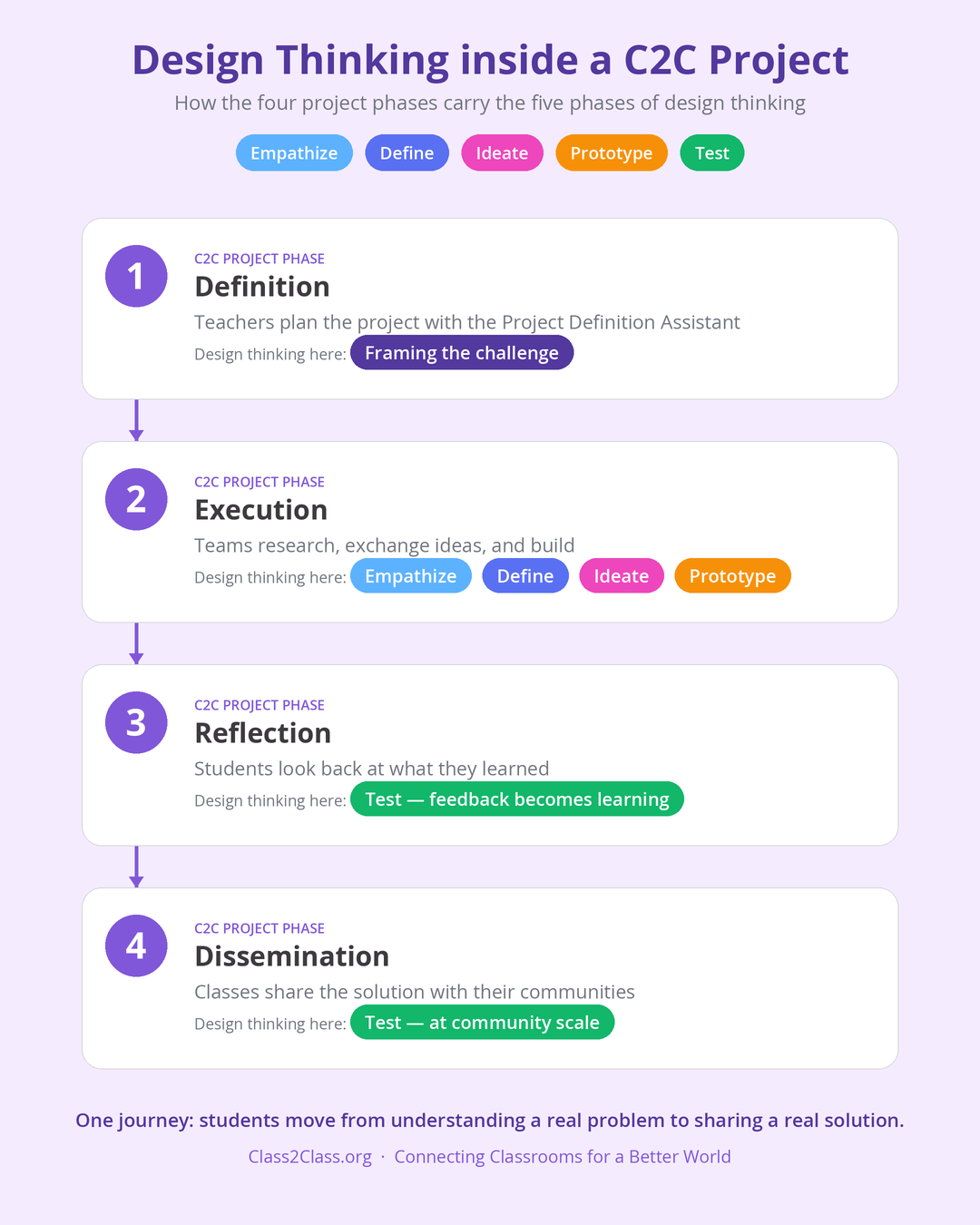
Every C2C project also moves through four phases: Definition, Execution, Reflection, and Dissemination. The design thinking phases fit naturally inside them:
The teacher stays in the facilitator role through all of this. The platform suggests structure; you decide what fits your students. That matters because design thinking only works when students do the thinking. The OECD’s Learning Compass 2030 calls this student agency — students setting goals and acting on them — and names it a central aim for education. A solution-focused project is student agency in practice: the ideas, the prototype, and the final pitch belong to the students.
Where to See Design Thinking in Education at Work
The easiest way to see design thinking in education at work is to open a real project. The public Discover Page gathers ready-made project ideas for classrooms of different ages and language levels — many of them built around designing solutions to problems students can see from their own window: water, waste, energy, the spaces where they learn. Each idea comes with objectives, suggested skills, and a session-by-session plan, and most run in about five to six class sessions.
The path is simple. You read a project idea, click “Create Project,” and adapt it to your classroom — your timeline, your language level, your goals. Once your project is public, another teacher can join, or you can invite a colleague you already know. Both classes then follow the steps together and share their work on a common board. When the project ends, you and your students receive certificates of completion.
Watch the competencies these projects exercise along the way. Students practice Critical Thinking & Problem-Solving when they decide which solution is most practical and impactful. They practice Collaboration & Teamwork when two classrooms with different languages agree on one idea. And they build Global Awareness when they discover that the same problem has a different shape in another country. None of this needs special equipment. Recycled materials, a shared board, and time to talk are enough.
One honest note: a first international project takes patience. Messages cross time zones. Ideas get lost in translation and found again. That friction is not a bug — working through it is where much of the learning happens, as UNESCO argues in Reimagining our futures together, its case for cooperation as the heart of education.
A Path, Not Extra Work
Design thinking in education is not one more thing on your plate. It is a structure for work your students already want to do: noticing real problems and trying to fix them. On Class2Class, that structure comes ready inside the project ideas on the Discover page — the phases, the activities, and a partner class to build with. You do not need to be an expert in design thinking to start. The project template carries the method; you bring your students and their questions. Many teachers begin with one short project, see what their class can do, and grow from there.
Referencias
Internal links
- Class2Class — Educational Framework
- Class2Class — Guide to COIL (Collaborative Online International Learning)
- Class2Class — Discover page (public project ideas)
- Class2Class — Free sign-up
Academic references
- Panke, S. (2019). Design Thinking in Education: Perspectives, Opportunities and Challenges. Open Education Studies
- OECD (2019). Learning Compass 2030
- Condliffe, B. et al. (2017). Project-Based Learning: A Literature Review. MDRC
- UNESCO (2021). Reimagining Our Futures Together: A New Social Contract for Education