
What is Equity?
Equity asks a distributional question. Not “does this work” but for whom does it work, and at whose expense. A product can improve outcomes on average while making things worse for the students who were already furthest behind, and an average will never reveal it.
This evaluates whether the product design benefits all students equally or if it unintentionally widens existing gaps. ICEI 5E Standards & Definitions
ICEI sets three bars, and they escalate. Inclusive design means building for at least two distinct learner groups and showing awareness of bias. Active bias mitigation means evidence of steps taken to reduce algorithmic or content bias, evidence of action rather than stated awareness. Equitable implementation means actively creating the conditions for underserved groups to take part, which is a stronger obligation than simply not excluding them.
These are the commitments the rest of this page is built on. Each one is a property of how evaluation works, not a policy a teacher has to apply.
-
Projects are never compared
Each project is its own evaluation unit, which removes the ranking that would otherwise punish an under-resourced classroom.
-
Confidence, not a grade
Report confidence is stated per participation mode, so a lighter-evidence project reads as more cautious rather than worse.
-
Offline and teacher-only modes
Defined in the model for classrooms that cannot rely on a live connection. Defined, not yet built.
-
Multilingual by default
English fluency is not the price of admission, and instructions are written to travel.
-
Group level only
No individual student is profiled, scored, or tracked over time. Age is calibrated from the first step.
Why it matters
For a platform built on international classroom collaboration, this is the most likely way for us to fail while appearing to succeed. ICEI put the risk in writing in their review of the literature on Collaborative Online International Learning.
sensitive to power asymmetries between partner classrooms, language proficiency differences, and unequal resource access, factors that can reproduce inequities rather than ameliorate them ICEI, on the COIL literature, Evidence Ready report (January 2026)
Read plainly: put a well-resourced classroom and an under-resourced one into the same project, evaluate them with the same instrument, and the design will make the second look like the weaker partner. That is not a measurement of learning. It is a measurement of circumstances, and treating it as the first is the specific harm this dimension exists to prevent.
How we work on Equity
Most of our Equity work sits in the evaluation design, because that is where the harm above would actually occur.
Never reading a simpler classroom as a weaker one
- Report confidence is stated per participation mode, so a lighter-evidence project produces a more cautious report rather than a worse-looking one.
- Projects are never compared against each other. Each is its own evaluation unit, which structurally removes the ranking that would punish under-resourced classrooms.
Lowering the barrier to entry
- Offline and teacher-only modes are defined in the model for classrooms without a reliable live connection.
- Multilingual support, so English fluency is not the price of admission.
- Teacher-gatekeeping rather than student self-registration, which keeps participation possible for schools with strict device and account policies.
Mitigating bias where we can see it
- Age calibration from the first step, so a younger group is not read against an older group’s expectations.
- Group-level analysis only. No individual student is profiled, scored, or tracked over time.
Equity from different perspectives
The same commitments land differently depending on where you sit. Here is what they mean for each group.
A lighter project is not a lesser one
Most of these commitments exist so your classroom is never penalised for its circumstances.
- Your project is never ranked against another school’s. There is no leaderboard to lose.
- Ask for extra time, a different format, translation help, or assistive technology for a student who needs it.
- Work in your own language. Keep instructions plain and avoid idioms, which do not travel.
- Schedule around religious practice, holidays, and school calendars on both sides.
- Your students join through you, so a school with strict device or account policies can still take part.
What you bring is enough
You are not being measured against the class on the other side.
- Your project is looked at on its own. It is never scored against another school’s project.
- You are never scored individually, and nothing about you is tracked from one project to the next.
- You can take part in your own language. Writing in a second or third language is expected, not a problem.
- A slower connection, a shared device, or a phone instead of a laptop should not stop you. Tell your teacher if it does.
- If you need more time, a different way to hand something in, or help from assistive technology, ask your teacher.
Design for the harder classroom
A project should be designed so that schools can participate regardless of their access to technology, funding, or other resources.
- Connectivity, device, and bandwidth differences are a design input, not an exception to handle later.
- Do not build an activity that assumes every student has their own device, or a live call that assumes matching school hours.
- Do not rank or compare partner classrooms in materials you produce. The evaluation does not, and neither should you.
- Plan for more than one language, and for instructions that survive translation.
- Students are reached through their teacher, never directly, which is also what keeps participation open to stricter schools.
Where this sits in the SDGs
Equity is the dimension where our work lines up most directly with three of the Sustainable Development Goals. A project that reaches an under-resourced classroom on fair terms is working on all three at once.
-
 Goal 4Quality Education
-
 Goal 5Gender Equality
-
 Goal 10Reduced Inequalities
Goal 4 is about equal access to a quality education, not just access to a school. That is what the multilingual support, the offline and teacher-only modes, and teacher-gatekeeping are for: the same learning experience should be open to a classroom without a translator, a reliable connection, or a device for every student.
Goal 10 is about reducing the gap between groups rather than raising an average. That is why projects are never compared against each other and why connectivity, device, and bandwidth differences are treated as a design input: a classroom with less should not come out looking like the weaker partner.
Goal 5 is about equality regardless of sex and gender. The commitment behind it sits in our Ethical Guidelines: every person is treated with dignity whatever their sex, gender identity, or sexual orientation, and nobody is asked to trade in stereotypes about genders any more than about countries. On this page, group-level analysis only is the mechanism that matters most, because no student is profiled or scored as an individual at all.
Class2Class projects are tagged to the Goals, so a classroom can connect its work to the same framework. Browse the SDG calendar to see what other classrooms are running, or read how to teach Goal 4 in a K-12 classroom.
Related resources
The published statements behind this page, and the practical guides that go with them.
Accessibility Statement
Our commitment, the regulatory framework, and a section on known limitations. A commitment with its gaps named, not a conformance claim.
 Teacher guide
Overcoming Language Challenges
Practical ways to run a collaboration when the two classrooms do not share a first language.
 Teacher guide
Breaking Time Zone Barriers
Four strategies for collaborating asynchronously, so matching school hours is not a requirement.
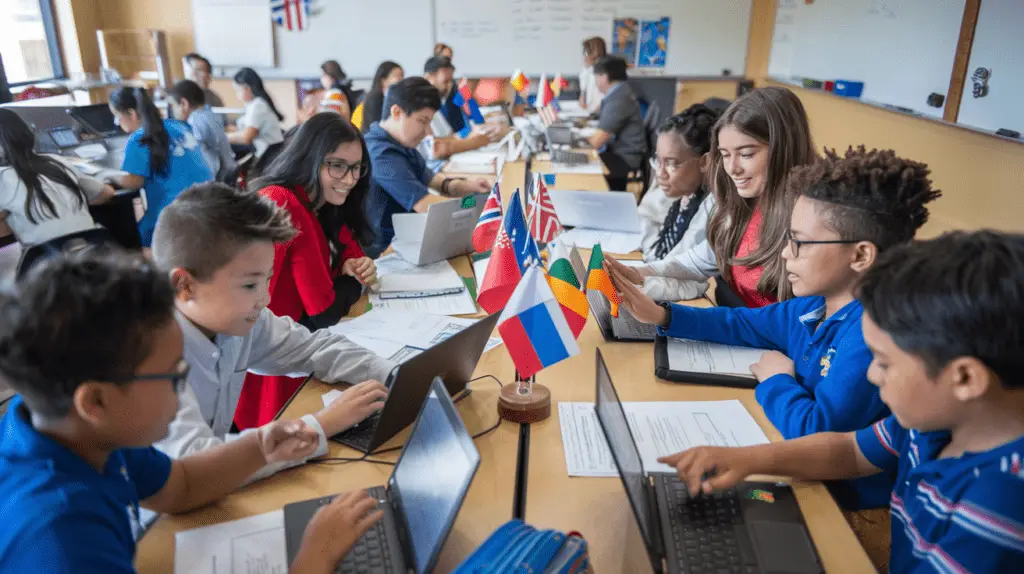 Article
Intercultural competence development
What intercultural competence involves, and how a collaboration can build it rather than assume it.
 Classroom story
Student-Led Inclusion Project
A school in Argentina where students led the work on reducing inequalities in their own community.
PolicyPrivacy & Accessibility
What data we hold, and the accessibility standards the platform is designed against.
Equity is one of five.
Each dimension catches a different way a well-meaning product can fail. They are read together, not in isolation.