

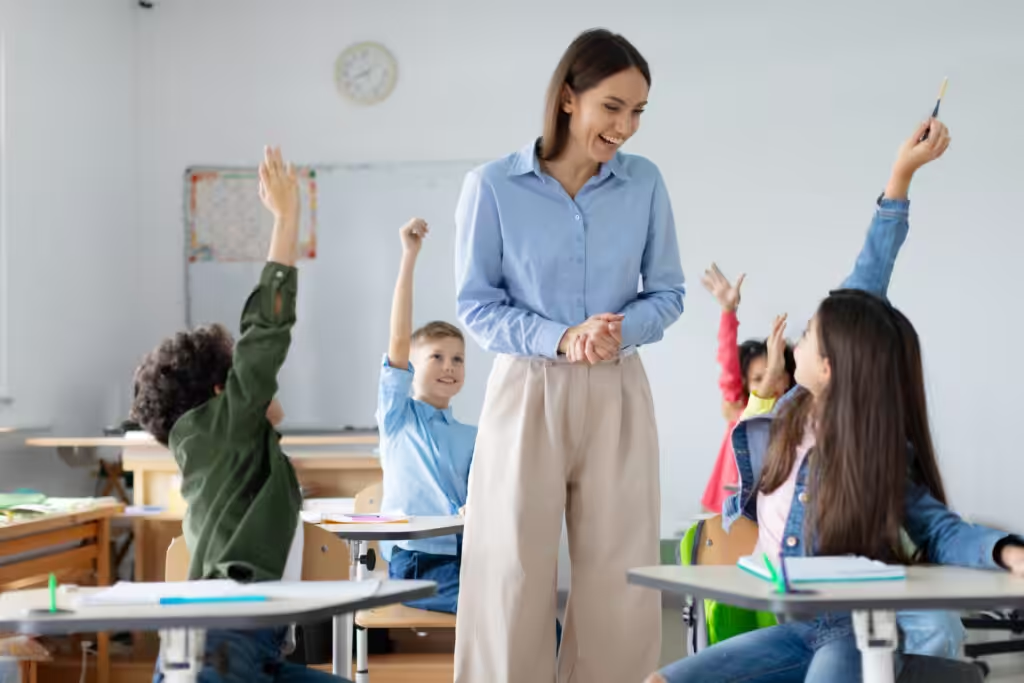
There’s a quiet question every new teacher eventually asks themselves, usually somewhere between the second and third month of the school year. You’ve planned the lessons. You’ve organized the unit. The students are doing the work — more or less. And still, something feels off. The class is busy, but it isn’t alive. If that sounds familiar, here’s a way to name what might be happening: the classroom is doing its job, but it’s doing it with the door closed — and what’s missing is a global perspective in education.
Imagine teaching kids to swim by only ever showing them photos of water. They’d memorize the shapes of waves. They could tell you what a pool looks like. They might even pass a written test. But the moment they actually had to swim, they wouldn’t know what to do — because nothing in the lesson had ever touched real water. A lot of classrooms work like that. The content is fine. The teacher is doing everything right. But the students are learning about the world without ever stepping into it. That gap is what a global perspective in education is meant to close.
This article is a small argument for opening the door — and for why doing so doesn’t require an extra degree, a tech budget, or a fluent second language. The team behind Class2Class.org has been working on this for years, connecting classrooms across more than 144 countries, and what they’ve learned is simple: the first step toward a global perspective in education is much smaller than it sounds.
Table of contents
What students lose when the classroom is disconnected
When a classroom has no contact with the world outside its own walls, three things tend to happen — and a new teacher will recognize all of them.
The first is that learning becomes something to memorize instead of something to do. Without a real reason to use what they’re studying, students treat content as material for a test. They study the chapter on water. They learn the chapter on culture. They forget the chapter the day after the exam. This is exactly the gap that project-based learning was designed to close: a well-designed PBL experience always includes a “real audience” — someone other than the teacher who will see and respond to the work. When the audience is only the gradebook, the work shrinks to fit the gradebook, and any global perspective in education the teacher hoped to bring stays on the syllabus rather than in the room.
The second is that “diversity” stays inside the textbook. Students read about other countries. They look at maps. They watch a video. But the people on the other side of those maps remain abstract — characters in a unit, not human beings their age with their own version of math homework and their own opinions about a problem they share. As the Class2Class guide to international collaborative learning points out, the same content (a lesson on water, a lesson on STEM, a lesson on what makes a school) lands very differently when students know peers in another country are working on it too. The lesson stops being a chapter and starts being a conversation.
The third is the hardest to name, but probably the most important: motivation drops because nothing the student does ever leaves the room. A drawing goes home in a backpack. An essay gets a grade and disappears. A presentation is given to thirty classmates who have already been told what to expect. Over time, students intuit that the work is mostly performance — something to be done, not something to be for. Bringing a global perspective in education back into the room reverses this signal. The work is now for someone. And that small shift changes everything that follows.
What a global perspective in education really means (it’s smaller than you think)
This is where most new teachers stop reading the brochure and put it away. A global perspective in education sounds like it belongs to schools with international programs and travel budgets — not to the teacher who has 28 students, a curriculum to cover, and parent-teacher conferences next Thursday.
Here’s a better way to think about it. Most classrooms already have a window to the world. There are videos. There are news clips. There are textbooks with photos. What most classrooms don’t have is a door — a way for students to actually walk through and meet someone on the other side. Adding a global perspective is just installing the door. It’s not bigger than that.
In practice, it shows up as three small shifts a new teacher can make without rebuilding their year.
A real audience. Instead of presenting a project only to the class, students present it to peers in another country. This is what happened in the Women in STEM project across Colombia, India and Ukraine, where three teachers connected their classrooms so their students could celebrate women in science across continents. The content of the lesson didn’t change. The audience did — and so did the seriousness with which students prepared.
Comparing contexts. Instead of studying “what other countries are like” from a book, students compare their own context with another classroom’s directly. The simplest possible version of this is the My School project that Teacher Gisel ran with classrooms in Argentina, India and Ukraine: each class prepared a short presentation about their country, their city, and their school, and then they met online to share. That is the entire project. It takes a couple of hours. It does more for intercultural understanding than a month of textbook reading.
A shared challenge. Instead of treating a topic as an abstract subject, students work on it alongside a real partner classroom that’s looking at the same problem from a different angle. When Teacher Jhansi Ravikumar connected her classroom in India with students in Malaysia and Myanmar for the Global Water Conservation Challenge, water stopped being a chapter and became a question shared across three countries. When students from ten countries debated whether rivers should be connected for irrigation, transport and flood control, the lesson on water resources turned into a real argument with real stakes.
Each of those three shifts is small. Together they’re what a global perspective in education actually looks like inside a normal classroom — and each of them maps to one of the United Nations Sustainable Development Goals, which is what the SDG Teacher’s Guide is for: helping a teacher pick a real-world theme that fits what they were already going to teach.
How a brand-new teacher takes the first step toward a global perspective in education
The good news for anyone reading this and feeling overwhelmed: nobody is asking you to redesign your school year. You replace one unit — or even one week — with a connected version of the same content.
Class2Class organizes every international collaboration project into four phases — Definition, Execution, Reflection, and Dissemination — supported by seven practical steps that walk a teacher through the whole thing. Think of it as a lesson plan template, but for a project that happens to include another classroom.
The team also distinguishes three project sizes. A Connect project takes one to two hours: two classes share their contexts on a topic, meet briefly online, and that’s it. A Collaborate project takes four to eight hours and uses project-based learning to tackle a shared challenge together, with both classes researching, exchanging findings, and co-creating an output. A Create project takes ten or more hours and follows a full design-thinking process — empathize, define, ideate, prototype, test — where two classes identify a real problem and build a solution together. For a new teacher building a global perspective in education, the right starting point is almost always Connect. The My School project is a Connect project. You could run that first, and the rest will make sense in retrospect.
If the topic feels like the hardest part, Class2Class’s K-pop in the Classroom case is worth reading: a four-week project built around a topic students already loved became a serious PBL experience where they researched, analyzed cultural meaning, and presented to an international audience. The lesson there is that the content doesn’t have to be heavy. Students bring the seriousness when the work is for someone real.
And if you want to learn at your own pace before you commit to anything, the global collaboration essentials are designed exactly for that — a training hub a new teacher can return to whenever they need support, without enrolling in a course or attending a workshop.
The teacher’s role changes, but doesn’t get harder
Here’s the part that surprises most teachers who try this: connecting the classroom to the world doesn’t add work. It replaces work. It replaces memorization with investigation. It replaces “what’s another country like?” with “what does the student in that country think?” It replaces the gradebook as audience with peers as audience — and peers are a much better audience anyway, because they care.
The teacher’s role shifts in the same direction. You stop being the only adult in the room with knowledge of the outside world, and you start being the bridge between your students and the rest of it. That’s not a bigger job. It’s a different one — and, for most teachers who try it, a more interesting one. Building a global perspective in education isn’t a project on top of teaching; it is a way of teaching that makes the rest of the work feel more meaningful.
The Class2Class team summarizes the shift in a sentence: a meaningful classroom is one connected to a real context, and a global perspective in education is what gives a small classroom access to that context. There’s no more real context than another classroom on the other side of the world working on the same question.
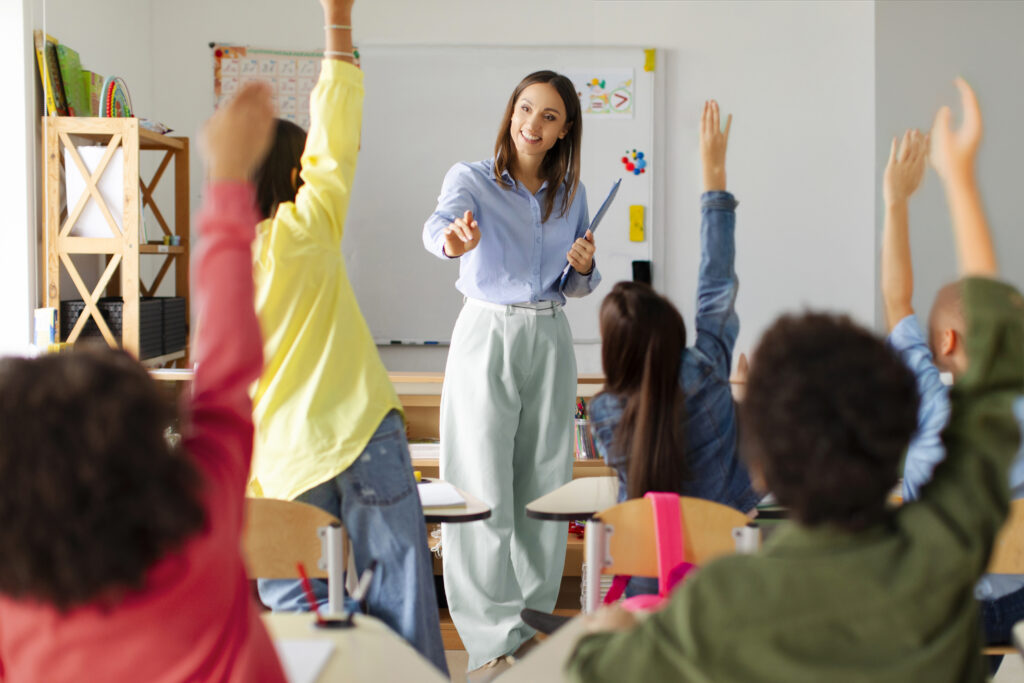
Open the door once. See what happens.
If you’ve read this far and you’re a teacher, here’s the smallest possible next step. Create a free Class2Class account. Pick a topic you were already going to teach this term. Run a one- to two-hour Connect project. That’s it. No syllabus rewrite, no tech setup, no English fluency required.
Two links to make it easier. First, a first overview through our Project Assistant, a super useful tool for busy teachers who want to start collaborating internationally. There, you will find video tutorials on how to use it. Second, the Class2Class platform overview so you know what you’re signing up for: a free network of teachers in 113+ countries, all running the same kind of small first project you’re about to run toward their own global perspective in education.
The door is already there. Class2Class is just the handle.