Classroom collaboration activities across countries
Choose classroom collaboration activities for international partners. Compare research, exchange expertise or create together, with practical planning tips.
Last updated
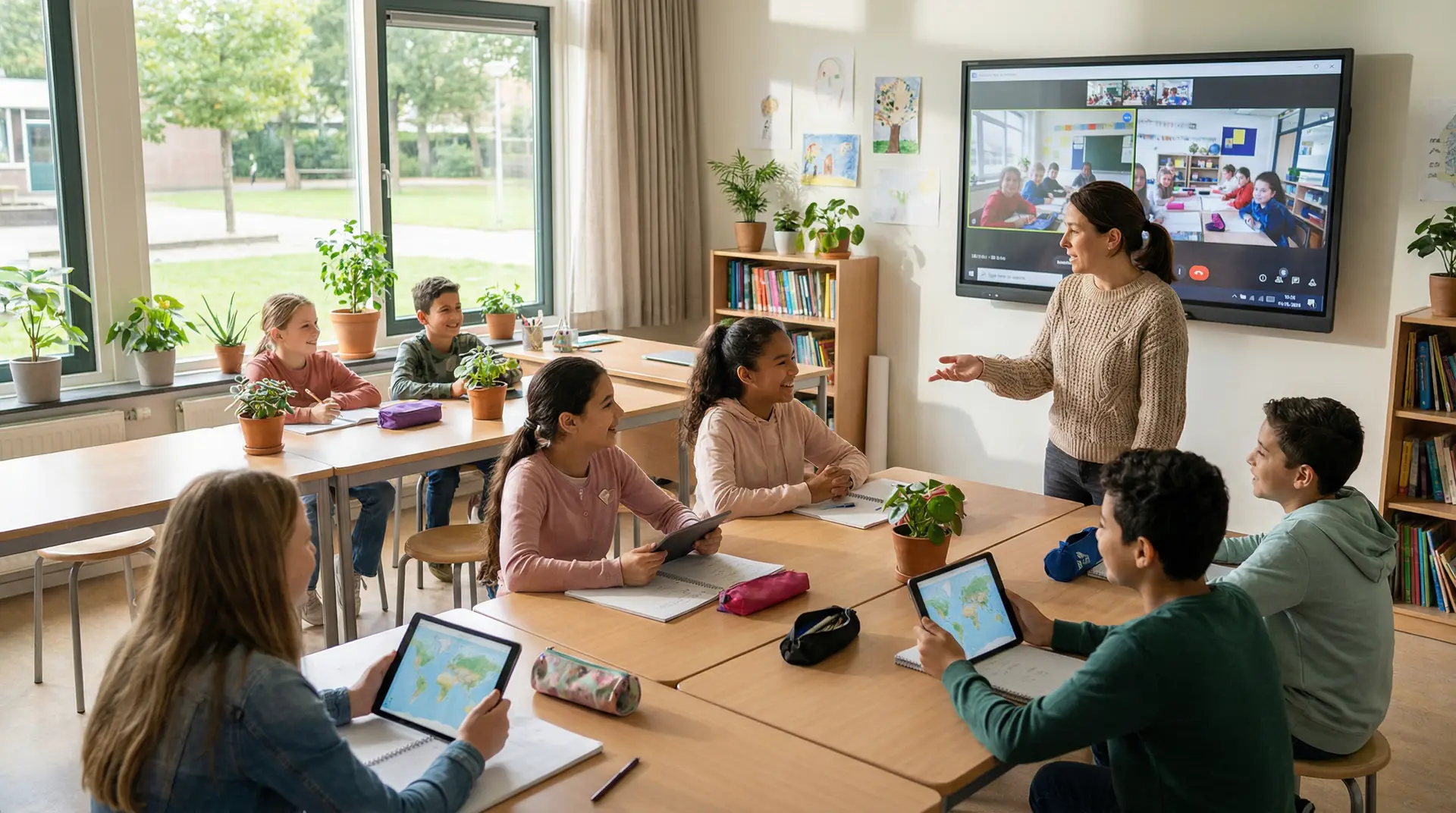
Classroom collaboration activities work best when both classes need something from each other. Students can compare local findings, teach peers about a topic or create a shared piece of work. Choose one curriculum question, then agree a manageable exchange with the partner teacher.
Choose classroom collaboration activities for your subject
Use these ideas as starting points to adapt with a partner teacher. The country examples below are possible designs, not reports of verified classroom results.
Science: compare local evidence
Science collaborations thrive on comparative data collection. Classes in different climates track temperature, precipitation, and daylight hours to understand climate zones. Biology students photograph local plants and animals, creating shared field guides that show biodiversity differences. Physics classes test the same experiments and compare results, investigating whether environmental factors affect outcomes.
For example, classes in Minnesota and Singapore could compare local water-quality information using the same safe, school-approved method. Students could discuss how geography and development affect access to clean water. Choose suitable published data or a supervised investigation; students should not handle unknown or unsafe water.
Mathematics: use a shared data question
Mathematics projects work well when connected to real-world contexts. Students survey their communities on the same questions, analyze data sets together, and create comparative visualizations. Exchange rate projects where students plan hypothetical visits to partner countries make currency conversion meaningful. Geometry students photograph architectural elements in their cities and compare design patterns across cultures.
Language arts: write for a partner audience
Language arts collaborations create authentic audiences for student writing. Pen pal exchanges where students provide peer feedback develop revision skills. Collaborative storytelling projects where each class writes alternating chapters build narrative understanding. Book clubs reading the same text from different cultural perspectives deepen literary analysis.
A class could read young adult novels with a partner class in the Philippines, then compare how the characters' experiences are represented. Ask students where a book matches their lives and where it relies on a stereotype.
Social studies: compare perspectives
Social studies partnerships bring textbook content to life. Students interview each other about political systems, economic structures, and daily life. History projects compare how different countries teach the same historical events. Current events discussions show how the same news story receives different coverage in different countries.
Arts: share and create together
Arts education travels remarkably well across borders. Music students share traditional songs and teach each other folk dances via video. Art classes exchange self-portraits and write about symbolism in each other’s work. Drama students perform scenes from plays for each other and discuss interpretation differences.
An SDG can give the activity a shared focus. Students might compare clean water, quality education or climate action in their communities, then explain what is similar, different and connected. See our SDG teacher guide for the wider framework.
Give both classes a reason to contribute
Agree clear learning goals, roles and an output that uses contributions from both classes. A shared presentation should compare or combine the work, rather than place two unrelated class reports side by side.
Start with an asynchronous introduction before deciding whether a live call would help. Small groups of three or four could share a short video, drawing or class message about their school, community and daily life.
Comparative research: both classes investigate the same question locally and compare findings. For example, a class in India and one in Texas could survey local renewable-energy use, map the results and create a joint presentation about solar and wind.
Expert exchange: each class teaches the other about a topic. A class in the United States and a class in Mexico could exchange short lessons about regional traditions and history, then ask follow-up questions. Avoid treating one class as the voice of a whole country.
Shared creation: both classes make parts of one product. For example, classes in South Korea and Indonesia could design two halves of a model bridge, using the same materials and agreed measurements. They would exchange drawings and explain engineering choices before testing how the designs fit together.
Build in reflection time after each interaction. Students need space to process cultural differences they notice, communication challenges they face, and insights they gain. A simple exit ticket asking “What surprised you today?” or “What question do you have for our partner class?” keeps the learning visible.
A shared question gives virtual international collaboration a purpose. Keep the learning goals visible during each exchange.
Find a partner with shared goals
The best international partnerships start with curriculum alignment, not just geographical variety. Before seeking a partner class, identify which units in your existing curriculum would benefit from comparative perspectives.
Choose a partner by learning goals, student age, language and availability. Country differences can support an investigation, but there is no proven country pairing that suits every class.
For elementary science, classes might compare seasons, weather and plant growth. India or South Korea could be useful partners for a shared investigation; New York and Australia offer a possible northern/southern hemisphere comparison. Check the local conditions rather than assuming they are the same throughout a country.
One possible plant study connects classes in Chicago and Bangalore. Both groups plant the same seeds, record growth with weekly photos and compare the conditions. Discuss local rain, heat and the timing of the study rather than assuming a monsoon or drought will occur.
Middle school social studies could compare civic participation with a class in the Philippines, or investigate island ecosystems and sustainable development with an Indonesian partner. Ask the partner teacher which local examples their students can meaningfully investigate.
High school humanities could compare trade and migration with classes in Mexico or Canada, or discuss social justice, conservation and multilingual life with a South African partner. Select the question with the teacher rather than expecting one country to supply a particular perspective.
Check both schools' actual timetables, time zones, holidays and daylight-saving dates before planning a live meeting. A country pairing alone does not prove school-hour overlap. Asynchronous exchanges work when the classes cannot meet at the same time.
Choose communication tasks that fit both classes' language confidence. Classes where English is an additional language can use short sentences, shared vocabulary and visual support. Agree whether another shared language or translation support would help.
Make timing and language manageable
Most collaboration can happen at different times. Add a live meeting only when it helps the task and fits both classes.
Make a communication calendar together. Mark when each class will share work, reply and give feedback. Write deadlines with the date and time zone, and leave a response window that fits both timetables.
Students could record a two- or three-minute response, explanation or presentation. Recorded messages allow time to prepare and revise, and remove the need to be online together. Use text or images when recording or uploading video is difficult.
If you choose a live call, prepare a short agenda. One possible twenty-minute plan is five minutes for introductions, ten for prepared sharing and five for questions. Adjust it to the students and the purpose.
Use short sentences, explain unfamiliar words and avoid idioms. A Spanish class and English learners in Mexico could help each other practise their languages through a teacher-planned exchange.
Add photos, drawings, diagrams or charts to support meaning. For example, classes could exchange photo essays about community helpers. Give images useful captions and translation support where students need it.
Agree a realistic reply window, such as a few school days, and tell students what to expect. Adjust it when holidays, access or language support affect the plan.
Prepare for common problems
Even well-planned international collaborations face predictable challenges. Knowing them in advance helps you prepare solutions.
Uneven participation: agree response times, contributions and a backup plan with the partner teacher. Connect the activity to real learning goals. If it is assessed, explain what each class will assess; grading is not the only way to make participation meaningful.
Technical problems: plan a low-bandwidth alternative. A recorded video, a photo with a caption or a reviewed class message can replace a live call. Choose the communication route with the partner teacher and keep student personal contact details out of exchanges.
Challenge: Different academic calendars. School years and holiday schedules vary by country, creating gaps in communication. Solution: Map out both calendars before starting. Schedule the most intensive collaboration phases when both schools are in session. Use lighter asynchronous activities during periods when one school is on break.
Challenge: Student shyness or reluctance. Some students feel uncomfortable interacting with peers they perceive as different from themselves. Solution: Start with small group or paired interactions rather than whole-class conversations. Let students write or record videos before attempting live calls. Teach specific conversation skills and provide sentence starters for initial interactions.
Challenge: Sustainability beyond one project. Teachers struggle to maintain partnerships year after year. Solution: Start small with a single unit collaboration. If it works well, expand gradually. Build the partnership into your curriculum plans so it becomes part of your regular teaching rather than an extra project. Keep in touch with your partner teacher between active projects to maintain the relationship.
Communication difficulties can become a useful reflection task. Ask students what made a message hard to understand, what they changed and what helped the partner class reply. When bringing students from different countries together, use these reflections to improve the next exchange.
Assess learning and collaboration
Grading international collaboration requires evaluating both content learning and collaboration skills. Use rubrics that separate these dimensions so students understand what you’re assessing.
For content learning, assess the same objectives you would in any project: depth of research, accuracy of information, quality of analysis. The international element enriches the content but doesn’t change the core learning goals.
For collaboration skills, evaluate communication clarity, respect for cultural differences, reliability in meeting deadlines, and quality of feedback given to partners. A simple rubric might include:
- Communication: Messages are clear, respectful, and appropriate for international audience
- Contribution: Completes assigned tasks on time and shares work with partners
- Cultural awareness: Shows curiosity about differences and avoids stereotypes
- Collaboration: Actively works with partners rather than working in parallel
Include student self-reflection in your assessment. Ask students to write about what they learned from their international partners, how their thinking changed, and what challenges they overcame. These reflections often reveal deeper learning than the final project alone.
Consider peer assessment where students evaluate their partner class’s contributions. This requires careful structuring to remain constructive, but gives students ownership of the collaborative process.
Portfolio assessment works well for longer collaborations. Students collect their exchanges, responses, contributions, and reflections throughout the project, then select pieces that show their growth for final evaluation.
Why an international partner can help
A partner class can bring another perspective to the same topic. For example, classes in Indonesia and California could compare local water-conservation questions using evidence from their own communities.
Students can practise explaining ideas across language differences and asking about another community. Let partners describe their own experience, including how they get to school, rather than assuming every pupil in a country faces the same challenges.
These collaborations also address practical curriculum needs. Science teachers use international partnerships to collect comparative climate data. Social studies classes conduct cross-cultural research projects. English teachers pair students for peer writing feedback that exposes them to different writing styles and perspectives.
International classroom connections give students practice in digital citizenship, asynchronous communication and adapting a plan with others. These skills are also useful in later learning and work.
Use Class2Class to connect the work
Class2Class is free for teachers and students. Teachers find partners in Connect by subject, age range, language, SDG interest and availability. They can explore projects, agree a plan and use project chat and teacher messaging. Optional live meetings use external tools chosen by the teachers.
Plan a small first exchange
Use these steps to turn the chosen activity into a shared plan.
- Choose one curriculum unit where another perspective would help.
- Name the content learning and collaboration goals separately.
- Find a partner teacher with compatible goals and school dates; agree response times and contributions.
- Choose a simple output. A three- or four-week plan with introductions, a shared task and reflection is one option, not a required duration.
- Prepare students to ask respectful questions, check information and use the agreed communication tools.
Frequently asked questions
What is a simple first classroom collaboration activity?
Ask both classes to investigate one shared question locally, exchange the findings and compare them. Choose a question from a unit you already teach.
Do both classes need to meet at the same time?
No. Students can share work and reply at different times. Agree the response window with the partner teacher; add a live meeting only if it helps.
Can we use Class2Class for free?
Yes. Class2Class is free for teachers and students. Explore project ideas and contact a partner teacher to discuss a shared activity.
Choose one shared activity
Explore a project idea, then choose one activity with a partner teacher. Agree what each class will contribute and how students will use the replies.