






The learning behind the connection
Educational Framework
Class2Class brings classrooms together around shared projects. Our educational framework connects international collaboration, eight competencies, and student agency so teachers can plan learning with a clear purpose.
Three pillars, one shared learning experience
The framework starts with how students learn together. Teachers shape the project around their learners, curriculum, and classroom context.
Collaborative Online International Learning
COIL connects classrooms in different countries through shared online work. Students investigate a question, exchange perspectives, and contribute to something together. Teachers plan the connection and guide the collaboration.
A clear focus on competencies
Name the competencies a project gives students a chance to practise. Build activities around them, then use students' work and reflections to discuss what they tried, what changed, and what needs more practice.
Students as active participants
Give students meaningful choices: the questions they ask, the ideas they develop, and how they share their work. Teachers provide guidance while students take responsibility, listen to others, and reflect on their decisions.
Eight competencies students can practise
These are the current Class2Class competency definitions. The suggested activities show how to put each one into practice; they are starting points to adapt, not evidence of an outcome already achieved.
Intercultural Communication
Interact effectively with people from different cultures by communicating respectfully and valuing diversity to foster mutual understanding.
Try this: Ask a partner class how they understand a shared topic, then check that you have understood their perspective.
Global Awareness
Understand global issues and the interconnectedness of societies to act as responsible global citizens contributing to a more sustainable and equitable world.
Try this: Compare how the same issue affects the two school communities and discuss what connects them.
Collaboration & Teamwork
Work and learn collaboratively in diverse, multicultural teams to achieve shared goals and promote mutual understanding.
Try this: Agree on a shared goal and group roles, then combine everyone's contributions into one piece of work.
Digital Literacy
Use digital tools critically, safely, and collaboratively to learn, communicate, and participate responsibly in global environments.
Try this: Check the sources behind a shared claim and agree with the teacher what is appropriate to share online.
Critical Thinking & Problem-Solving
Analyze complex problems from multiple cultural perspectives, evaluate their causes and consequences, and propose creative, collaborative, and ethically responsible solutions that are viable in both local and global contexts.
Try this: Compare evidence and possible explanations before choosing a response to a shared problem.
Emotional Intelligence
Recognize, understand, and manage one's own emotions, and demonstrate empathy and respect toward others' emotions and perspectives to strengthen communication, collaboration, and intercultural relationships.
Try this: When a disagreement arises, describe how you feel, listen to others, and reflect on what the group needs.
Adaptability & Leadership
Adapt flexibly and openly to change and diverse cultural contexts, taking on collaborative leadership roles to guide international teams toward constructive solutions and the achievement of shared goals.
Try this: Take turns guiding the group and adjust the plan when a partner class needs a different approach.
Creativity & Innovation
Generate, develop, and improve valuable ideas to create original products or solutions, working openly and collaboratively with others and learning from feedback to iterate and improve.
Try this: Make a first version of an idea, invite feedback from the partner class, and improve it together.
Five questions for evaluating our work
The Five E framework examines Class2Class's work: Efficacy, Effectiveness, Equity, Ethics, and Environment. These are evaluation dimensions, separate from the teaching methods and student competencies above.
An educational intention is not proof of an educational outcome. Each dimension links to the published approach, available evidence, and limitations so readers can see what is established and what still needs examination.
Efficacy
Does it work?
Whether the platform delivers the learning it promises, judged the way a researcher would judge it.
Effectiveness
Could it work here?
Whether it holds up in a real classroom, with real teachers, real time limits, and real budgets.
Equity
Who does it work for?
Whether the design helps every classroom equally, or quietly widens gaps that already exist.
Ethics
How does it operate?
How we handle children's data and govern the AI: who decides, who reviews, and who answers for it.
Environment
Is it ecologically sustainable?
What the platform teaches about sustainability, and what it costs the planet to run.
Bring the framework into a classroom project
Start with a question your students can explore with another class. Agree on the learning focus with your partner teacher, leave room for student decisions, and plan time to share work and reflect.
Plan the international collaboration
The COIL guide explains how a shared question and work between partner classes give an international project its purpose.
Develop and test student ideas
Design thinking gives students a way to understand a need, explore ideas, make a first version, and improve it through feedback.
See a classroom example
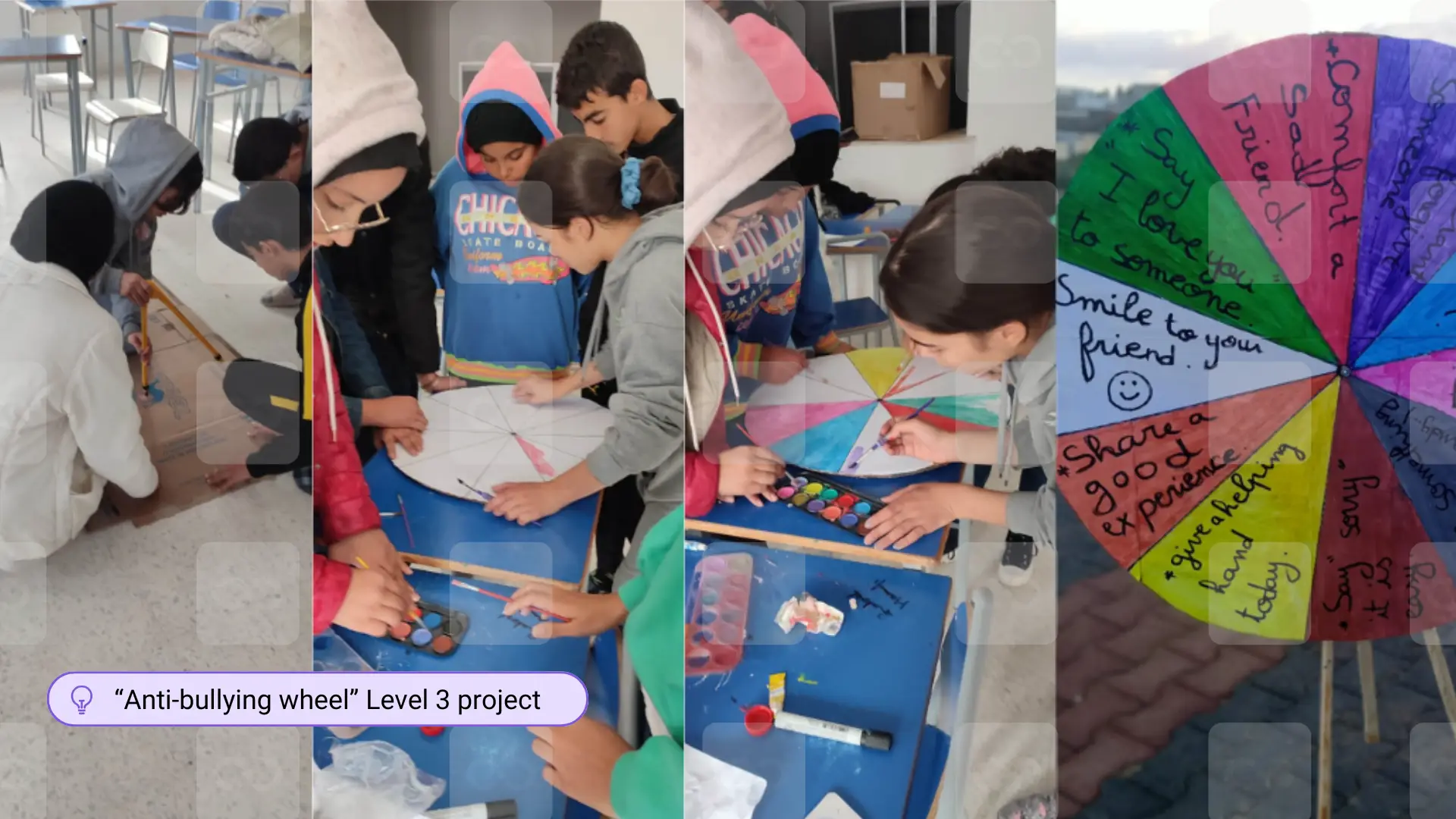
In Cut Bullying Out, students in Tunisia and India explored bullying and created practical responses for their schools. Read the story for the activities and context.
Choose a project with a clear learning purpose
Explore the projects on Class2Class, find a starting point that fits your students, and discuss the next steps with a partner teacher.