
Many teachers meet project-based learning the same way: a long guide, a rubric for every step, a six-week plan. The idea sounds right, but the preparation does not fit inside a normal teaching week, so the guide goes back in the drawer. It does not have to end there. You can make school projects easier and keep what makes them work. Project-based learning (PBL) — students learn by working on a real question, not by memorizing a list of facts — depends on a few essential pieces. The rest is optional. In this article you will find a minimum viable framework with four phases, and a place where projects with this structure already exist, free and ready to use.
The Essence of PBL: Three Parts You Cannot Cut
Before you make school projects easier, you need to know which parts carry the learning.
First, a real question . Not “make a poster about water.” Instead: “Why does water reach some homes in our city and not others?” The question is what turns a task into an investigation.
Second, real student work inside a clear design . You design the project — the activities, the steps, the deadlines — so students know exactly what to do at every moment. Inside that structure, the work itself belongs to them: they investigate, discuss, create, and present. A clear design from you is what lets students work with confidence instead of guessing what comes next.
Third, an audience . Students share their product with someone beyond the teacher: another class, families, the school community. The audience gives the work a purpose bigger than a grade.
The evidence behind these pieces is strong. A meta-analysis by Chen and Yang (2019) reviewed 46 studies and found that students in PBL classrooms achieved better academic results than students in traditional instruction, with a medium-to-large effect. The MDRC literature review by Condliffe and colleagues (2017) adds an important detail: the quality of the process — the question, the investigation, the collaboration — matters more than the size of the project.
Here is the trap many teachers fall into when they cut: they keep the poster and cut the question. That removes the essence and keeps the workload. Simplifying means the opposite. Keep the question, the student work, and the audience. Cut the rest — the extra documentation, the six-week timeline, the rubric for every single step. The most frequent cuts that go wrong are covered in this short guide to project-based learning mistakes .
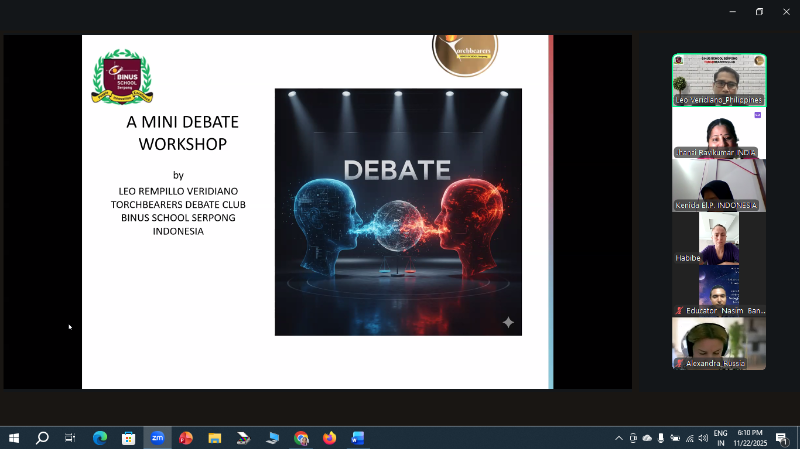
Teachers from five countries join a mini debate workshop to prepare the Should Rivers Be Connected? international debate
If you want to see the essence in action, look at one real project. In Should Rivers Be Connected? , students from 10 countries debated one question about water and sustainability. One question, real opinions, and a real audience of peers. The learning went far beyond the topic: students practiced listening, using evidence, and Critical Thinking & Problem-Solving. The structure was simple. The question did the heavy work.
A Minimum Viable Framework to Make School Projects Easier
A minimum viable project needs one question, four phases, and one shared product. That is the whole framework. The four phases organize every project on Class2Class: Definition, Execution, Reflection, and Dissemination .
Here is the framework at its smallest:
- Definition — choose one real question and plan the route: activities, steps, timeline. Usually one class session.
- Execution — students investigate in teams and build one product together: a podcast, a campaign, a set of interviews, a presentation. Two to four sessions.
- Reflection — not a single moment but short pauses across the project, closed by a final reflection: What did we learn? What surprised us? What would we change?
- Dissemination — students present the product to a real audience: the partner class, the school community, or both.
That can fit inside two weeks of normal classes. You do not need a semester to make school projects easier. You can read how the four phases work in a real international project in How a Global Classroom Project Generates Learning in 4 Phases , and there is a step-by-step plan to start a global classroom project in 2 weeks .
Why does such a small structure still work? Because each phase protects one piece of the essence. Definition protects the real question. Execution protects the students’ real work. Dissemination protects the real audience. Reflection makes the learning visible — to the students and to you. When teachers make school projects easier this way, they cut preparation time, not learning.
A small structure also makes evaluation lighter. You do not need a rubric for every step. Watch the group’s work in each phase — the first exchange, the shared product, the reflection — and use what you see as evidence of learning. On Class2Class, this evidence stays at group level, and you, the teacher, always make the final call. Reflection gives you formative evaluation — information about learning while it happens — without adding one extra test.
One more simplification: you do not have to design the Definition phase alone. The platform’s Project Assistant turns your topic idea into objectives, activities, and milestones step by step. You can edit everything it suggests — the final project is always yours. The teacher stays the facilitator and the decision-maker; the tool only prepares the ground.
And if your students do not have their own devices or accounts, you can still run the same four phases. You manage the project board on their behalf, and the class works on paper, in conversation, and through your screen. The framework does not depend on the technology. It depends on the question.
Ready-to-Use Projects: The Structure Is Already Built
The fastest way to make school projects easier is to not build them from zero.
Class2Class is a free platform that connects classrooms in more than 140 countries through COIL — Collaborative Online International Learning, a method where two classes in different countries learn by working together online. Every project on the platform follows the three approaches of the C2C model: Connect projects (1–2 hours) to explore cultures, Collaborate projects for project based learning international in scope and built around global challenges, and Create Solutions projects to design answers to real problems.
For a first step, a Connect project is the smallest complete unit of PBL: one question, one virtual classroom exchange, one reflection, in about two class hours. Many teachers start there because the time cost is small and clear. Your class meets a partner class, answers one cultural question, and reflects on what surprised them. If it works for your students, the longer Collaborate and Create Solutions projects follow the same four phases — only with more sessions.
When you are ready for more, open Explore Projects on the platform. These are projects created by teachers and open for collaboration — each one shows its central question, its activities, and the four phases already organized, so joining one is enough to make school projects easier from day one. If you prefer to start from a date the whole world marks together, the SDG Calendar connects international days to project ideas your class can join.
If you want real COIL project examples from classrooms like yours, look at two. Teachers from Ukraine, Italy, India, the United States, Bangladesh, and Turkey turned one simple question — “ What do you do in your free time? ” — into a complete project on hobbies, sports, and free time across 6 countries . And a teacher in Bangladesh, Nassim Mia, built an international project around the music his students already loved: K-pop in the classroom . Simple starting points, full PBL essence.
This is also where the competencies live. When students compare findings with a partner class, they practice Collaboration & Teamwork and Intercultural Communication — competencies the OECD Learning Compass 2030 describes as central for young people today. You do not teach these in a lecture. Students build them by working with real peers on a real question, which is exactly what connecting classrooms across borders makes possible.
Conclusion: Easier Does Not Mean Smaller Learning
The choice was never “full PBL or no PBL.” You can make school projects easier by protecting three things — a real question, real student work inside your design, a real audience — and running them through four small phases: Definition, Execution, Reflection, Dissemination. Everything else is optional. And because ready-made projects already carry this structure, your first step is not to design. It is to choose.
References
Class2Class resources
- How a Global Classroom Project Generates Learning in 4 Phases
- How to Start a Global Classroom Project in 2 Weeks
- Project-Based Learning Mistakes and How to Avoid Them
- Introducing the Project Assistant on Class2Class
- Explore Projects (platform)
- SDG Calendar
- Healthy Hobbies, Sports and Free Time Across 6 Countries
- K-pop in the Classroom
- Should Rivers Be Connected? An International Debate Across 10 Countries
Academic references
- Chen, C.-H., & Yang, Y.-C. (2019). Revisiting the effects of project-based learning on students’ academic achievement: A meta-analysis. Educational Research Review, 26, 71–81
- Condliffe, B., et al. (2017). Project-Based Learning: A Literature Review. MDRC
- OECD (2018). The Future of Education and Skills 2030: OECD Learning Compass