
Virtual Field Trips for K-12 Classrooms: A Teacher’s Guide to Taking Your Class Anywhere
- April 30, 2026
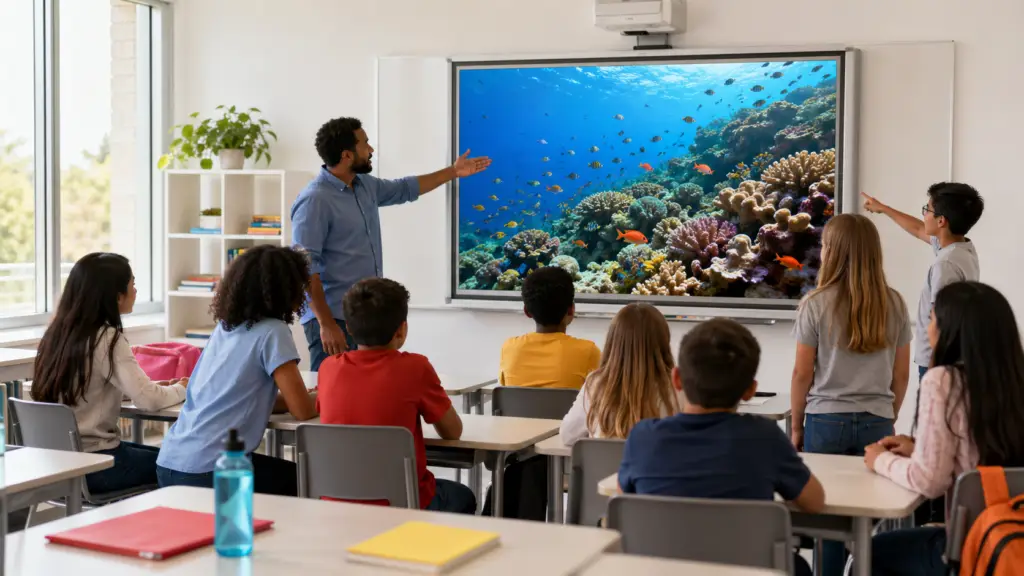
Virtual field trips for K-12 classrooms have moved from “pandemic substitute” to “permanent part of the toolkit.” When physical trips are budget-constrained, weather-disrupted, or simply impossible (your 5th graders aren’t visiting the deep ocean any time soon), a well-planned virtual field trip can deliver most of the wonder of an in-person visit at a fraction of the cost — and reach destinations that would otherwise be off-limits entirely.
This guide walks through what virtual field trips look like in 2026, the eight best free virtual field trips K-12 teachers are running this year, a 30-minute planning template, and the combination of virtual visits with global classroom collaboration that turns a one-off experience into a longer learning arc.
What virtual field trips are (and what they’re not)
A virtual field trip for K-12 classrooms is any structured experience that uses video, live tour, interactive simulation, or 360° media to bring students to a place, person, or event they couldn’t easily visit physically. The best ones share three traits: they’re guided (not just a video clip), they invite interaction (questions, observations, decisions), and they connect to something students were already learning about.
Virtual field trips are NOT a substitute for the deep human connection that comes from actually meeting peers in another country. That kind of connection comes from sustained contact — see our coverage of bringing students from different countries together — not from a single guided visit. The two formats complement each other: a virtual field trip introduces a place; ongoing collaboration makes it real.
Why virtual field trips work for K-12 learning
- Access without logistics. No buses, no permission slips with parking concerns, no museum closure surprises. A coral reef in Australia, a classroom in Kenya, the surface of Mars — all reachable in a 50-minute period.
- Equity built in. Students whose families can’t afford the optional “extra” cost of an in-person trip are not left out. Every student in the room gets the same experience.
- Repeatability. A teacher can run the same virtual field trip three years running, refining the discussion questions each time. In-person trips are one-shot.
- Curriculum integration. A virtual field trip slots into a single class period or stretches into a multi-day arc with pre-trip and post-trip activities. The flexibility lets you embed it where it makes pedagogical sense, not where the bus schedule allows.
- Pairs naturally with collaboration. Two classes in different countries can take the same virtual field trip simultaneously, then compare reactions — one of the most powerful applications of the format.
8 best virtual field trips for K-12 classrooms in 2026
Each of the eight below is free (or has a robust free tier), well-supported in 2026, and explicitly designed for K-12 classrooms rather than retrofitted from adult content.
1. Smithsonian National Museum of Natural History
The Smithsonian’s virtual tour offers a self-paced 3D walkthrough of every public hall — from the Hall of Mammals to the Hope Diamond exhibit. Free, no login required, and stable for years. Excellent for science units (3rd grade and up) and as the visual anchor for a research project.
2. Google Arts & Culture Expeditions
Hundreds of curated virtual tours — Versailles, the International Space Station, the Great Barrier Reef, the Acropolis. Many are produced in partnership with the institutions themselves, with explanatory cards aimed at a school audience. Free, browser-based, no app required.
3. NASA at Home
NASA’s K-12 portal includes virtual visits to the Kennedy Space Center, the surface of Mars (via the Curiosity and Perseverance rovers), and the International Space Station. Live “Ask an Astronaut” sessions periodically open up. Strong fit for STEM curricula across grade bands.
4. The Louvre Online Tours
The Louvre’s free virtual tour covers the major wings of the museum with high-resolution 3D imagery and supporting context. Useful for art history at any level, and especially good as a pre-trip for any class doing a French language or European history unit.
5. Monterey Bay Aquarium Live Cams
Live, ongoing webcams from inside the aquarium — kelp forest, sea otters, jellies, open ocean. Lower-production than the curated tours but oddly captivating for younger students, who will watch a single jellyfish for a full minute. Pairs with marine biology units in 2nd-5th grade.
6. Nearpod & Discovery Education virtual field trips
Two K-12-native platforms with structured virtual field trip libraries. Both have free tiers. Discovery has a particularly strong “Virtual Field Trips” series featuring cultural sites, scientific facilities, and historic locations with built-in teacher guides and discussion prompts.
7. Class2Class partner classrooms (the live virtual field trip)
Often overlooked: the most powerful “virtual field trip” K-12 teachers can offer their students isn’t a polished tour at all. It’s a live video session with a partner classroom in another country. A 6th grader in Texas listening to a 6th grader in Ghana describe their school day, their lunch, their walk home — that’s a virtual field trip with a level of authenticity no production can match. Class2Class operates in 144 countries and makes that kind of pairing possible. See our guide to international students collaboration for the implementation playbook.
8. National Park Service WebRangers
Free interactive virtual visits to U.S. National Parks, with curriculum-aligned activities. Yellowstone, Yosemite, the Everglades, and dozens more. Strong for environmental science and U.S. geography units, and the activities are well-suited to upper-elementary and middle school.
How to plan a virtual field trip in 30 minutes
Most teachers think virtual field trips need elaborate planning. They don’t. Here’s the 30-minute prep routine that consistently produces strong classroom experiences:
- Pick a destination tied to a current unit (5 min). The biggest mistake is choosing the destination first and trying to find curriculum links after. Reverse it. What are you teaching this week, and where would a virtual visit anchor it?
- Preview the tour yourself (10 min). Click through the entire experience before showing it to students. Note the 3-4 moments that genuinely surprised or moved you — those become your discussion anchor points.
- Write three pre-trip questions (5 min). Give students one observation question (what do you notice?), one connection question (what does this remind you of?), and one prediction question (what do you think we’ll learn?). Post them on the board before launching.
- Plan your “stop and discuss” points (5 min). Decide where you’ll pause the tour for a 60-second discussion. Two or three pauses in a 20-minute tour is right; more becomes interruptive.
- Prepare one post-trip activity (5 min). The simplest version: “Write three things you didn’t know before this tour and one question you still have.” That’s it. The questions become tomorrow’s mini-lesson.
Combining virtual field trips with global classroom collaboration
The single best upgrade you can make to a virtual field trip is doing it simultaneously with a partner classroom in another country and then comparing reactions. The mechanics are simple:
- Pick a partner classroom and align schedules. If you’re in the U.S. and your partner is in Europe, the time zones are workable for a same-day experience. Use a platform like Class2Class to find a partner if you don’t have one yet.
- Take the same virtual field trip on the same day. Both classes do the visit independently. No live link required — that’s what async makes possible.
- Exchange reactions. Each class records a 3-minute video summary or writes a one-paragraph reflection. The two classes swap them. The differences in what each group noticed are where the deepest learning happens.
- Optional live debrief. A 20-minute synchronous video meeting between the two classes a week later, with each side presenting “the most surprising thing” they learned. This converts a tour into a memory.
This combination — virtual field trip + paired-classroom comparison — is part of the broader active learning methods pattern that works across global classroom projects.
Common pitfalls (and how to avoid them)
“It became passive video time”
The single biggest failure mode. The fix is structural: build in the stop-and-discuss pauses, give students an observation task before the tour starts, and have a reflection deliverable at the end. Treat the virtual field trip the same way you’d treat any field trip — with a packet, prompts, and accountability.
“The tech failed”
Always have a backup tour bookmarked from a different host (e.g. Smithsonian if your primary was Google). Always preview from the same network you’ll use during class — school WiFi blocks some video sources. Cast to the projector ahead of time so you’re not troubleshooting cables in front of 25 third-graders.
“It was cool but didn’t connect to anything”
The cure is the same as for in-person trips: front-load the connection. Spend 15 minutes the day before talking about why you’re going on this trip and what unit it relates to. The trip becomes a chapter in the unit, not a one-off curiosity.
Frequently asked questions
What grade level are virtual field trips for?
All of K-12. Younger students (K-2) do better with shorter, narrative-driven tours (live aquarium cams, narrated zoo walks). Middle and high school can handle longer, more complex experiences like the Smithsonian or Louvre tours. The format scales — what changes is duration and discussion depth.
How long should a virtual field trip last?
15-25 minutes for the tour itself, plus 10-15 minutes of pre/post discussion. Going longer than 30 minutes of viewing tends to burn through attention. If you have a 50-minute period, structure it as 10 min pre + 20 min tour + 20 min discussion or activity.
Do I need VR headsets?
No. The vast majority of K-12 virtual field trips work on a regular projector or large display. VR headsets add immersion but also add management overhead and equity issues (who gets a turn?). Start without them.
Can virtual field trips replace physical ones?
Sometimes yes (when distance, cost, or safety make the physical trip impossible), often no (when the experience really needs to be tactile or social). The best practice in 2026 is to use them as complements: virtual to extend reach, physical for the high-impact local trips. Use the saved budget from one virtual visit to fund a better in-person trip elsewhere in the year.
How do virtual field trips connect to global learning?
They’re an entry point. A virtual field trip introduces a place; an ongoing classroom partnership makes that place a relationship. The natural progression is: visit virtually → connect with a classroom in that region → run a small joint project. See our overview of international classroom project ideas for ready-made follow-ups.
Where to go from here
Virtual field trips are a low-friction first step into global learning. Their real power shows up when they’re paired with the relationships that follow — pen pal exchanges, joint projects, simultaneous tours with a partner class abroad. The format is most useful as the introduction, not the destination. To turn a virtual visit into an ongoing connection, set up a free Class2Class teacher profile and use the partner finder to match with a classroom in the country your students just “visited.” Five minutes to set up; a year of follow-on conversations as the payoff.
Ready to bring this into your classroom? Class2Class connects K-12 teachers in 144 countries — free to use, free to match with a partner classroom, free to launch your first international project.