
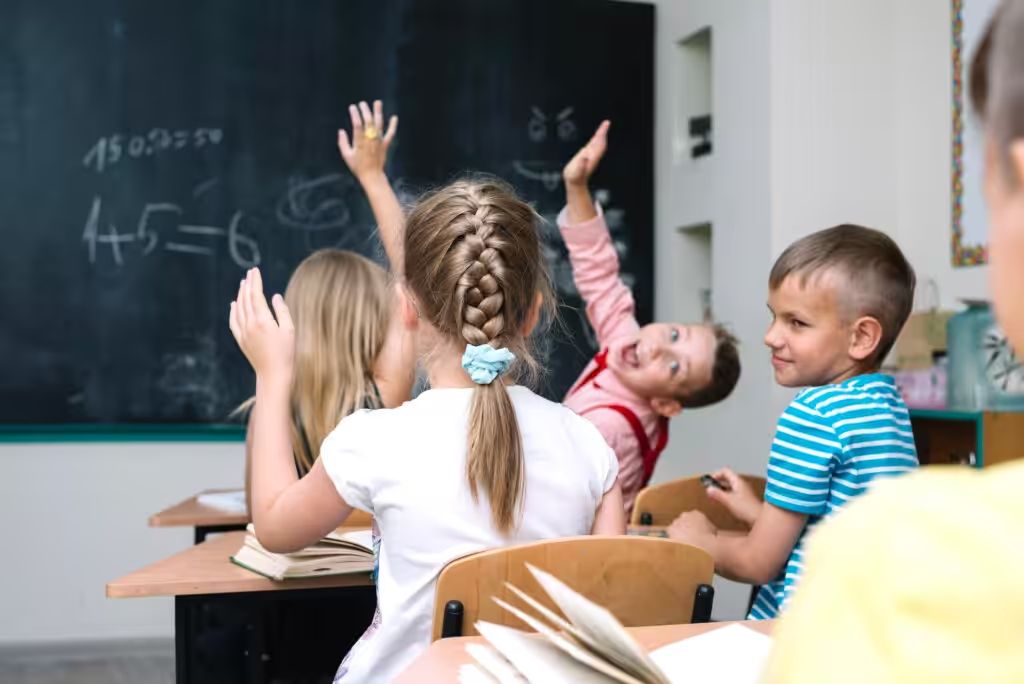
Teacher Gisel Crespo in Argentina wanted her students to see what school looks like beyond their own classroom. She connected with Teacher Jhansi in India and Teacher Olenka in Ukraine through Class2Class. Each class prepared a short presentation about their school — the building, the daily schedule, the celebrations — and then both classes met online to share it and ask each other questions. That is international classroom collaboration in practice: structured, purposeful, and grounded in a real classroom activity.
This article explains how that process works from the inside. You will learn what students actually exchange, how both classes coordinate step by step, and which tools on the Class2Class platform make the whole process possible.
What students exchange in an international classroom collaboration
COIL — Collaborative Online International Learning — is the model at the heart of every project on Class2Class. The simplest way to explain it: two classes in different countries work together on a shared question. They do not just meet online; they produce something together.
But what does “something” look like in practice?
It starts with an Icebreaker — the first contact between the two classes. In the My School project, Teacher Gisel Crespo’s students in Argentina prepared a short presentation about their school: the building, the daily schedule, the celebrations. Their partners in India did the same. Both classes met online, watched each other’s presentations, and opened a live Q&A. An Argentine student asked about the bindi. An Indian student explained the cultural and spiritual tradition behind it. That kind of exchange — a genuine question answered by someone who actually lives it — generates the type of intercultural understanding that a written description cannot easily replicate.
After the Icebreaker, the exchange deepens. During the Working in Class phase, students investigate their local reality, compare it with what their partner class discovered, and begin building their shared product. This product can take many forms: a video, a report, a digital poster, a podcast, a proposed solution to a community problem. What makes it different from a regular school assignment is that both classes contribute to it. Students in Turkey do not produce content only for their own teacher — they produce content that students in Colombia will read, respond to, and build on.
In the Hobbies, Sports, and Free Time project, classrooms from six countries — Ukraine, Italy, India, the United States, Bangladesh, and Turkey — participated in exchanges organized around each country’s time zone. Through those conversations, students discovered that a student in Ukraine and a student in Italy could both love football and yet describe the game and the experience of playing it in completely different ways. That is Intercultural Communication at work: not explained in a worksheet, but felt in a real conversation between real people.
The exchange ends with a Presentation and a Reflection. Students share what they built with an audience beyond the classroom — their partner class, their school community, or both. Then they look back: What did we learn? What surprised us? What would we change? These questions are where the learning becomes visible, to both students and teachers.
How two classes coordinate step by step
This is the question that worries most teachers: How do we actually organize this across time zones, different school calendars, and different languages?
Every cross-border project on Class2Class follows four phases — Definition, Execution, Reflection, and Dissemination — drawn from the COIL model that educators around the world have used for over two decades. The important thing is that these phases are built into the platform. You do not have to design the structure yourself.
Phase 1 — Definition. Typically, one teacher builds the project using the platform’s Project Creation Assistant — setting the central question, activities, and timeline. Other interested teachers then join that project and work from the same structure. Some logistics — such as scheduling live sessions across different time zones — are discussed between partner teachers once a match is made, but the project framework usually stays as originally designed. The Project Creation Assistant suggests objectives, activities, and milestones step by step. You can edit anything it proposes. The final plan is always yours.
Phase 2 — Execution. Students investigate, create, and collaborate. This is the longest phase of any global classroom project. In an Explore Cultures project — the most accessible entry point on the platform, often completed in one to two hours — the Execution phase might be a single live session. In a longer project, it can run for weeks. During that time, students exchange materials through the shared project board, give feedback to their partners’ work, and join two or three live sessions to discuss progress and make decisions together. The pace is set in Phase 1, so both teachers know exactly when each milestone happens.
Phase 3 — Reflection. After the main work is complete, students and teachers pause to look back. What happened here? What did we understand that we did not understand before? The platform provides structured reflection prompts. Responses become a group-level record of what the collaboration meant — evidence that stays in the project for the teacher to review and use in the future.
Phase 4 — Dissemination. The project closes with sharing. Students present what they built to an audience beyond their own classroom. Many teachers invite parents, open a school exhibition, or share the work online. When students know a real audience will see what they created, the quality of their work changes. They are no longer producing for a grade. They are producing for people.
Research published in the International Journal of Educational Technology in Higher Education (2022) confirms that this kind of structured virtual exchange — where students have a clear purpose, a shared product, and an authentic audience — leads to measurable gains in intercultural competence and communication skills. The structure is not just an administrative requirement. It is what turns an online meeting into a genuine learning experience.
What platform tools make this coordination possible
You do not need to build the coordination system yourself. Class2Class provides the tools to find a partner, plan the project, run the sessions, and document the learning — all in one free platform.
Finding a partner class. When you create a free account, you join a community of teachers in 144+ countries. You can search for a partner by subject area, age group, language, and project type. The platform shows you which teachers are currently looking for partners. Most teachers find a match within a few days. You send a connection request, introduce yourself and your class, agree on a project, and you are ready to start.
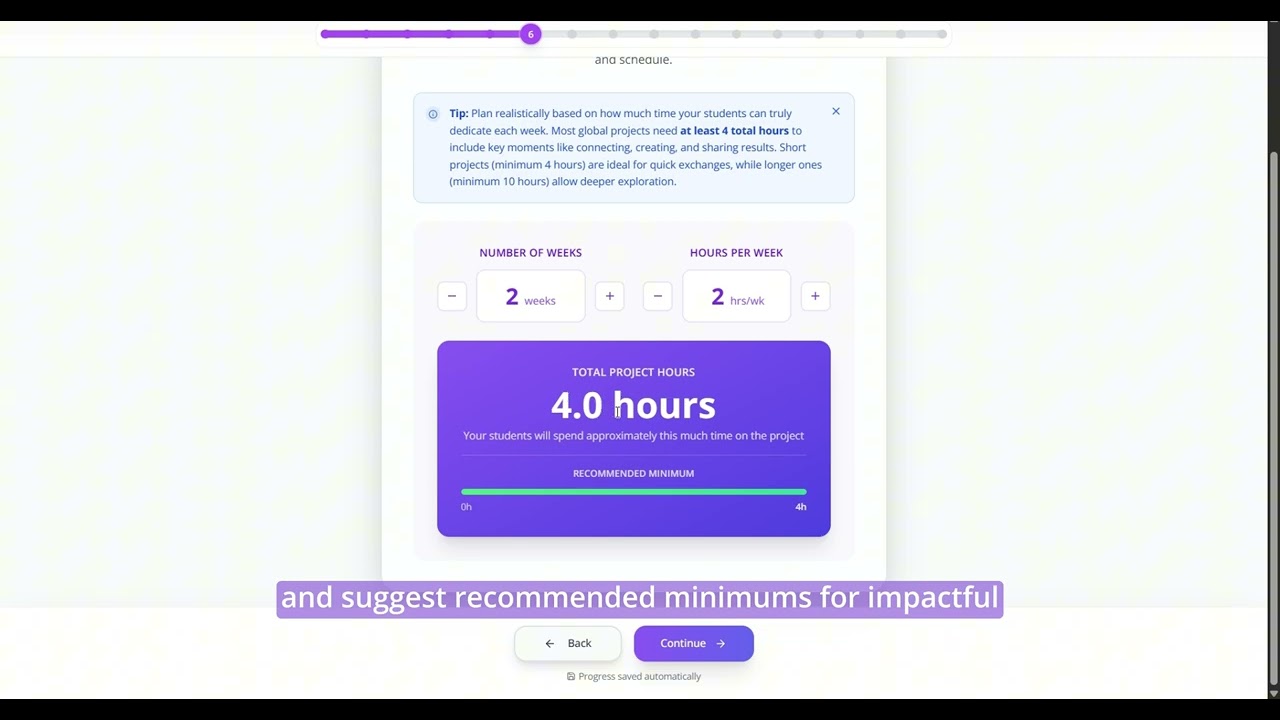
Planning with the Project Creation Assistant. The Project Creation Assistant helps you build the project plan. You answer a few questions about your students, your subject, and your goals, and the tool generates a complete project structure: phases, activities, and suggested timelines. Once published, partner teachers join the same plan, which means both classes are always working from the same shared structure.
Sharing work on the project board. Think of this as the shared workspace for both classes. Teachers and students upload evidence of their work — photos, documents, videos, short recordings — and both classes can see what the other has contributed. This is how the exchange happens between live sessions. Students review each other’s work before they meet, so when both classes join the video call, they already have questions, reactions, and ideas. The session becomes a real conversation, not a presentation to strangers.
Running live sessions. Class2Class does not host video calls directly — most teachers use Zoom, Google Meet, or a tool they already know. The platform lets you schedule an event within the project: the host enters the meeting details, and all participants are notified automatically. You enter the call with a shared context. That makes a visible difference, especially the first time you connect with a class you have never met before.
Researchers who study COIL implementation consistently point to structured tools like these as essential for teachers who are new to international collaboration — educators who want to connect their classrooms across borders but do not yet have the experience to design the scaffolding themselves (Rubin & Guth, 2022). Class2Class was built for exactly that teacher.
The structure is already there — you just need to start
The hardest part of international classroom collaboration is not the logistics. It is believing that your class, with your real resources and your real schedule, can do this.
Teacher Gisel in Argentina did not have a special budget or extra planning time. She had a topic her students cared about — their own school — and a platform that helped her find Teacher Jhansi in India and Teacher Olenka in Ukraine. The structure was there. The curiosity was there. The rest happened on the live call.
UNESCO’s Global Citizenship Education framework (2020) argues that intercultural learning must be experiential — not described, but lived. International classroom collaboration is how that happens in a regular K-12 classroom, without travel, without a special curriculum, and without a budget. The platform provides the structure. The experience is yours to give your students.
Class2Class Internal References
- My School Project — Argentina, India, and Ukraine
- Hobbies, Sports, and Free Time — 6-Country Collaboration
- Cómo un proyecto de aula global genera un aprendizaje increíble en cuatro fases
- Primera guía de proyectos internacionales
- Project Creation Assistant — Video Guide
Academic References
- International Journal of Educational Technology in Higher Education (2022) — The effectiveness of COIL on intercultural competence development in higher education
- Rubin, J., & Guth, S. (Eds.). (2022). The Guide to COIL Virtual Exchange: Implementing, Growing, and Sustaining Collaborative Online International Learning. Stylus Publishing.
- UNESCO (2020). Global Citizenship Education: Topics and Learning Objectives. Updated edition.