
PISA 2025: a classroom guide to reading, evidence and reasoning
PISA 2025 raises questions about how students read and use evidence. Try this 35-45 minute activity: students compare two fictional school notes, check the numbers and explain a claim. It works on paper in one classroom; sharing with another class is optional.
Try the activityLast updated
PISA 2025 results put reading and critical thinking back in the spotlight. OECD reports a 28-point fall in its average reading score between 2015 and 2025. What could that mean for a lesson in your classroom? Start with one useful question: can a claim use correct numbers but still leave out an important comparison?
In this original Class2Class activity, students test a fictional claim that a school poster reduced lunch leftovers. They read two notes, write an explanation and improve it after a question from another group. This is classroom practice, not an official PISA task.
Try a claim, evidence and reasoning activity
Plan 35-45 minutes for students aged about 13-16, adapting the reading and calculations to your class. Adjust this suggested timing as needed. You need paper or a shared display, pencils and optional calculators. The task works without a device, account or partner class.
Copy both practice source notes for students. Let them read Note A first and underline its claim. Then give them Note B and ask what they now need to compare. Introduce leftovers as food left after lunch. Distinguish the total amount from the average per lunch: the total shared equally across all lunches served.
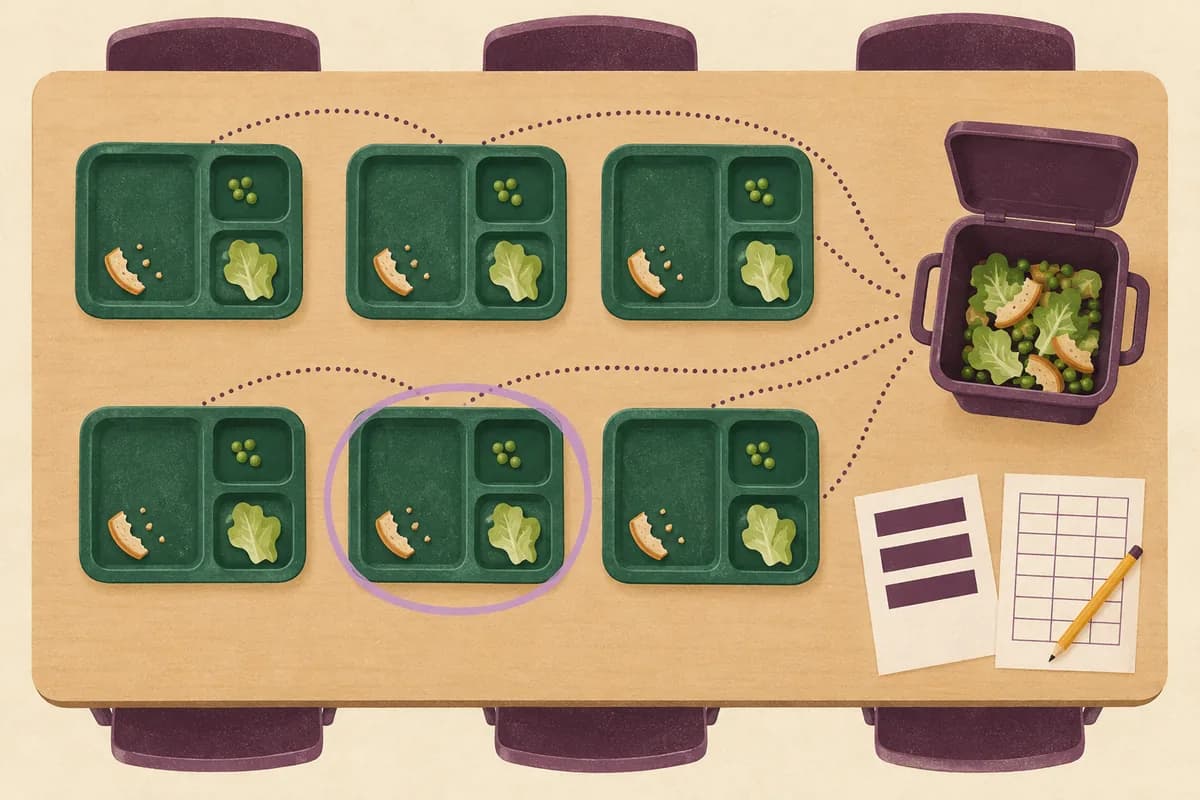
Give students these two practice sources
Practice source A: school notice
In two five-day school weeks, we recorded 12 kg of lunch leftovers in week 1 and 9 kg in week 2. A new poster went up at the start of week 2 asking pupils to take only what they expected to eat. Less food was left over, so our poster worked.
Fictional school notice, invented for this exercise
Practice source B: catering log
Week 1 served 160 lunches; week 2 served 100. Both weeks used the same method to weigh leftovers after lunch. The menu changed, and fewer pupils attended in week 2. The log does not explain why pupils left food.
Fictional catering log, invented for this exercise
Read, explain, compare and revise
- Read and question, about 5 minutes. Each student marks the claim in Note A, the data that support it and one piece of missing context. Ask who wrote each fictional note and what each note records.
- Model a fair comparison, about 8 minutes. Work through one grams-per-lunch calculation. Explain why dividing by lunches served gives an average per lunch, which answers a different question from comparing totals. Keep units visible.
- Write individually, about 7 minutes. Each student answers the school question in three or four sentences, using a figure from each note, an explanation of the comparison and a limitation.
- Exchange explanations, about 8 minutes. Another group, or an optional partner class, identifies the strongest evidence and asks one question. Ask students to challenge the reasoning respectfully, not rank one another.
- Revise individually, about 7 minutes. Each student writes a revised answer and completes: “I changed or kept my conclusion because …” Allow more time or a second lesson where needed.
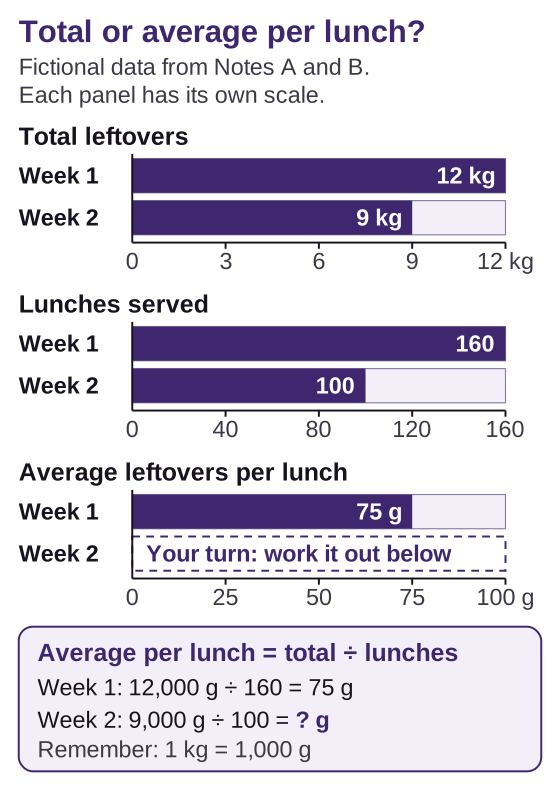
For step 2, show this diagram. It works through week 1 and leaves week 2 for students to calculate. Each panel starts at zero and has its own scale.
Teacher notes: calculations and sample answer
Swipe horizontally to see all columns
| Practice measure | Week 1 | Week 2 |
|---|---|---|
| Total leftovers | 12 kg | 9 kg |
| Lunches served | 160 | 100 |
| Average leftovers per lunch | 75 g | 90 g |
All values in this table are fictional practice data. Keep the per-lunch answers back until students have tried the comparison. Convert kilograms to grams before dividing: 12,000 divided by 160 is 75 g per lunch, and 9,000 divided by 100 is 90 g per lunch. The total fell, while the average per lunch rose. An average shares the total equally across all lunches; real trays differ.
Note A records a lower total and credits the poster. Note B adds the number of lunches served and changes in the menu and attendance. The log gives a reason to question that inference: the number of lunches and the menu changed too. Neither the lower total nor the higher rate establishes what the poster caused.
One possible student answer is: “The total fell from 12 kg to 9 kg, but fewer lunches were served. Leftovers per lunch rose from 75 g to 90 g. I cannot tell whether the poster worked because the menu and attendance changed. I would collect more comparable observations before deciding.” This is an example of reasoning, not the only acceptable wording.
An extension is to plan better evidence. Ask students what they would keep consistent, what they would record and which comparison would answer their question. More observations can improve a description, but simply adding weeks does not remove every possible explanation for a change.
Look for each student's thinking
Use these prompts to respond to each student's explanation. They are classroom feedback suggestions, not an official PISA marking rubric or a tested assessment tool. A polished group poster does not replace an individual explanation.
- Evidence: Does the answer use the two notes faithfully and include quantities with the correct units?
- Comparison: Does it distinguish total leftovers from the average leftovers per lunch and show how the rate was calculated?
- Reasoning: Does it explain why the evidence supports, qualifies or challenges the headline?
- Limits: Does it separate an observed difference from a claim about the poster’s effect?
- Revision: Can the student name the question or evidence that changed their answer, or explain why they kept it?
For vocabulary support, explain claim, evidence, total, per lunch and limitation before students write. Offer a sentence starter such as “The total suggests …, but the average per lunch shows …”. Allow oral rehearsal or a teacher-supported spoken response where appropriate, while keeping each student’s own reasoning visible.
Try a shared evidence board
With 12 students, try four groups of three. One reader marks the notice claim, another reads the log, and a checker checks the units and calculation. Each group adds its strongest evidence and one question to a shared board. Adjust the groups for your class. Roles guide the discussion; every student still writes and improves their own answer.
Try a new example later
In a later lesson, give students a fresh example before they discuss it with others. Keep their usual accessibility support. Ask each student to explain what the evidence shows and what it cannot establish. This checks their reasoning on another task; it does not certify a PISA level or establish lasting improvement.
Fictional library notice: "Sixty books were returned late before our reminder campaign and sixty afterwards. The campaign made no difference."
Fictional library log: The earlier period had 300 loans; the later period had 600. The library also changed its return deadlines. All these details are invented for practice.
Ask: How many books were late per 100 loans in each period? Does the notice describe the comparison fully? Can either source establish the campaign's effect?
Teacher notes: Late returns were 20 per 100 loans, then 10 per 100. The total stayed the same while the rate fell. The deadline change and other possible differences prevent attributing the change to the campaign from these records alone. Keep these notes back until students have attempted the task.
Share explanations with another class (optional)
A second group in the same room can complete the exchange. If you already work with another class, send the same practice sources and ask each class to share an anonymised explanation and one question. Agree the language, timing and what may be shared under your schools’ existing privacy and safeguarding arrangements.
The useful addition is another interpretation to examine. Do not turn the exercise into a comparison of countries or pupils’ ability. You can adapt the local question later, but real measurements need a clear method and honest limits. An online exchange is optional.
Keep the classroom discussion focused on the fictional records. Any later food project should avoid asking pupils to disclose hunger, family income or personal diets.
For a broader account of observing communication, collaboration and critical thinking in project work, read our guide to 21st-century skills.
What PISA 2025 tells us
PISA assesses how sampled 15-year-old students apply knowledge in reading, mathematics and science. OECD published PISA 2025 Results (Volume I): Future-Ready Students on 8 September 2026. The assessment year and publication year are different.
OECD reports that its average reading score fell by 28 points and mathematics by 22 points between 2015 and 2025. These are score points, not percentages. Trends differ across countries; an OECD average cannot describe every education system or your class.
The results give context for questions about learning. They do not diagnose an individual pupil, isolate one cause of a decline or test this activity. Sampling uncertainty and differences between assessment cycles matter; consult the OECD technical notes when interpreting results. This guide makes no claim that Class2Class or international collaboration raises PISA scores.
The classroom routine, fictional notes and feedback prompts are original Class2Class editorial proposals. They are not OECD materials or an OECD-endorsed intervention. Teachers may copy the practice exercise for classroom use.
Frequently asked questions
What is a claim, evidence and reasoning activity?
Students state a claim, use evidence and explain how the evidence supports or challenges it. In this activity, they compare two fictional notes and use totals and per-lunch amounts to explain their answer.
Is this an official PISA lesson or test?
No. This is an original Class2Class activity with invented practice notes. You can copy them for your class. It is not an OECD test or marking rubric, and it has not been shown to improve PISA scores.
Do I need a partner class or student accounts?
No. Use paper copies of the two practice notes and let students compare answers with another group in your classroom. A partner class is optional.
Can students reach different conclusions?
Yes. Accept different explanations when students use both sources accurately, show the comparison and explain its limits. Ask them to support their conclusion with a figure and say what they would check next. These notes cannot show whether the poster caused a change.
Explore classroom projects
Explore classroom projects on Class2Class for more questions your students can investigate together.