Should rivers be connected? A debate across 10 countries
The Should Rivers Be Connected? project combined individual research and two-minute recorded opinions with a separate live workshop on rebuttals. Its teacher roster spans ten countries, and a later celebration shared selected videos and reflections.
Last updated
One question, recorded arguments and a live workshop
The Should Rivers Be Connected? project brought teachers and students into a discussion about water and sustainability. Students researched the question, recorded their opinions and joined a separate workshop to practise responding to opposing arguments.
The competition invited participants aged 10 to 25 to consider whether countries should connect rivers for irrigation, transport and flood control.
Linked to SDG 6: Clean Water and Sanitation, the project aimed to give students practice in research, English communication and considering different viewpoints about environmental decisions.
Teacher Jhansi Ravikumar from India coordinated the project as a Class2Class Ambassador. Leo R. Veridiano, from the Philippines and based in Indonesia, was the Guest of Honour and led the workshop. He had organized online debate and speech competitions since 2021. Ambassador Md Nasim from Bangladesh welcomed participants to the live session.
The project teacher roster lists ten countries: India, Indonesia, Malaysia, Morocco, Myanmar, the Philippines, Russia, Sri Lanka, Turkey and Vietnam. The recorded contributions and workshop offered different ways to take part.
Five days to prepare a recorded opinion
On Day 1, teachers introduced the question and the format. Students chose whether to argue for or against connecting rivers. During Days 2 and 3, they researched facts, examples and different viewpoints to prepare a two-minute speech.
Day 4 was for practising clear pronunciation and respectful delivery. On Day 5, students recorded their individual opinions and submitted the two-minute videos to the project board. The published timeline set 25 November 2025 as the submission deadline.
The live rebuttal workshop on 22 November 2025
In the separate live workshop, Leo explained thesis statements and how to build an argument with claims, reasons and evidence. He focused on rebuttal: listening to an opposing argument and responding to it with reasons and evidence.
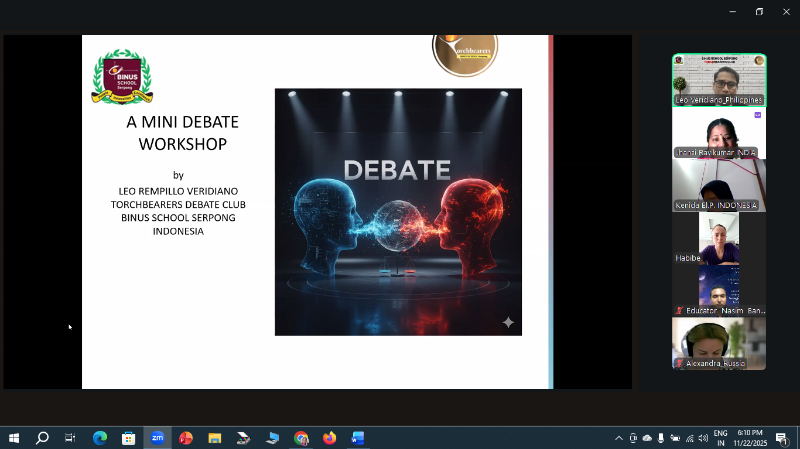
The meat of a debate is in the rebuttal.
Leo R. Veridiano
Students then practised responding live to their peers. Leo asked them to listen, answer the point being made and explain their own reasoning.
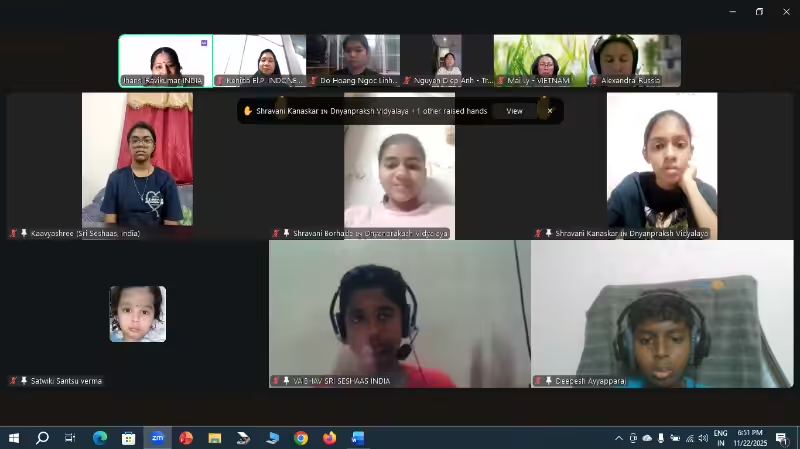
Satwiki from India responded to an argument about flooding by arguing that river connections could help with flood control and hydropower. She referred to flooding in Punjab when explaining her position. These were arguments being tested in a classroom debate.
Leo praised Satwiki's point and pronunciation: "I'm so proud of Satwiki. You gave such a wonderful point - and the pronunciation is so correct."
Kavyashree from India argued against river connections, giving five reasons that included ecosystem damage and climate unpredictability. Vaibhav described water as "a natural gift" and argued that sharing it could build relationships. Shravani Kanaskar argued that extending rivers could bring water to dry areas, support farming and help the economy.
The differing positions gave students concrete arguments to listen and respond to.
What students said they would take forward
Shravani said this was her first competition of this type: "This is the first time I joined this type of competition. I learned so much from this class." She had presented her position to peers during the workshop.
Leo encouraged students to research the opposing side as well as their own: "Research not only the arguments that support your thesis, but also the arguments against it. Know what your opponents will say, so you're ready."
Sai Mahand was preparing for another debate competition the following week. He said he planned to revise his speech after the workshop: "After attending this debate workshop, I'm going to modify it, because I didn't add any rebuttal."
Deepesh valued the direct feedback: "I saw a lot of YouTube videos, but they didn't give me as much knowledge as this workshop. The personal advice Sir gave about rebuttals was very helpful."
Kavyashree described feeling more prepared: "I did not know much about debates before. But now that I know so much more - thank you to Leo Sir - this workshop has made me ready to face future things."
Vibhav said, "This training session made me more comfortable with my speech and to deliver it in a fierce and perfect way." He and three classmates were preparing for a debate with students in Uganda.
Teachers reflected on the workshop
Teacher Alexandra Ziborova from Russia commented on the students' reasoning: "I was really impressed with the students' ideas and viewpoints. All of them tried to do their best and tried to say something reasonable. Debating is a very special skill that people should have."
Teacher Habibe Yıldırım from Turkey described what she wanted to take back to her class: "After taking part in this workshop, I learned so many things. I have a lot of things to teach my students now. Your students are so impressive and so confident - that really impressed me."
Teacher Zinzinthin from Myanmar said, "I'm so amazed and surprised - they are very good at critical thinking. I love debate because this is a key to promote critical thinking in students."
A celebration and plans for another exchange
On 29 November 2025, the International Debate Celebration brought participants together to watch selected opinion videos, share reflections and receive international participation certificates.
At the time, Teacher Burçin Can Solak from Turkey said the workshop had made debate clearer for her and agreed to organize another exchange the following year. Teacher Zinzinthin described plans for debate training at her center in Myanmar in December. Teacher Kenida from Indonesia, who had observed this workshop, said she wanted her students to take part in the next project.
The workshop introduced the Asian Parliamentary debate format. Leo's rebuttal presentation and the step-by-step project timeline were shared within the project for teachers to use.
A sequence teachers can adapt
The sequence was clear: introduce a question, research different positions, practise, record an opinion and reflect together. Teachers can adapt that sequence to questions in other subjects or the UN Sustainable Development Goals, including climate action, gender equality, responsible consumption or quality education.
Choose a question your students can investigate, guide respectful responses and give them time to prepare. For younger pupils, use accessible examples and support them in turning an observation into a reason.
Thank you, Class2Class.org, for helping us connect students beyond borders. Together, we continue to help young learners grow.
Jhansi Ravikumar, project coordinator
Sources
Original account by Ornella Celeste, published on 30 April 2026.
Explore a question for your next exchange
Use the SDG Calendar to find a topic that connects with your lessons. Explore Class2Class project ideas and choose one you can adapt with a partner teacher.