The Class2Class eight competencies: a teacher guide
The eight Class2Class competencies are intercultural communication, global awareness, collaboration and teamwork, digital literacy, critical thinking and problem-solving, emotional intelligence, adaptability and leadership, and creativity and innovation. Use them to plan tasks and reflect on student work.
Last updated
Put knowledge into practice
A student can recite the water cycle, name the capitals of ten countries and define a stakeholder, yet still need support to defend an idea, work through disagreement or design a response to an unfamiliar problem. Competencies describe how students use what they know.
The Class2Class eight competencies give teachers a shared vocabulary for planning that practice. Our educational framework connects international collaboration with intercultural communication, critical thinking, adaptability and other skills students can use in project work.
The OECD PISA Global Competence Framework and UNESCO's Education for Sustainable Development guidance offer background for this work. They connect knowledge with perspectives, values and responsible action. Use the examples below to decide what to practise and what evidence to look for.
What are the Class2Class eight competencies?
The framework identifies eight related competencies. A project can give students opportunities to practise several, while teachers choose a manageable focus.
- Intercultural communication: listen, ask questions and adjust communication across cultural differences.
- Global awareness: see the classroom as part of a wider system of people, places and shared challenges.
- Collaboration and teamwork: coordinate work, share responsibilities and resolve disagreement productively.
- Digital literacy: communicate, create and check information critically and responsibly in digital spaces.
- Critical thinking and problem-solving: evaluate information, weigh evidence and reason through uncertainty.
- Emotional intelligence: recognize and manage one's emotions, and respond with empathy and respect to others.
- Adaptability and leadership: adjust when circumstances change and help a group move its work forward.
- Creativity and innovation: generate, develop and improve ideas into useful responses or products.
Student agency runs across all eight
Student agency means acting with intention: setting goals, making decisions, taking responsibility and reflecting to improve. It is not a ninth competency. It runs across the eight as students take a role in the questions, work and choices of a project.
Teachers provide the structure and support. Students might suggest a question, choose how to explain a finding or revise their work after a partner replies. Look for these choices alongside the competency you want them to practise.
See the competencies in classroom projects
These published Class2Class project accounts show the activities students took part in. They give teachers concrete examples to adapt; they are not standardized measurements of competency gains.
My School: an intercultural exchange
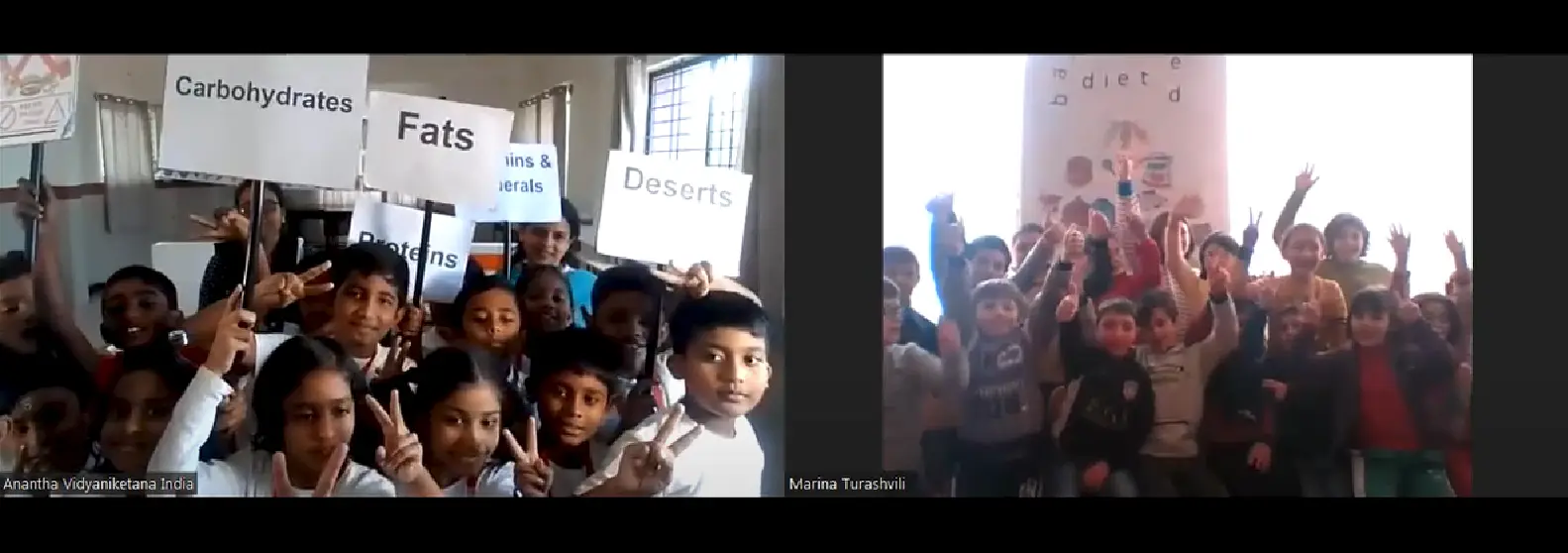
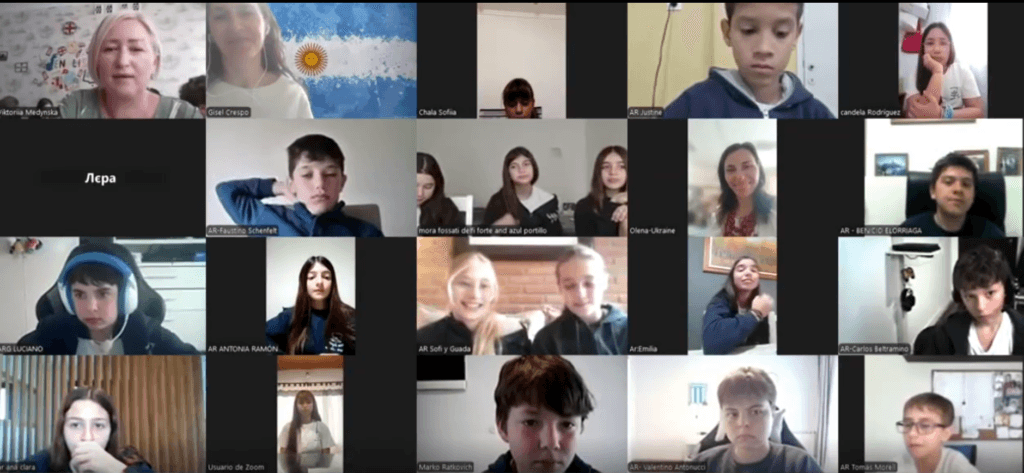
In the My School project, Teacher Gisel Crespo hosted two separate sessions with classrooms in India and Ukraine. Each class prepared a short presentation about its country, city and school, then met online to share it. The exchange asked students to explain familiar routines and ask about unfamiliar ones. This gives a teacher opportunities to discuss intercultural communication, global awareness and the feelings involved in meeting new peers.
Should Rivers Be Connected?: an international debate
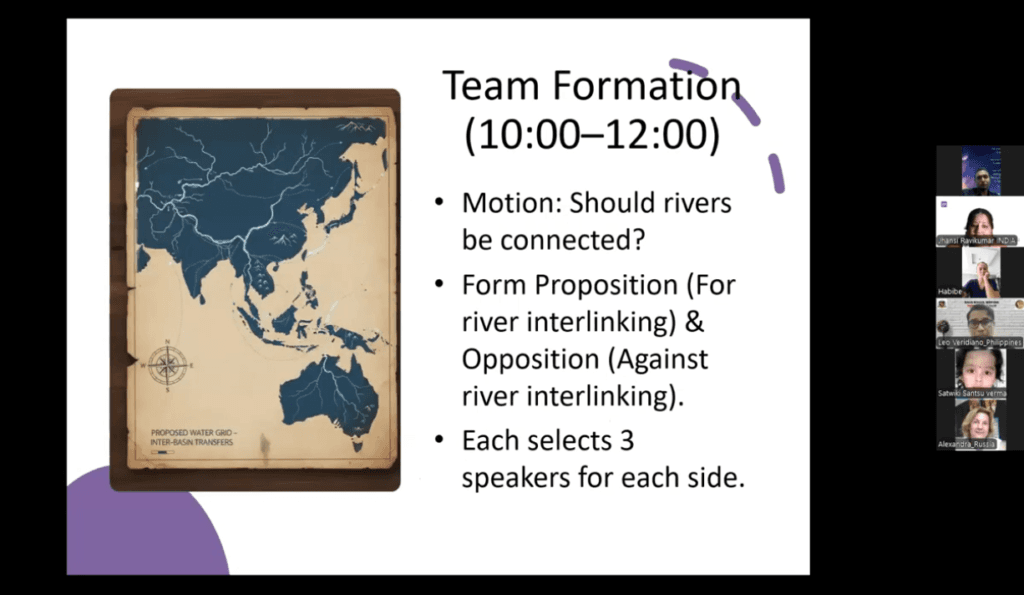
The international debate Should Rivers Be Connected? brought students from ten countries into a conversation about connecting rivers for irrigation, transport and flood control. Teacher Jhansi Ravikumar coordinated the project, with Teacher Leo R. Veridiano, from the Philippines and based in Indonesia, leading the workshop. The five-day plan covered the format, research and practice, ending with recorded speeches. A separate live workshop let students practise rebuttals. Listening, checking evidence and adjusting an argument make this a useful example for critical thinking, communication and adaptability.
The Global Water Conservation Challenge
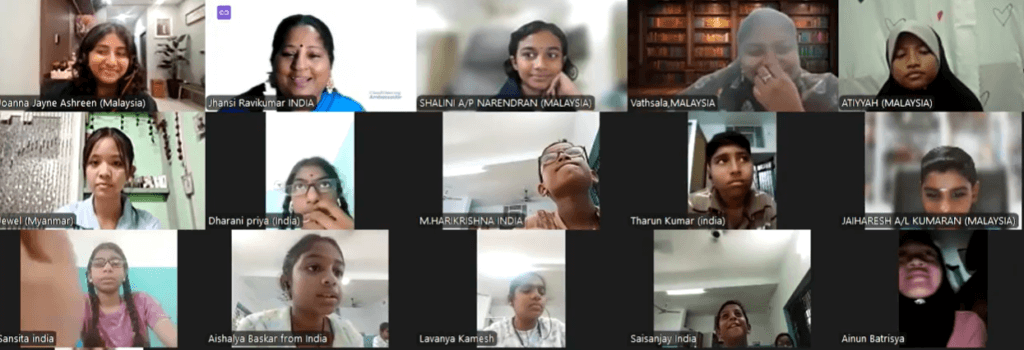
The Global Water Conservation Challenge connected classrooms in India, Malaysia and Myanmar, led by Teachers Jhansi Ravikumar, Vathsala Nayer Vailathan and Zin Zin Thin. Students presented water issues and conservation ideas, joined a quiz and shared reflections. The account shows how a common water question gave classes in different places a reason to exchange information. A teacher can use that pattern to plan critical thinking, global awareness and clear communication.
Two further examples are worth exploring: K-pop in the Classroom, a four-week project involving music research and cultural exchange, and Women in STEM Across Borders, where students in Colombia, India and Ukraine presented women scientists from their own countries.
A shared task can call on several competencies at once. Name the practice you want to see and support it through instructions, feedback and reflection.
Choose an approach that fits your learning goal
Class2Class describes three project approaches: Explore Cultures, Explore Global Challenges and Create Solutions. They offer different ways to investigate a question rather than a ladder of difficulty. Choose one that fits your curriculum, partner class and available time.
- Explore Cultures: use introductions, school-life questions or cultural topics to build an exchange. The My School account gives one example of a simple format used with different partner classes.
- Explore Global Challenges: investigate a shared topic, compare evidence and discuss different perspectives. A water question or international debate can give both classes something to contribute.
- Create Solutions: understand a problem, develop ideas and test or improve a response together. Choose a task with enough time for feedback and revision.
A short exchange and a longer investigation can both serve a useful purpose. Leave room for preparation, partner replies and reflection. Teachers can mix approaches across the school year without committing to a fixed annual number or assuming one approach guarantees more learning.
Use COIL, project-based learning and design thinking
SUNY COIL describes teachers partnering to design learning and students partnering to complete activities. Class2Class uses that shared work as a framework for international collaboration. Project-based learning provides an inquiry around a real question, while design thinking helps students understand a need, generate ideas, test a response and improve it. Choose the methods that the task needs.
Make the learning journey visible
Across a school year, several projects can form a changemaker journey: students revisit questions, take responsibility and reflect on how their work changes. Use formative evaluation to make that learning visible and decide what to try next. The Class2Class educational model describes evaluation as supportive reflection, with teachers retaining pedagogical control.
Black and Wiliam's Inside the Black Box argues for the role of formative assessment in classroom learning. Use feedback while students can still improve their work. Class2Class's published ethics policy keeps decisions about students with people and rules out automated AI decisions about grades.
- Name one or two competencies before the exchange and explain what they could look like in the task.
- Collect examples during the work: questions, replies, drafts, group decisions and changes after feedback.
- Ask students what the partner class added to their thinking and what they would change next time.
- Discuss the group product alongside contributions and individual reflections; one final output does not show everything each pupil learned.
The assessment strategies guide offers criteria and feedback questions to adapt with your partner teacher. After the exchange, the reflection checklist helps you choose what to keep and one change to make.
Sources
- Class2Class. Educational Framework.
- Black, P., and Wiliam, D. (1998). Inside the Black Box: Raising Standards Through Classroom Assessment. Phi Delta Kappan, 80(2), 139-144, 146-148. Linked 2010 reprint: 92(1), 81-90.
- OECD (2018). Preparing Our Youth for an Inclusive and Sustainable World: The OECD PISA Global Competence Framework.
- SUNY COIL Center. What is COIL?
- UNESCO (2017). Education for Sustainable Development Goals: Learning Objectives.
- Wiek, A., Withycombe, L., and Redman, C. L. (2011). Key competencies in sustainability: a reference framework for academic program development. Sustainability Science, 6, 203-218. Background on sustainability competencies in higher education.
Choose a competency for your next project
Choose one or two competencies that fit a topic you already teach. Explore a project idea, then agree the shared task and learning evidence with your partner teacher. Give students a meaningful role in the decisions and time to reflect on what they try.